
How to Build an Email List That Drives Real SaaS Revenue
At its core, building an email list is about forging a direct, owned communication channel with your prospects and customers. It's a flywheel: you attract your ideal audience with genuinely valuable content (lead magnets), capture their details through slick sign-up forms, and then build on that initial trust with permission-based, relevant emails. This isn't just a marketing task—it's the bedrock of sustainable SaaS growth.
Why An Email List Is Your Most Valuable SaaS Asset
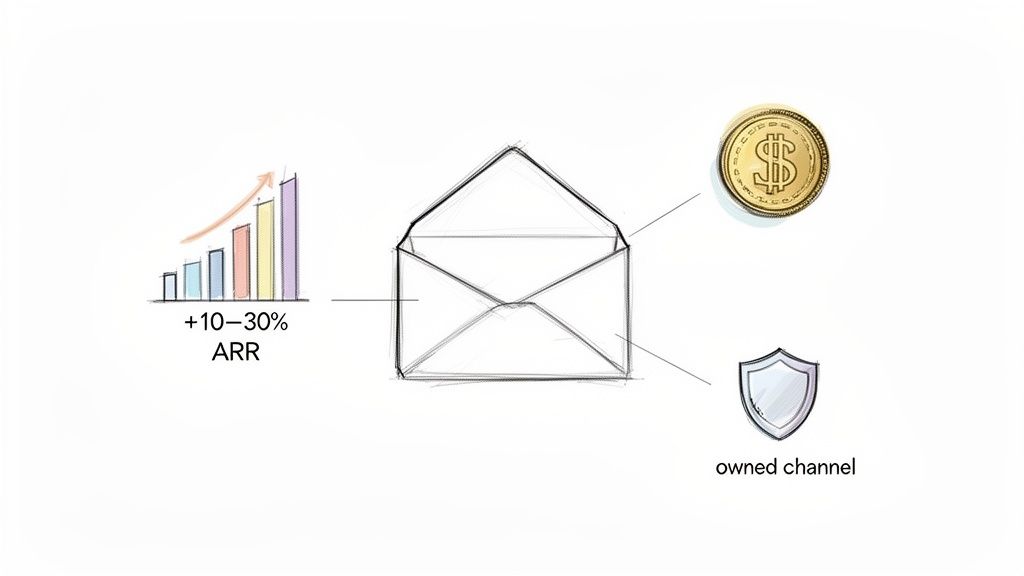
Let's get one thing straight: your email list is not just for sending newsletters. For any B2B SaaS company, it's the most reliable and profitable marketing asset you will ever own—a direct line to revenue that you control completely.
Think about it. Unlike social media or paid ads, your email list isn't at the mercy of some unpredictable algorithm update or skyrocketing ad costs. It's your own private channel, an engine for driving the metrics that actually matter.
A healthy, permission-based list has a direct, measurable impact on:
User Activation: You can guide new sign-ups to that critical "aha!" moment with a well-timed, automated onboarding sequence.
Churn Reduction: Spot at-risk users and proactively re-engage them with helpful content, feature announcements, and success stories.
Account Expansion: Easily identify your happiest customers and nurture them toward upsell and cross-sell opportunities.
The Unmatched ROI of Email Marketing
The numbers don't lie. While other channels deliver fleeting engagement, email marketing consistently produces an insane return on investment. The average ROI sits somewhere between a staggering 3600% to 3800%. That's not a typo. Nearly one in five companies even report returns soaring past 7000%.
For B2B SaaS marketers, this isn't just vanity metrics. It translates directly into a 10-30% boost in Annual Recurring Revenue (ARR) by building loyalty through smart, personalized lifecycle campaigns.
Your email list isn't just a database of contacts. It's a curated audience of prospects and customers who have explicitly raised their hand to hear from you. You simply cannot replicate that level of intent on any other platform.
Building Your Revenue Engine
Ultimately, learning how to build an email list is about constructing a powerful, predictable sales pipeline. It's a foundational piece of your entire growth strategy, feeding every other marketing and sales activity with qualified, engaged leads.
Every single email address you collect represents a potential long-term relationship. It's an opportunity to build trust, demonstrate your product's value, and guide someone from a curious prospect to a loyal, high-value customer. This isn't just another box to check; it's the foundation for predictable and scalable growth.
Creating Lead Magnets Your Prospects Actually Want
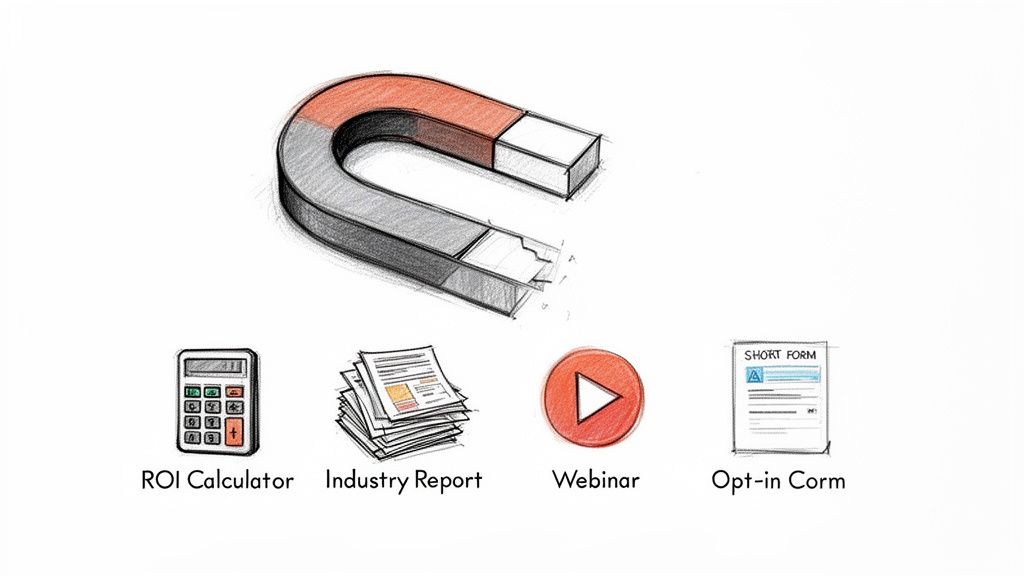
Let's be honest: the days of getting a quality B2B lead with a generic, five-page PDF are long gone. If you want to build an email list of actual potential customers—not just freebie seekers—you need to offer something with immediate, tangible value.
That's the whole job of a lead magnet. It's an irresistible, problem-solving resource you offer in exchange for an email address. The best way to think about it is as a "trailer" for your product's value. It needs to solve a small, specific problem that your ideal customer is wrestling with right now.
This approach is powerful because it doesn't just attract an audience; it attracts the right audience. It pre-qualifies them by signaling they have the exact pain point your SaaS is designed to fix. For B2B, this means ditching the basic checklists and creating resources that deliver unique insights, data, or real utility.
Aligning Value With Your Product Core
The most powerful lead magnets feel like a natural extension of your product. If your SaaS helps finance teams with forecasting, a "10 Productivity Tips" ebook is a complete mismatch. A far better hook would be an interactive "Cash Flow Forecasting Calculator" or a benchmark report on "Average Burn Rates for Series A Startups."
This alignment is everything.
A great lead magnet should lead a prospect to one logical conclusion: "Wow, this free tool was incredibly helpful. I can only imagine what their paid product can do." It bridges the gap from a curious browser to a qualified lead who already gets your value prop before they've even seen a demo.
High-Impact Lead Magnet Formats for B2B SaaS
Not all lead magnets are created equal, especially in B2B. Your audience is busy, smart, and looking for actionable solutions, not fluff. You need to focus on formats that deliver a quick, measurable win.
Here's a breakdown of what we've seen work best for SaaS companies.
High-Converting Lead Magnet Ideas for B2B SaaS
This table compares some of the most effective lead magnet types, helping you pinpoint the best fit for your audience and goals.
| Lead Magnet Type | Ideal for Attracting | Example | Key Success Factor |
|---|---|---|---|
| Interactive Tool/Calculator | Prospects in the evaluation stage; analytical roles (finance, ops). | "Calculate Your Potential ROI with Our Software" | Provides instant, personalized value and a clear business case. |
| Original Data/Industry Report | Decision-makers and strategists who need data to justify choices. | "The 2024 State of B2B Marketing Spend" | Contains proprietary data or insights not available elsewhere. |
| Exclusive Webinar/Workshop | Leads looking for in-depth solutions to a specific, complex problem. | "Live Workshop: How to Cut Cloud Costs by 30%" | Actionable, expert-led content that solves a high-stakes problem. |
| Cheatsheet or Framework | Practitioners and hands-on users looking for a quick reference. | "The Ultimate Go-to-Market Launch Checklist" | Distills complex information into a simple, one-page format. |
| Template Library | Teams who need a starting point for their own workflows. | "5 Plug-and-Play Email Nurture Sequence Templates" | Saves the user significant time and effort. |
| Free Mini-Course | Users who need foundational knowledge before they're ready to buy. | "A 5-Day Email Course on Mastering API Integrations" | Structured, educational content that builds trust and authority. |
Choosing the right format is half the battle. The other half is making sure it delivers on its promise and naturally points toward the larger problem your software solves.
The goal is to provide a "quick win" that is both immediately useful and directly tied to the broader problem your SaaS solves. It's the first step in demonstrating your expertise and building trust.
Designing Frictionless Opt-In Experiences
You could have the most valuable lead magnet in your industry, but it won't convert if the sign-up process is a pain. The goal is to make saying "yes" as easy as possible. This is where the user experience (UX) of your opt-in forms and landing pages becomes mission-critical.
Keep your forms brutally simple. For an initial opt-in, an email address is usually all you need. You can always enrich the lead with more data later as you build the relationship.
Your call-to-action (CTA) button needs to be specific and scream value. Ditch "Subscribe" and use action-oriented language like "Get My Free ROI Calculator" or "Download the 2024 Report."
Remember, every single field you add increases friction and will absolutely lower your conversion rate. Be ruthless about what you ask for upfront.
Turning Sign-Ups Into Actionable Customer Data
An email address is a great starting point, but let's be honest—it's just the beginning. The real magic happens when you turn that single point of contact into a rich, actionable profile. This is where you graduate from generic email blasts to creating personalized experiences that actually drive people to use your product and become paying customers.
It all starts the second someone decides to sign up. Your form's design and the data you ask for are your very first chance to gather intelligence without creating friction that sends them running. A clunky, demanding form will absolutely tank your conversion rates, while a smart one makes the whole exchange feel painless.
Designing High-Converting Sign-Up Forms
Here's the golden rule for sign-up forms: only ask for what you absolutely need right now. For most top-of-funnel offers like a webinar or an ebook, an email address is all you need. Every single field you add is another reason for someone to bounce.
Think about the actual user experience. Is your form buried on the page? Is the value you're offering obvious? Does the button say something generic like "Submit," or does it use specific, benefit-focused language like "Get My Free Playbook"? These tiny UX details make a massive difference in your opt-in rates.
Think of your initial sign-up form as the start of a conversation, not an interrogation. You're just trying to get permission to talk again. You can always learn more about them later as you build trust.
This low-friction approach shows you respect their time, making them far more likely to sign up. Once they're on your list and see the value you're delivering, they'll be much more willing to share more details down the road.
Using Progressive Profiling to Gather Data Over Time
This is where progressive profiling becomes a B2B marketer's secret weapon. Instead of hitting new subscribers with a ten-field monstrosity of a form, you strategically ask for more information over time. It's a simple idea with a huge impact.
Imagine a user grabs your first lead magnet with just their email. The next time they visit your site for another resource, your form technology is smart enough to recognize them and ask for something new.
First visit: Asks for Email Address.
Second visit: Recognizes them and asks for First Name and Company Name.
Third visit: Asks for their Job Title or Company Size.
This feels so much more natural and less intrusive. With every interaction, you're building out a more detailed picture of the lead without ever putting up a wall of form fields. That gradually collected data is the fuel for creating seriously targeted campaigns.
Automating Data Enrichment for Deeper Insights
While progressive profiling is great for getting data directly from the user, automated data enrichment works quietly in the background to fill in the rest of the puzzle. With just an email address or a company name, these tools can pull in a ton of valuable B2B data.
This process can instantly give you context like:
Firmographics: Company size, industry, and annual revenue.
Technographics: What other software and tools the company uses.
Demographics: The contact's exact job title and seniority.
This enriched data is what allows for incredibly precise targeting. For example, you could create a welcome series aimed specifically at VPs of Marketing working at Series B tech companies with over 100 employees. That level of personalization makes your first emails feel hyper-relevant and proves you understand their world from day one.
When you combine sleek forms, smart progressive profiling, and automated enrichment, you turn a simple email sign-up into an intelligent, dynamic customer profile. This is the foundation for the kind of sophisticated segmentation that truly drives SaaS growth.
Automating The Entire Customer Journey With Email
A static email list is a missed opportunity. It's just a collection of contacts. But once you introduce smart segmentation and timely automation, that list transforms into your most powerful revenue driver.
We're not just collecting emails; we're tracking every single interaction—from a demo request to a feature click, all the way through to renewal. This lets us build automated workflows that deliver exactly the right message at exactly the right moment.
Here are four of the most effective automated workflows you can build:
Welcome Series: For new trials, guiding them with onboarding tips and feature tours.
Feature Adoption Campaign: Triggered by key usage milestones to deepen engagement.
Upsell Sequence: Deployed based on product satisfaction and heavy usage patterns.
Win-Back Emails: Activated by churn signals or a period of inactivity.
Imagine a trial user completes their first three key tasks in your app. Instead of a generic check-in, they instantly get a tailored guide on advanced features related to what they just did. That's the power of automation.
Mapping The Customer Lifecycle
To send relevant content, you first need to understand where your users are in their journey. This is where lifecycle mapping comes in.
We use segmentation tags like trial status, usage frequency, and plan tier to feed our automation workflows. As a user moves from a free trial to a paid plan, or from a casual user to a power user, your email triggers should mirror that progression.
This isn't just about making users happy—it directly impacts conversion rates.
The key is to let behavioral signals power your personalization. Tracking events like logins, feature clicks, or dashboard visits unlocks incredibly timely and relevant outreach. The first step, always, is getting your data into one central place.
This is what that data flow looks like in practice:
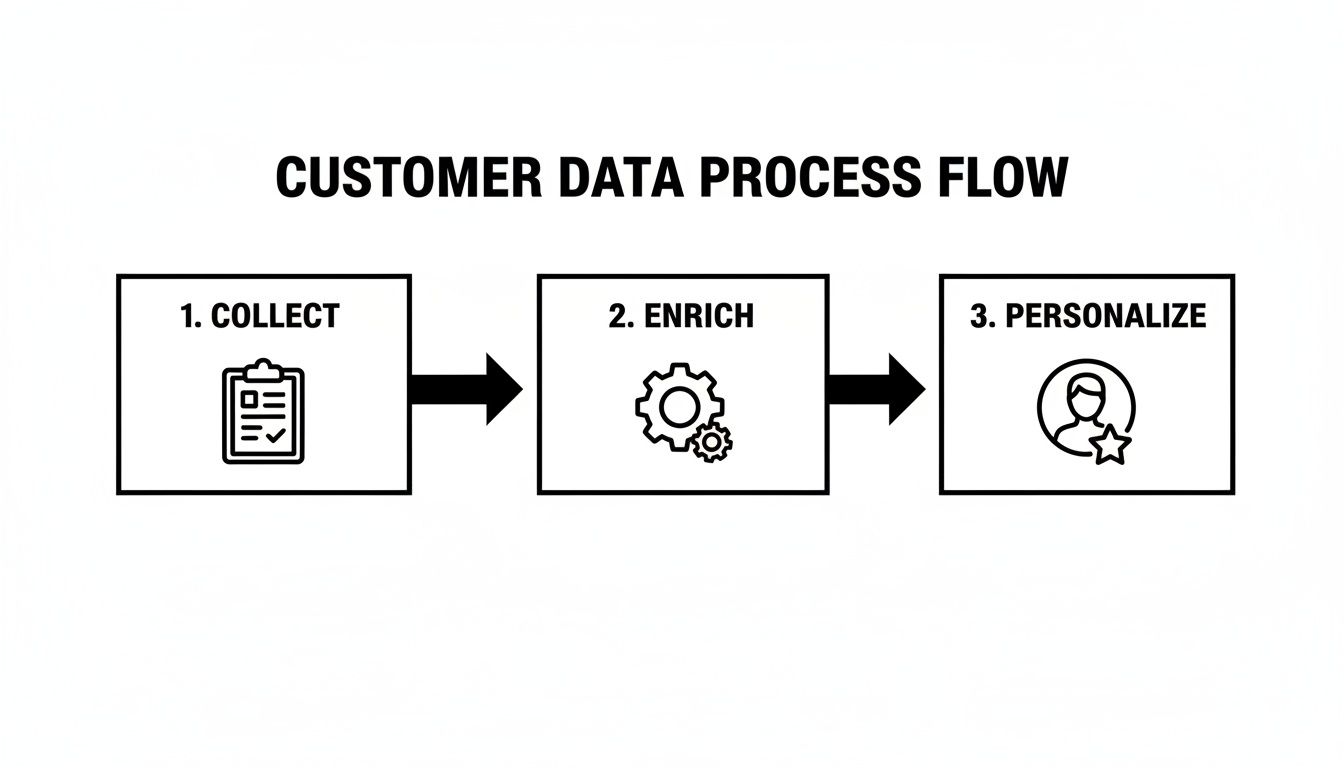
This flow from collection to enrichment to personalization is where automation works its magic, boosting engagement and building a richer profile for every single user.
Designing Automated Workflows
Great automation always aligns the content with the user's immediate context. That means every single campaign needs crystal-clear entry and exit criteria based on their behavior.
Define your trigger events. This could be anything from a completed signup form to the first time a user activates a specific feature.
Craft your email content. Think about the user's next logical need. What question can you answer before they even ask it?
Set your timing delays. Don't just guess. Base delays on typical user behavior patterns to feel natural, not robotic.
Test everything. Constantly test your subject lines, CTAs, and templates to optimize open rates and clicks.
When timed correctly, behavioral triggers can increase email engagement by over 50%.
Build out separate workflows for each key stage: trials, upsells, renewals, and churn recovery. Each path should use enriched data points to deepen the relationship, not just sell.
Measuring And Optimizing Performance
You can't improve what you don't measure. The right metrics will guide your continuous improvement and show you what's actually working.
Track conversion rates by segment to see which of your workflows are driving the most revenue. Here are the core metrics to live by:
List growth rate: How many new, qualified contacts are you adding each week?
Email-attributed revenue: Connect your campaigns directly to sales numbers.
Engagement score: A combined metric tracking opens, clicks, and site visits from emails.
Churn recovery rate: How many former users are you successfully bringing back?
Use A/B tests on subject lines, send times, and CTAs to find your top performers. Then, it's simple: double down on what works and kill the sequences that are underperforming. This data-driven approach ensures every message contributes to growth instead of just adding to the noise.
Of course, compliance is non-negotiable, even in automated sequences.
Always include clear opt-out links and honor preferences automatically.
Use a double opt-in process to confirm permission and slash spam complaints.
Stay on top of regional regulations like GDPR, CCPA, and CASL.
And remember, your deliverability depends entirely on solid list hygiene. Regularly prune inactive subscribers and manage bounces to protect your sender reputation.
Key Takeaways And Next Steps
Automating your email strategy transforms a simple list into a predictable growth engine. By using behavioral triggers and enriched data, you'll increase engagement and drive more revenue.
Here's the game plan:
Map your customer lifecycle stages so you know exactly when to send each message.
Build automated triggers for onboarding, feature adoption, upsells, and reactivation.
A/B test your workflows and content constantly to refine performance.
Keep compliance and deliverability top of mind at every single stage.
Start by mapping your most critical workflows today, and then gradually layer in more personalization and advanced triggers. One B2B SaaS company I know saw a 45% boost in trial-to-paid conversions just by adding a feature adoption workflow. They triggered it on first login and sent contextual tips that also cut churn by 20%.
Another team implemented a simple win-back sequence and recovered 12% of their lapsed users in just three weeks.
These aren't outlier results. They show why a dynamic, automated approach will always beat static, one-off email blasts. The future of list growth isn't about size—it's about smart automation.
Don't Let Your Emails End Up in the Spam Folder
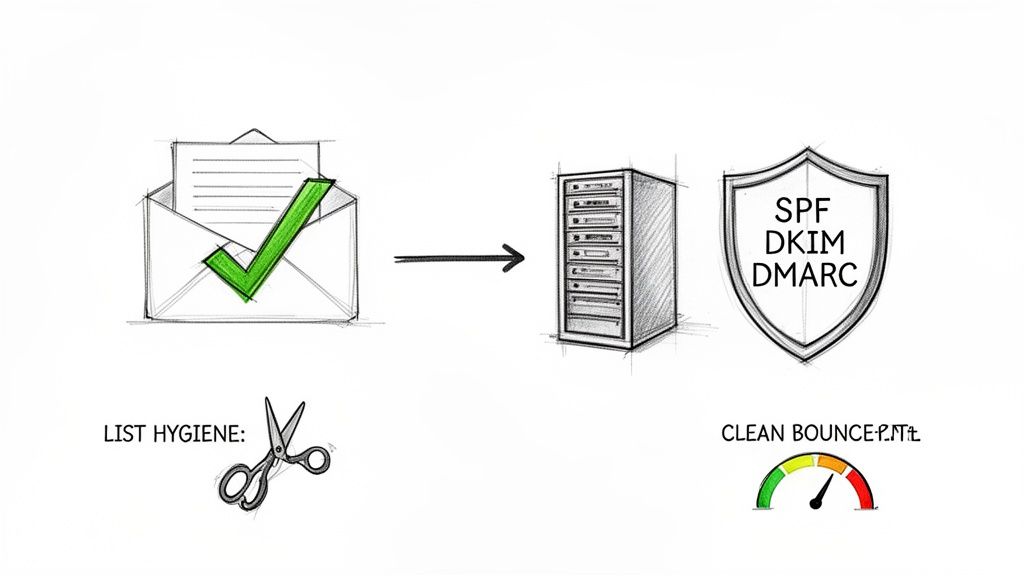
You've done the hard work of building a killer list and creating a lead magnet people actually want. So, what happens if those emails never even make it to the inbox?
A brilliant list is totally useless if your messages get buried in spam. Getting deliverability right isn't just a technical chore—it's how you protect your hard-earned revenue.
Your sender reputation is basically your credit score with Internet Service Providers (ISPs) like Gmail and Outlook. A bad score gets your emails flagged, filtered, or blocked entirely. It's simple: a healthy email list and a great reputation are two sides of the same coin.
The Technical Handshake: SPF, DKIM, and DMARC
Before you even think about hitting 'send' on a campaign, you need to get your technical house in order. Three records—SPF, DKIM, and DMARC—are the foundation. They work together to prove to ISPs that your emails are legit and not from some spammer spoofing your domain.
Think of them as your email's official ID. They authenticate where your emails come from, confirming you are who you say you are.
SPF (Sender Policy Framework): This is a public list of all the servers authorized to send email for your domain. It's like the approved guest list at a private event.
DKIM (DomainKeys Identified Mail): This adds a digital signature to every email, like a tamper-proof seal. The receiving server checks this signature to make sure the message wasn't messed with in transit.
DMARC (Domain-based Message Authentication, Reporting & Conformance): This is the enforcer. It tells ISPs what to do if an email fails the SPF or DKIM check—either quarantine it or reject it flat out.
Setting these up isn't optional; it's table stakes for serious email marketing. They're the bedrock of a solid sender reputation.
A clean sender reputation is an asset you earn over time, not something you're given. Every single email you send either builds it up or tears it down. There's no middle ground.
Proactive List Hygiene: Clean Often, Send Better
Beyond the technical setup, how you manage your list day-to-day has the biggest impact on your deliverability. An old, unengaged list is a fast track to the spam folder.
Proactive list hygiene is just the practice of regularly cleaning out your subscriber base to keep it fresh and engaged. It means you have to be disciplined about removing people who aren't opening your stuff anymore.
I know it feels wrong to shrink your list, but holding onto those inactive contacts is actively hurting you. ISPs see consistently low open rates as a massive red flag that your content is unwanted, which tanks your reputation.
Here's a simple workflow we use:
Find the Unengaged: Tag contacts who haven't opened or clicked an email in the last 90-120 days.
Try to Win Them Back: Send them a targeted re-engagement campaign. It's a final, "Hey, do you still want to hear from us?" effort.
Cut Them Loose: If they ignore that campaign, it's time to say goodbye. Remove them from your active sending list for good.
Yes, your list size will drop. But your open rates, click-through rates, and sender reputation will all go up. It's a trade worth making every time.
Compliance is Your Best Defense
Finally, great deliverability is tied directly to ethical, permission-based marketing. Rules like GDPR aren't just legal hoops to jump through; they're a blueprint for building a high-quality, engaged list from the start.
It all boils down to consent. Never, ever add someone to your list who didn't explicitly ask to be there.
The gold standard here is the double opt-in. That's where a new subscriber has to click a confirmation link in their email to be officially added. This one simple step filters out typos, bots, and tire-kickers right from the beginning.
When you respect consent and make unsubscribing easy, you build a list of people who actually want to hear from you. That translates to higher engagement, fewer spam complaints, and a sender reputation that ISPs trust.
Measuring The Metrics That Actually Matter
You can't fix what you don't measure. But in the world of B2B SaaS, tracking the wrong things is just as bad as tracking nothing at all.
Vanity metrics like open rates feel good, but they don't keep the lights on. It's time to shift your focus from "Did they open it?" to a much more important question: "Did this email actually drive a valuable action?"
Think about it. An email with a modest open rate that converts three high-value leads is infinitely more successful than a newsletter blast with a huge open rate that generates zero pipeline. The goal isn't just attention; it's action.
Key Performance Indicators for SaaS List Building
To get a clear, unfiltered view of your success, you need a dashboard built around the metrics that directly connect to revenue and growth. These are the numbers that tell you if your list-building efforts are actually moving the needle.
List Growth Rate: This is your pulse check. It's the percentage increase in new, qualified subscribers over a set period, like a week or a month. A steady, positive growth rate is the earliest sign that your top-of-funnel strategy is working.
Conversion Rate by Lead Source: Here's where the real insights are. Not all subscribers are created equal. You need to know which channels—your blog, that webinar you ran last month, a specific paid campaign—are delivering subscribers who eventually become paying customers. This data tells you exactly where to double down on your marketing spend.
Email-Attributed Revenue: This is the big one. The ultimate proof. It directly ties your email campaigns to the money coming in the door. By tracking which sales, trials, or upgrades came from an email click, you can confidently prove the ROI of your entire email strategy.
A Simple Framework for Optimization
Once you're tracking the right data, you can stop guessing and start systematically improving your entire process. The name of the game is continuous testing and refinement.
Your data tells a story about what your subscribers actually want. A/B testing is how you listen to that story and give them more of it. It's the engine that turns good results into great ones.
Start by setting clear, achievable goals for your core KPIs. For example, maybe you want to increase your blog-to-subscriber conversion rate by 15% this quarter.
Great. Now, use A/B testing to experiment with different elements to hit that number. Test your lead magnet offers, your headlines, your call-to-action buttons, even the layout of your forms. Small, incremental wins from consistent testing add up to massive growth over time, giving you the confidence to scale what works.
Got Questions? We've Got Answers
Even the sharpest marketers run into questions when fine-tuning their list-building strategy. It's a constantly moving target. Here are a few of the most common ones that pop up when we're talking with B2B SaaS teams.
🎯 Key Takeaways
Email lists drive 10-30% ARR growth with unmatched ROI of 3600-3800%
Focus on quality over quantity - 500 engaged subscribers beat 10,000 uninterested ones
Create lead magnets that align with your product core and solve real problems
Use progressive profiling and data enrichment to build rich customer profiles
Implement behavioral automation for 50%+ higher engagement rates
Prioritize deliverability with SPF, DKIM, DMARC setup and list hygiene
Track revenue-focused metrics: list growth, conversion by source, email-attributed revenue
🚀 Transform Your Email List Building with SMASHSEND
Ready to turn your hard-earned email list into a real revenue engine? With SMASHSEND, you can build the kind of automated workflows that drive growth, all while ensuring your emails actually land in the inbox.
See how top SaaS teams are adding 10-30% more ARR with our platform:
✅ 98% deliverability rate - Industry-best inbox placement
✅ AI-powered lead magnets - Generate high-converting offers in minutes
✅ Smart automation workflows - Behavioral triggers that increase engagement by 50%+
✅ Built-in CRM & enrichment - Automatically build rich customer profiles
✅ Advanced analytics - Track email-attributed revenue with precision
Frequently Asked Questions
Have a question not in here? Contact us
- How Big Should My Email List Be?
Quality over quantity is key. A small, engaged list of 500 ideal customers is infinitely more valuable than a bloated list of 10,000 uninterested contacts. Start with a goal of 100 subscribers from high-intent sources and focus on engagement rates rather than pure numbers.
- Is It Okay To Buy An Email List?
Never buy an email list. It's the fastest way to damage your sender reputation, increase spam complaints, and violate regulations like GDPR. These contacts never consented to hear from you, making it both ineffective and legally risky. The only sustainable path is building an organic, permission-based list.
- What Is The Best Lead Magnet For B2B?
The best B2B lead magnets provide tangible, problem-solving value. Interactive tools like ROI calculators, exclusive industry benchmark reports with proprietary data, and deep-dive technical whitepapers work best. The goal is to prove your expertise and give prospects a real 'aha!' moment that leads them toward your paid solution.
- How long does it take to see results from email list building?
You can start seeing initial results within 30-60 days, but meaningful revenue impact typically takes 3-6 months of consistent effort. Early indicators include growing subscriber numbers, improving engagement rates, and increased website traffic from email campaigns. Revenue attribution becomes clearer as your automated workflows mature.
- What's the average conversion rate for lead magnets?
Conversion rates vary widely by industry and offer quality, but B2B lead magnets typically convert between 1-5%. High-value, targeted offers like interactive tools or exclusive data reports can achieve 10-15% conversion rates. Focus on creating genuinely valuable content that aligns closely with your product's core value proposition.
- How often should I email my subscribers?
Frequency should be based on value, not a rigid schedule. For B2B audiences, 1-2 high-value emails per week often works well. Use engagement data to optimize—if open rates and click-through rates remain strong, you can increase frequency. Always include preference centers so subscribers can control their email frequency.