
Learn how to increase customer lifetime value and grow profits
Want to grow your B2B SaaS? The answer isn't just about chasing new logos. It's about getting more value from the customers you already have.
When you deliver real, sustained value, something powerful happens. Customers stick around longer, they spend more, and they start telling their friends about you. That's how you turn your initial acquisition cost into a long-term profit engine.
Why LTV Is Your True North for Sustainable Growth
In the world of B2B SaaS, Customer Lifetime Value (LTV) is more than just another three-letter acronym. It's the ultimate measure of a healthy, sustainable business. While it's easy to get caught up in the thrill of acquiring new customers, the smartest companies know the real path to scaling annual recurring revenue (ARR) is by maximizing the value of their existing customer base.
Let's be honest, customer acquisition costs (CAC) aren't getting any cheaper. That's why focusing on LTV has shifted from a "nice-to-have" to a "need-to-do" for capital-efficient growth.
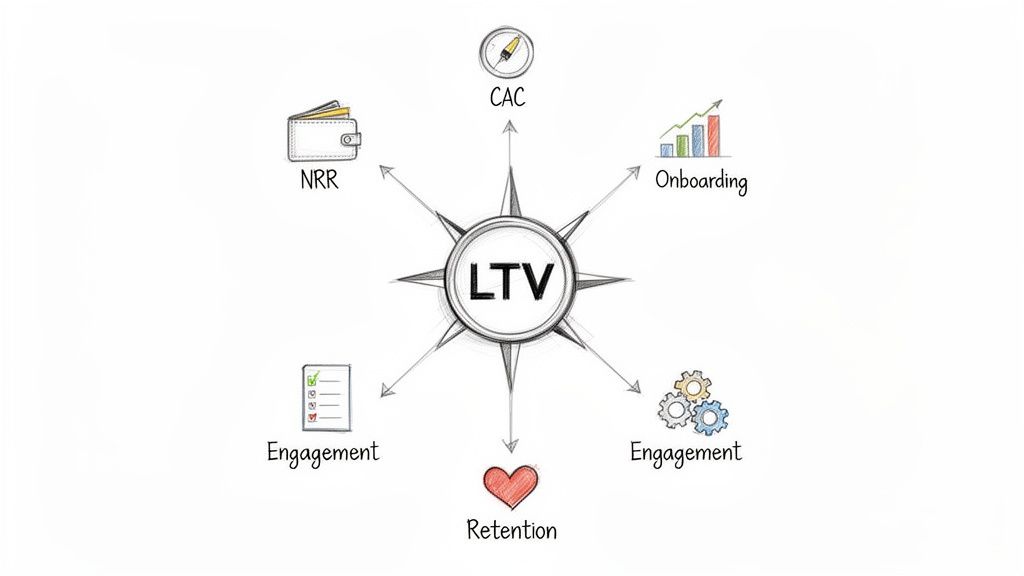
Think of it this way: your LTV dictates how much you can afford to spend to win new business. The gold standard for a healthy SaaS business is an LTV to CAC ratio of 3:1 or higher. For every dollar you put into sales and marketing, you should be getting at least three dollars back over that customer's lifetime. If that ratio is out of whack, your growth engine will eventually sputter and die.
Connecting LTV to the Metrics That Matter
LTV doesn't exist in a vacuum. It's the direct result of how well you're managing other key metrics that paint the full picture of your customer relationships.
Net Revenue Retention (NRR): This is the holy grail. It measures revenue from your existing customers, factoring in both expansion (upsells, cross-sells) and churn/downgrades. An NRR over 100% is a game-changer; it means you'd still grow even if you didn't sign a single new customer.
Customer Acquisition Cost (CAC): We just talked about this. A higher LTV gives you the firepower to invest more in acquiring customers, letting you outmaneuver competitors in your market.
Customer Churn Rate: This is the LTV killer. It's the percentage of customers you lose over a period. The most direct path to boosting LTV is simply to keep customers from leaving.
Here's a stat that should grab your attention: a modest 5% increase in customer retention can boost profits by anywhere from 25% to 95%. It's profoundly more profitable to keep the customers you have than to constantly fill a leaky bucket.
The Operational Toolkit for LTV Growth
Boosting these numbers doesn't happen by accident. It takes a deliberate, systematic approach. Growing LTV requires a unified effort that spans the entire customer journey—from that first onboarding session to product engagement and proactive retention campaigns. The secret sauce is orchestrating it all with smart, timely communication.
This is where a lifecycle automation platform like SMASHSEND becomes indispensable. It's the toolkit you need to turn your LTV strategy into a scalable, automated system that nurtures customers at every single stage. You can translate your high-level goals into automated actions that drive real, measurable revenue growth.
Mastering Onboarding to Secure Long-Term Value
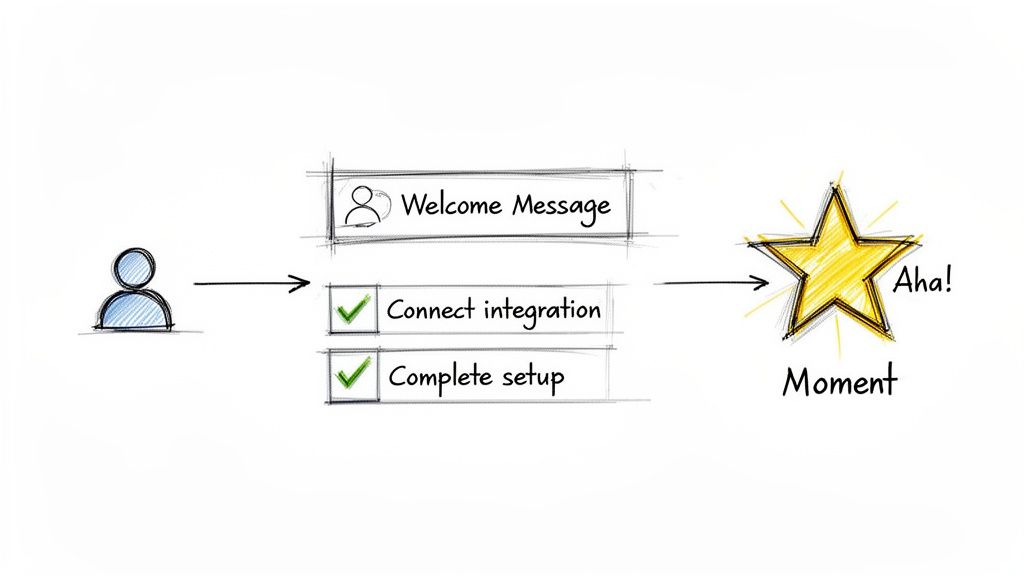
A powerful onboarding experience is your first, and frankly, your best shot at securing long-term value. This is where you prove your product isn't just another line item on a credit card statement but an indispensable part of your customer's workflow. The entire goal is to get users to their "aha!" moment as fast as humanly—or automatically—possible.
This initial period sets the tone for the whole relationship. A clunky, confusing start plants a seed of doubt that can quickly blossom into churn. On the flip side, a smooth, value-driven onboarding process builds immediate trust and gets the momentum going in your favor.
Shorten the Time to Value with Behavior-Based Sequences
The secret to a killer onboarding is drastically shortening the Time to Value (TTV). This is simply how long it takes a new user to actually feel the value you promised them. The faster they get there, the stickier your product becomes.
One-size-fits-all email flows just don't cut it anymore. What really moves the needle is building behavior-based welcome sequences that adapt to what users are—and aren't—doing inside your app.
Think about it. A user who signs up but hasn't connected a key integration after two days needs a totally different nudge than someone who has already invited three teammates. The first user needs help and encouragement; the second is ready for a power-user tip.
It's not just a nice-to-have, either. Globally, 65% of consumers (and B2B buyers are consumers, too) now expect these kinds of tailored experiences. In fact, for software companies, this kind of personalization can deliver a 30% premium on LTV. Slashing TTV with smart, triggered messaging directly boosts satisfaction and cuts early churn—which is absolutely vital for hitting that healthy 3:1 LTV to CAC ratio.
Crafting Onboarding Emails That Actually Work
Your onboarding emails should feel less like a marketing campaign and more like a personal guide from an expert. Every single message needs a clear purpose: move the user to the next activation milestone. This is where well-designed email automations become your most valuable player.
Here are a few proven email types to build into your sequence:
The Personal Welcome: Fire this off immediately after sign-up, and have it come from a real person—the CEO, Head of Customer Success, whoever. Keep it short, be genuinely excited to have them, and give them a direct line for help. It's a simple touch that makes your company feel human from day one.
The Activation Checklist: A day or two in, send an email with 2-3 essential setup steps. Frame it as a simple checklist to create a sense of progress. For a project management tool, this might be: "Create your first project," "Invite a teammate," and "Assign a task."
The Value-Driven Nudge: If a user gets stuck, trigger an email that highlights the benefit of the action they haven't taken. Instead of a robotic "You haven't connected your calendar," try something like, "Sync your calendar to see all your deadlines in one place and never miss a beat."
The Social Proof Highlight: Drop in a mini-case study or a powerful quote from a happy customer in a similar industry. This reassures new users they made the right choice and shows them what's possible.
The best onboarding processes make every new user feel supported, capable, and successful from the moment they sign up. It's not just about teaching features; it's about building confidence and demonstrating ROI.
Building Your Onboarding Engine
To put all this into practice, you need a system that can track user behavior and trigger the right message at the right time. Your goal is an automated, yet deeply personal, journey that scales.
Start by identifying the 3-5 key actions a user must take to become "activated." These are your onboarding milestones.
Then, map out your automated flows. What happens if a user completes step one but not step two? What if they get stuck for three days? Having these branching paths ensures every user gets the precise guidance they need, exactly when they need it.
Driving Expansion Revenue with Smart Automation
Chasing new logos is exciting, but for B2B SaaS, the real secret to hyper-growth isn't just acquisition—it's expansion revenue. This is all the additional annual recurring revenue (ARR) you generate from the customers you already have through upsells, cross-sells, and add-ons. It's not about being pushy; it's about being predictive.
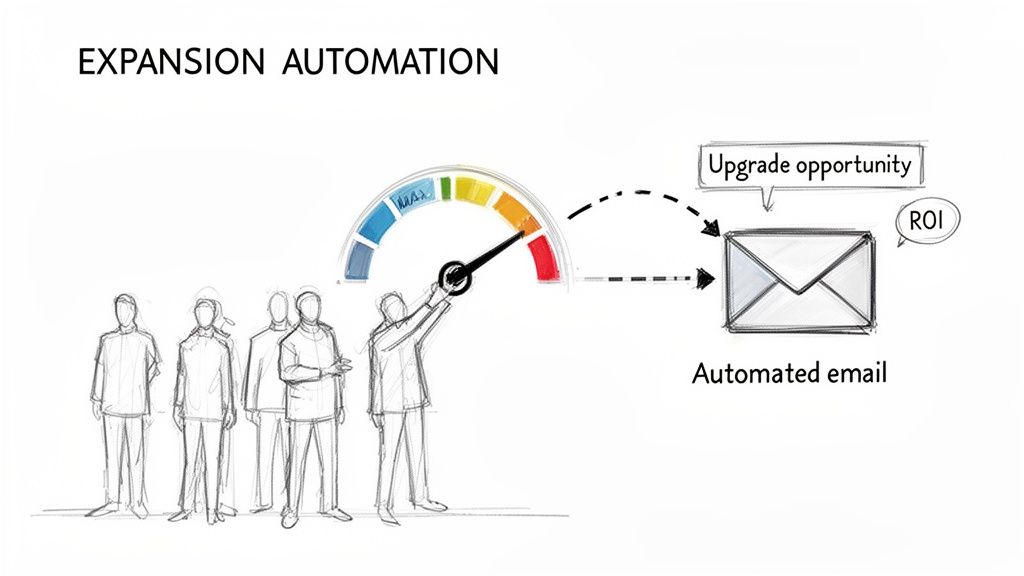
Smart automation turns this into a natural extension of customer success, not a heavy-handed sales effort. By tapping into your product usage data, you can pinpoint the exact moment a customer is ready for more and deliver the right message to make it happen. You're essentially turning a sales pitch into a helpful suggestion at the perfect time.
Identify Upsell Triggers with Behavioral Data
Your product analytics platform is a goldmine for finding expansion opportunities. Your customers signal their needs through their actions long before they ever think to contact your sales team. The trick is to translate these behaviors into automated triggers that kick off a conversation about upgrading.
This is where dynamic, predictive segmentation shines. Instead of relying on static lists, you create living segments of users who are exhibiting specific, high-intent behaviors right now.
Here are a few powerful examples of behavioral triggers that work wonders:
Approaching Usage Limits: A team on your 'Pro' plan is consistently hitting 90% or more of their user seats or data storage. This is the clearest signal imaginable that they're outgrowing their current tier.
Exploring Gated Features: A user repeatedly clicks on a feature that's locked behind your 'Enterprise' plan. They aren't just curious; they're actively trying to solve a problem that your premium offering already addresses.
Sudden Team Growth: An account suddenly invites five new team members in a single week. This is a huge flag for organizational growth and a prime opportunity to introduce more advanced collaboration or admin features.
Tracking these signals lets you shift from reactive selling to proactive, value-based guidance. You're no longer guessing who needs an upgrade—you're letting their own actions tell you exactly who to talk to, and when.
Crafting High-Impact Automated Campaigns
Once you've nailed down your triggers, the next move is to build automated campaigns that feel timely and personal. A generic "Upgrade Now!" email blast is a waste of time. Your message has to be contextual, referencing the user's specific behavior to show you actually understand what they need.
Key Takeaway: The goal of an expansion campaign isn't just to sell a bigger plan. It's to demonstrate how a higher-tier plan will solve an immediate, tangible problem the customer is already experiencing.
Lifecycle Email Triggers for Expansion Revenue
| User Behavior Trigger | Target Segment | Automated Email Campaign Goal | Example SMASHSEND Tactic |
|---|---|---|---|
| Hits 90% of plan's user seat limit | Admins on "Pro" plan with growing teams | Proactively offer an upgrade to the "Business" plan before they hit the hard limit. | Trigger a 2-email sequence showing the cost-per-seat savings on the next tier. |
| Repeatedly clicks a gated "Enterprise" feature | Power users on "Business" plan | Demonstrate the value of the specific feature they're trying to access. | Send a short video demo of the locked feature in action and a link to book a call. |
| Adds a new integration (e.g., Salesforce) | Accounts that connect a key enterprise tool | Cross-sell an add-on or higher tier with advanced integration capabilities. | Nudge them with an email: "Supercharge your Salesforce data with our advanced analytics." |
| Account shows a 30% MoM increase in usage | Highly engaged accounts | Nurture them toward a higher tier by highlighting features for scaling teams. | Send a case study of a similar company that upgraded to support their growth. |
Building a Moat with Proactive Retention Campaigns
While driving expansion revenue builds your castle higher, it's proactive retention that builds the moat to protect it. This is your defensive strategy—plugging tiny leaks in your revenue base before they turn into catastrophic floods. This isn't about sitting back and waiting for a cancellation email to land in your inbox. It's about spotting the warning signs early and intervening with helpful, automated campaigns.
The goal here is to shift your entire mindset from reactive damage control to proactive relationship management. By tracking the right leading indicators, you can turn a potential churn event into a powerful opportunity to reinforce your value, rebuild trust, and ultimately protect your hard-earned revenue.
Spotting At-Risk Customers Before They Churn
Happy, engaged customers rarely churn out of the blue. They almost always leave a trail of digital breadcrumbs that signal declining health long before they make the final decision. Your job is to listen for these subtle cues and act on them swiftly.
The key is to identify the leading indicators of churn—behaviors that correlate with a higher likelihood of cancellation. These are the tripwires that should kick off your automated retention workflows.
Here are some of the most reliable churn indicators in B2B SaaS:
A Drop in Product Usage: A team that once logged in daily is now showing up once a week. Key feature adoption has stalled, or they've stopped inviting new users altogether. This is the most potent signal that they're no longer seeing value.
Failed Payments and Dunning: While often just a technical snafu, a failed payment is a critical friction point. If you don't handle it smoothly, it can easily lead to unintentional churn, especially for smaller accounts that might not have a dedicated procurement person.
Support Ticket Volume Changes: A sudden spike in support tickets can obviously indicate user frustration. But here's something people miss: an account that goes completely silent after being highly engaged can also be a massive red flag. They may have simply given up trying to solve their problems.
A critical insight for B2B SaaS leaders is that a modest 5% increase in customer retention can fuel profit boosts ranging from 25% to 95%. As customer acquisition costs continue to climb, focusing on keeping the customers you have is the most direct path to sustainable growth.
Re-Engaging Inactive Users and Declining Accounts
For customers whose usage is slipping, your approach needs to be centered on value, not features. They've lost their way, and you need to guide them back to their "aha!" moment.
A great tactic here is the value-check-in campaign. Trigger an email when a user's activity drops below a certain threshold for two consecutive weeks.
The goal isn't to nag them. It's to restart the value conversation and remind them why they signed up in the first place.
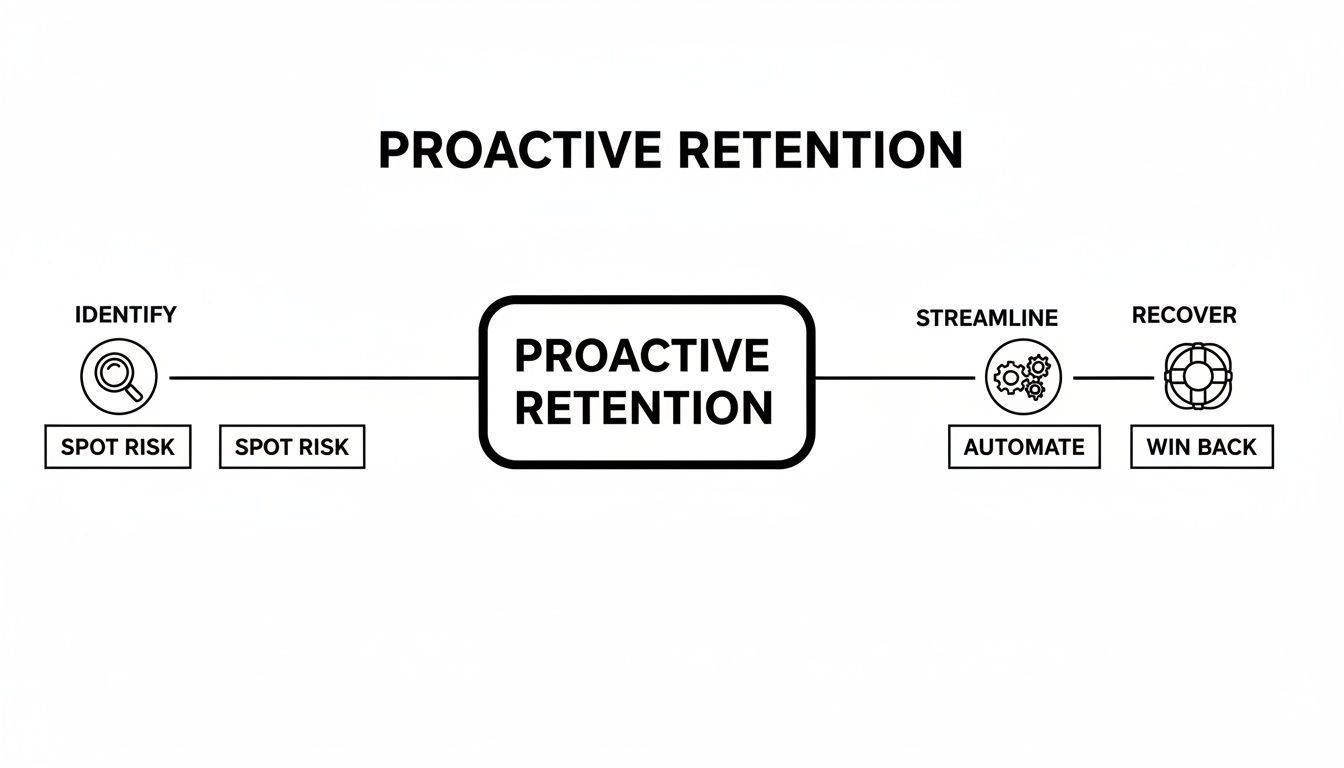
The big takeaway here is that retention isn't a one-off campaign. It's a continuous, automated process that defends your revenue around the clock.
Operationalizing LTV Growth with Your Tech Stack
All the strategies we've talked about—onboarding, expansion, retention—are solid on their own. But they truly become a growth engine when you build a system to run them on autopilot. A brilliant strategy is just a theory without great execution, and that's where your tech stack, with a lifecycle automation tool at its core, makes all the difference.
The whole point is to build a scalable system that nurtures customers 24/7, without your team having to pull levers manually all day. This isn't about getting rid of the human touch. It's about using technology to handle the predictable, repeatable parts of the customer journey so your people can focus on high-value, strategic conversations that actually require a human.
Creating a Single Source of Customer Truth
If you want to figure out how to increase customer lifetime value, you have to start with a unified view of each customer. This means tearing down the data silos that keep your teams from seeing the full picture. Your lifecycle automation platform should be the central hub where all this data comes together.
The core idea is simple: turn disparate data points into a coherent customer story. When you can see the full picture—from their first website visit to their most recent feature usage—you can engage them with uncanny relevance.
Building Your Automated Workflows
Once your data is unified and your teams are aligned, it's time to build the automated workflows that do the heavy lifting. This is where you turn all that strategy into action. Using a visual tool like SMASHSEND's automation flow builder makes this surprisingly easy, letting you map out complex journeys with simple drag-and-drop logic.
Don't try to boil the ocean. Start with the campaigns that will give you the biggest bang for your buck:
The Onboarding Sequence: Guide new signups to that "aha!" moment with a series of emails triggered by their actions (or inactions) in the product.
The Billing Recovery Flow: This one is a no-brainer. Automatically chase down failed payments to prevent that painful, completely avoidable involuntary churn.
The Expansion Nudge: Set up a trigger to target users who are bumping up against their plan limits with a perfectly timed upgrade offer.
Every automated flow you build is a permanent asset for your business. It becomes an autonomous system that works 24/7 to drive revenue, boost retention, and increase the lifetime value of every single customer you bring on board.
Your LTV Questions, Answered
Even with a solid plan, getting into the weeds of LTV optimization always brings up a few tricky questions. Where do we even start? What does a "good" LTV/CAC ratio actually look like? And can we really move the needle on this without a huge, dedicated team?
Let's clear up some of the most common questions that pop up when you start getting serious about customer lifetime value.
What's a Good LTV to CAC Ratio for a B2B SaaS Company?
The benchmark that every healthy B2B SaaS business should be aiming for is an LTV to CAC ratio of 3:1 or higher.
Put simply, this means for every dollar you put into acquiring a customer, you should be getting at least three dollars back over their lifetime. It's the classic sign of a sustainable business model.
Can We Improve LTV Without a Dedicated Lifecycle Marketer?
Absolutely. Don't let a small team stop you. While having a dedicated expert is a massive advantage, any founder or growth marketer can make a huge dent by just picking one high-impact area and starting there.
The key is to not try and boil the ocean. A perfect place to start is user onboarding. Just this one initiative can dramatically improve user activation and slash that painful early-stage churn. It's a direct, measurable win for your LTV.
What Is the Biggest Mistake Companies Make When Trying to Increase LTV?
The single biggest mistake is trying to push for an upsell before the customer is actually successful and happy.
Sustainable LTV growth is all about creating value first. Before you ever ask for more money, you have to be sure your customers are fully activated, getting what they came for, and feel supported. Once you have that solid foundation of customer success, talking about expansion revenue becomes a natural—and often welcome—conversation, not a cringey sales pitch.
Ready to turn these LTV strategies into an automated growth engine? With SMASHSEND, you can build the onboarding, expansion, and retention flows that increase customer lifetime value 24/7. Start your free trial today and see how much more revenue you can generate from the customers you already have.
Frequently Asked Questions
Have a question not in here? Contact us
- What's a Good LTV to CAC Ratio for a B2B SaaS Company?
The benchmark that every healthy B2B SaaS business should be aiming for is an LTV to CAC ratio of 3:1 or higher. For every dollar you put into acquiring a customer, you should be getting at least three dollars back over their lifetime. If you're hitting 5:1 or more, you're in an incredible position with room to get more aggressive with your growth spend.
- How Often Should We Be Measuring and Reporting on LTV?
For most SaaS teams, calculating and digging into your LTV on a monthly or quarterly basis is the right rhythm. This gives you enough data to spot real trends without getting whiplash from tiny fluctuations. The most powerful way to report on LTV is through cohort analysis by grouping customers by sign-up month.
- Can We Improve LTV Without a Dedicated Lifecycle Marketer?
Absolutely. While having a dedicated expert is a massive advantage, any founder or growth marketer can make a huge dent by picking one high-impact area and starting there. A perfect place to start is user onboarding - figure out the 2-3 'aha!' moment actions a new user must take and set up a simple, behavior-based welcome email series.
- What Is the Biggest Mistake Companies Make When Trying to Increase LTV?
The single biggest mistake is trying to push for an upsell before the customer is actually successful and happy. Sustainable LTV growth is all about creating value first. Before you ever ask for more money, you have to be sure your customers are fully activated, getting what they came for, and feel supported.
- How does customer retention impact LTV?
Customer retention has a massive impact on LTV. A modest 5% increase in customer retention can boost profits by anywhere from 25% to 95%. It's profoundly more profitable to keep the customers you have than to constantly fill a leaky bucket with new acquisitions.
- What are the key metrics that influence customer lifetime value?
The key metrics that influence LTV include Net Revenue Retention (NRR), Customer Acquisition Cost (CAC), Customer Churn Rate, average revenue per user (ARPU), and customer engagement scores. An NRR over 100% is a game-changer as it means you'd still grow even without signing new customers.