
10 Actionable B2B Email Marketing Best Practices for 2026
In the B2B SaaS world, email marketing is evolving. It's no longer about sending generic newsletters and hoping for the best. Today, the most effective email strategies are data-driven revenue engines, running 24/7 to activate new users, recover failed payments, expand accounts, and win back churned customers. This requires a fundamental shift from outdated batch-and-blast tactics to a sophisticated, lifecycle-aware approach that directly impacts key business metrics.
This guide outlines 10 critical b2b email marketing best practices designed specifically for the modern SaaS company. We will move beyond the basics, offering actionable frameworks, practical examples, and platform-specific tips to help you transform your email program into a measurable driver of Annual Recurring Revenue (ARR). You won't find generic advice here; instead, we'll focus on the systems and processes that separate high-performing teams from the rest.
Each practice is a building block for creating a powerful system that not only communicates but also converts. You will learn how to:
Segment audiences using behavioral and firmographic data for precise targeting.
Implement automated lifecycle workflows and trigger-based sends.
Protect email deliverability and maintain a strong sender reputation.
Personalize content dynamically based on real-time user data.
Continuously test, measure, and optimize every aspect of your campaign performance.
We'll cover everything from advanced segmentation and lifecycle automation to Account-Based Marketing (ABM) campaigns and leveraging product data for contextual messaging. By the end of this article, you'll have a clear roadmap for ensuring every email you send has a distinct purpose and a direct, positive impact on your bottom line.
1. Segment Your Audience by Behavioral and Firmographic Data
One of the most impactful B2B email marketing best practices is to move beyond generic, one-size-fits-all campaigns. Effective segmentation is the foundation of personalization, allowing you to deliver messages that resonate with the unique challenges and goals of different audience groups. This involves dividing your contacts based on who they are (firmographics) and what they do (behavioral data).
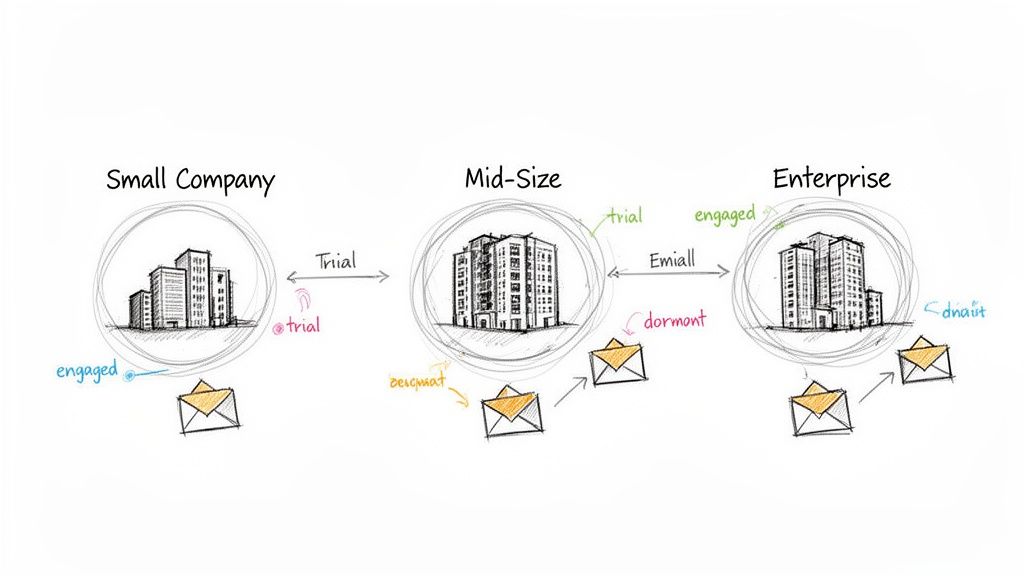
Firmographic data includes static company attributes like industry, company size, revenue, and geographic location. Behavioral data, on the other hand, is dynamic and reflects user actions within your product or on your website, such as feature adoption, login frequency, last activity date, and content downloads. Combining these two data types creates powerful, hyper-relevant segments. For instance, a segment of "at-risk enterprise customers in the finance industry who haven't used a key feature" requires a vastly different message than "highly-engaged SMB users who recently upgraded."
How to Implement This Strategy
Integrate Your Data Sources: Connect your CRM, product analytics platform, and marketing automation tool to create a unified view of your customer. This is crucial for building segments that leverage both firmographic and behavioral triggers.
Start with Key Segments: Don't try to create dozens of segments at once. Begin with 3-5 high-impact groups, such as segmenting by lifecycle stage (prospect vs. customer), company size (SMB vs. Enterprise), or engagement level (active vs. inactive).
Automate Data Enrichment: Manually gathering firmographic data is inefficient. Use a tool that automatically appends company information to your contacts based on their email domain. Explore how you can leverage a company enrichment feature to streamline this process.
Update Segments Regularly: User behavior and company details change over time. Set up a process to refresh your segments automatically or on a monthly basis to ensure your messaging remains accurate and timely.
By segmenting your audience, you can craft targeted nurture sequences, deliver relevant case studies, and send tailored onboarding flows that directly address the recipient's context, significantly boosting engagement and conversion rates.
2. Implement Automated Lifecycle Workflows and Trigger-Based Emails
Manually sending one-off campaigns is inefficient for engaging B2B customers at scale. Lifecycle email workflows are automated sequences triggered by specific user actions or time-based events, ensuring you deliver the right message at the right moment. This allows you to run critical communication 24/7 without manual intervention, responding instantly to key moments like signups, feature adoption, or payment failures.
Instead of reactive communication, this B2B email marketing best practice proactively guides users through their entire journey. For example, Calendly triggers renewal reminder emails 30-60 days before a subscription expires, while Stripe uses billing-triggered workflows to alert customers of failed payments, preventing involuntary churn. These automated touchpoints feel personal and timely because they are directly tied to the user's specific context and actions.
How to Implement This Strategy
Map Your Customer Lifecycle: Identify 8-10 critical moments for email intervention, from onboarding and feature adoption to renewal and churn recovery. This map becomes the blueprint for your automation strategy.
Prioritize High-ROI Workflows: Start by setting up billing and churn recovery automations. Emails triggered by failed payments, expiring credit cards, or declining product usage have an immediate and measurable impact on revenue.
Use Conditional Logic: Avoid sending irrelevant messages. Implement conditional splits in your workflows to ensure users don't receive an "upgrade" email if they have already upgraded or an "onboarding" tip for a feature they already master.
Test and Optimize Trigger Timing: The timing of your emails is crucial. Send payment failure alerts within 24 hours, but give users a 30-45 day heads-up for annual renewals.
Review Performance Quarterly: Don't "set and forget" your automations. Analyze open rates, click-through rates, and conversion goals for each workflow every quarter to identify optimization opportunities. To dive deeper into setup and strategy, explore this comprehensive email marketing automation guide.
3. Prioritize Email Deliverability and Sender Reputation
Even the most brilliantly crafted email is useless if it never reaches the inbox. Email deliverability, the science of getting your messages past spam filters and into your recipients' primary folder, is a non-negotiable foundation of successful B2B email marketing best practices. It all comes down to building and maintaining a strong sender reputation with Internet Service Providers (ISPs) like Gmail and Outlook through proper authentication, list hygiene, and sending protocols.
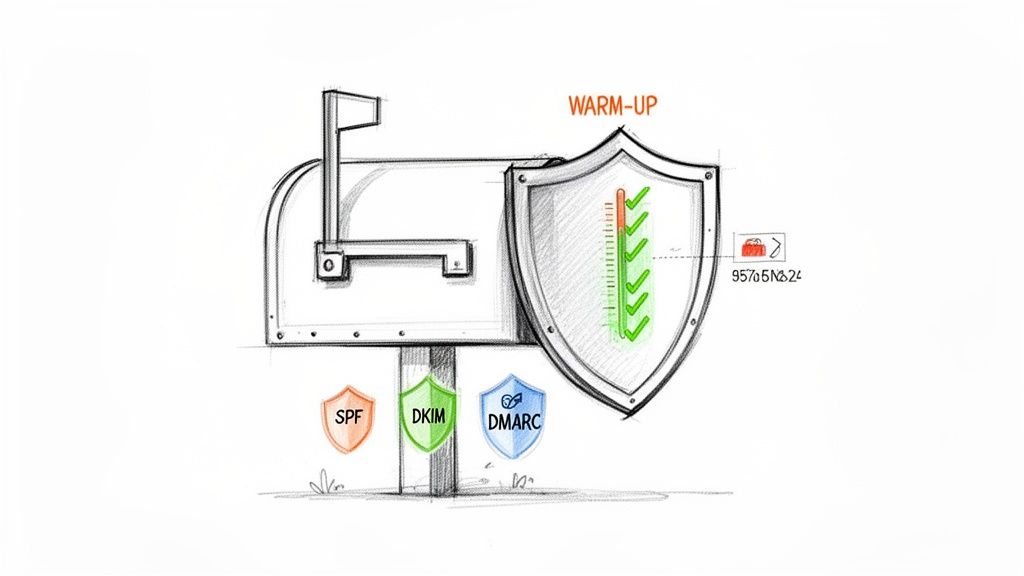
ISPs use your sender reputation to decide whether to trust your emails. This reputation is built on technical setups like SPF, DKIM, and DMARC, which act as digital signatures proving your emails are legitimate. It also depends on user engagement signals like open rates, spam complaints, and bounce rates. Poor deliverability means your entire email strategy is compromised, as your audience will never see your valuable content, product updates, or transactional alerts. Platforms like SendGrid excel at this, providing robust domain authentication and warm-up processes to ensure high inbox placement from day one.
How to Implement This Strategy
Implement Authentication Protocols: Before sending any campaigns, configure SPF, DKIM, and DMARC records for your sending domain. These are critical technical requirements that verify your identity to receiving mail servers and prevent spoofing.
Warm Up New Domains or IPs: If you're using a new sending infrastructure, don't blast your entire list at once. Start by sending to your most engaged segments and gradually increase your volume over several weeks. This "warm-up" process demonstrates positive sending behavior to ISPs.
Practice Strict List Hygiene: Regularly clean your email list by immediately removing hard bounces and unsubscribes. Use a suppression list to avoid sending to known spam traps or invalid addresses, which can severely damage your reputation.
Monitor Key Deliverability Metrics: Keep a close watch on your bounce rates (aim for under 2%), unsubscribe rates (under 0.2%), and spam complaint rates (under 0.1%). Spikes in these metrics are early warning signs of a deliverability problem.
Separate Email Streams: If possible, use different subdomains or IPs for marketing emails versus critical transactional emails (like password resets or purchase receipts). This isolates your transactional deliverability from any potential issues caused by marketing campaigns.
By treating deliverability as a top priority, you ensure your communication channel remains open and effective, directly protecting your campaign ROI and revenue.
4. Use Personalization and Dynamic Content Based on User Data
In B2B, generic, one-size-fits-all emails are quickly ignored. True personalization moves far beyond simply inserting a first name; it involves using dynamic content blocks that adapt based on firmographic data like company size, behavioral triggers like product usage, or custom attributes unique to the user. This approach ensures every email feels like it was crafted specifically for the recipient, dramatically increasing relevance and engagement.
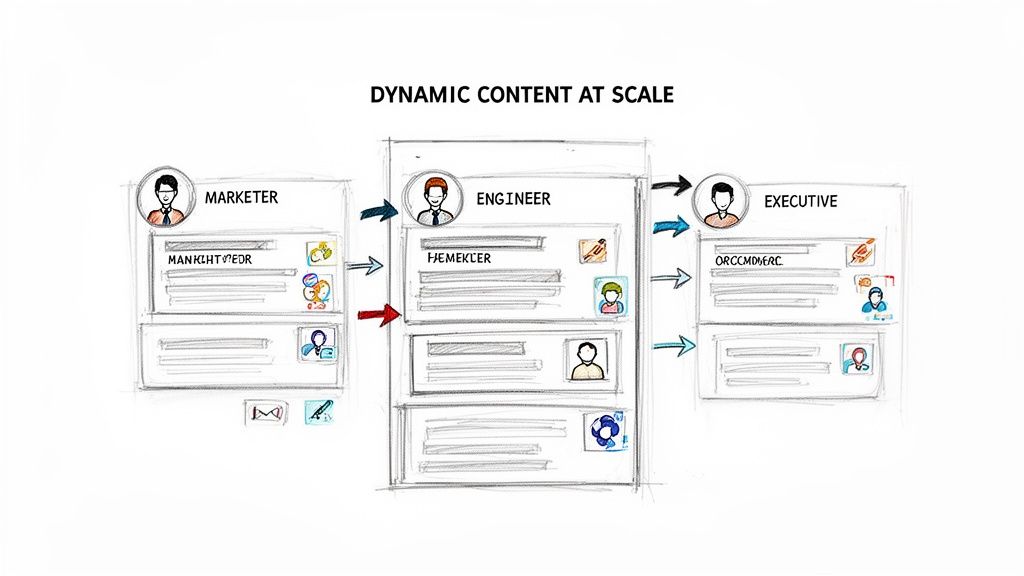
Dynamic content allows you to create a single email template that displays different information for different segments. For example, a welcome email can showcase specific features relevant to a user's role (e.g., marketer vs. salesperson), while a nurture campaign can reference the recipient's industry to highlight relevant case studies. This level of customization is one of the most effective B2B email marketing best practices for building strong customer relationships and driving action.
How to Implement This Strategy
Start with Subject Lines: Personalizing the subject line often provides the highest return on investment. Include the recipient's company name or reference a specific goal to immediately capture their attention.
Leverage Product Usage Data: Use behavioral data to create highly relevant messages. For example, send a targeted email recommending an advanced feature to a user who has already mastered the basics, or create win-back campaigns that reference a user's most-used features.
Create Role-Based Content Blocks: Develop different versions of your email copy, calls-to-action, and images for key personas. A message to a C-level executive should focus on ROI and strategic value, while a message to a practitioner should highlight efficiency and features.
Use Progressive Profiling: Gradually collect more data about your contacts over time through forms and interactions. This allows you to build a richer user profile for deeper personalization without overwhelming new leads with long sign-up forms.
5. Test, Measure, and Continuously Optimize Campaign Performance
Guesswork has no place in a high-performing email strategy. One of the most critical B2B email marketing best practices is to adopt a data-driven mindset, where every campaign element is an opportunity for improvement. This means systematically testing variables, measuring their impact on key metrics, and using those insights to continuously refine your approach for better results.
This process involves more than just looking at open and click rates; it's about understanding what truly motivates your B2B audience to act. For example, LinkedIn's email tests revealed that action-oriented CTAs like "See recommendations" outperformed more passive phrases by 15%. Similarly, Marketo found that sending campaigns at 10 AM in the recipient's local time zone beat 9 AM by 8%. These small, incremental gains compound over time, leading to significant improvements in engagement and revenue.
How to Implement This Strategy
Isolate One Variable at a Time: To get clean, reliable data, only test one element per experiment. This could be the subject line, CTA button color, sender name, or send time. Testing multiple variables at once makes it impossible to know which change caused the result.
Focus on High-Impact Campaigns First:Prioritize your testing efforts on automated sequences and high-volume broadcasts where you can gather data quickly. An improvement in your main onboarding flow will have a much larger impact than a one-off announcement.
Establish a Testing Cadence: Create a schedule for running tests and reviewing performance, such as a monthly or quarterly review. Document all your hypotheses, results, and key learnings in a shared "testing playbook" to build institutional knowledge and prevent repeating mistakes.
Use Statistical Significance: Don't declare a winner based on a small sample size. Run tests until you reach a statistically significant result, which typically requires a few hundred conversions or over 1,000 opens. This ensures your findings are reliable and not just due to random chance.
6. Build Trust Through Transparent, Value-First Content Strategy
B2B decision-makers are inundated with promotional emails and have become highly skeptical of overt sales pitches. One of the most critical B2B email marketing best practices is to shift from a sales-first to a value-first mindset. This approach focuses on building trust and establishing authority by consistently delivering content that educates, solves problems, and offers genuine insights before asking for a commitment. By prioritizing the recipient's needs, you create a loyal audience that views your brand as a credible partner, not just a vendor.
This strategy positions your emails as a valuable resource rather than an advertisement. Instead of leading with product features, you lead with solutions to your audience's most pressing challenges. For instance, Stripe builds immense authority by sharing deep engineering insights and industry research, while HubSpot provides free templates and educational courses. This trust-building foundation makes subscribers far more receptive when you eventually introduce a relevant product or service, as you've already proven your value.
How to Implement This Strategy
Lead with Their Problem: Start your emails by acknowledging a specific pain point or challenge your target audience faces. This shows you understand their world and makes the content immediately relevant.
Provide Standalone Value: Share actionable advice, checklists, or insights that are useful even if the recipient never becomes a customer. This selfless approach is the cornerstone of building trust.
Mix Your Content Ratio: A balanced content calendar is key. Aim for a mix that is roughly 70% educational (guides, tips, research), 20% community-building (webinars, case studies, success stories), and only 10% promotional (product updates, demos).
Use Soft Calls-to-Action (CTAs): Instead of aggressive "Buy Now" buttons, guide subscribers with softer CTAs like "Learn More," "Read the Full Report," or "See How It Works." This respects their journey and reduces pressure.
Incorporate Social Proof: Weave in testimonials, customer quotes, and case studies to validate your claims and show that peers trust your expertise. This reinforces the value you provide and builds confidence in your solutions.
7. Create Account-Based Marketing (ABM) Email Campaigns
For B2B companies targeting high-value, strategic accounts, Account-Based Marketing (ABM) flips the traditional lead generation funnel on its head. Instead of casting a wide net, ABM focuses marketing and sales resources on a predefined set of target accounts, treating each one as a market of one. This approach coordinates hyper-personalized email sequences with sales outreach to address the specific needs and stakeholders within each account, making it one of the most effective B2B email marketing best practices for enterprise sales.
The core principle of ABM is alignment. Marketing doesn't just generate leads to pass over to sales; both teams collaborate to engage key decision-makers within a target company. For example, a campaign might send role-specific content to the CMO, the Head of Operations, and the CEO of a single target account simultaneously, with each message tailored to their unique priorities. This creates a cohesive and compelling narrative around your solution that resonates across the organization.
How to Implement This Strategy
Identify and Prioritize Target Accounts: Start small. Collaborate with your sales team to select 20-50 high-value accounts that are an ideal fit for your product. Define your Ideal Customer Profile (ICP) based on firmographics like industry, revenue, and employee count.
Map Key Stakeholders: Within each target account, identify 3-5 key decision-makers and influencers. Research their roles, responsibilities, and pain points to inform your messaging strategy. Use tools like LinkedIn Sales Navigator to map the buying committee.
Develop Account-Specific Content: Create personalized content assets that speak directly to the target account's challenges. This could include a custom-branded case study, a webinar addressing their industry's trends, or an ROI calculator pre-filled with their company data.
Coordinate Multi-Channel Outreach: Email is powerful, but it's even more effective when combined with other channels. Align your email sends with sales calls, LinkedIn outreach, and even targeted digital ads. Dive deeper into how to coordinate these efforts by exploring multi-channel marketing automation strategies.
Hold Regular Sales & Marketing Syncs: Schedule weekly or bi-weekly meetings to review account engagement, refine messaging, and plan the next wave of outreach. This ensures both teams are aligned on strategy and execution.
By adopting an ABM approach, you move from broad-stroke marketing to precision-targeted engagement, dramatically increasing the relevance of your communication and improving your chances of landing high-value deals.
8. Optimize Email Frequency and Deliverability Through Preference Centers
Striking the right email cadence is a critical challenge in B2B marketing. Sending too many emails leads to unsubscribes and spam complaints, while sending too few risks your brand being forgotten. A preference center is the ideal solution, putting control back into the hands of your subscribers and demonstrating a commitment to their experience. This practice is essential for maintaining a healthy sender reputation and improving long-term deliverability.
Giving users the power to choose what content they receive and how often they receive it transforms your email relationship from a monologue into a dialogue. Instead of a binary "subscribe" or "unsubscribe" choice, users can tailor their inbox experience to their specific needs. For example, a busy executive might opt for a monthly digest, while a product manager might want weekly updates on new features. This self-segmentation provides invaluable data on which content resonates most with your audience.
How to Implement This Strategy
Make Your Preference Center Accessible: Include a clear, easily identifiable link to your preference center in the footer of every email, right next to the unsubscribe link. Also, make it accessible within user account settings.
Offer Granular Choices: Go beyond a simple on/off switch. Allow users to select their preferred frequency (e.g., daily, weekly, monthly) and choose the topics or content types they are interested in (e.g., product updates, blog posts, event invitations, promotions).
Include a "Pause" or "Snooze" Option: Sometimes subscribers are just temporarily overwhelmed. Provide an option to pause emails for 30 or 90 days as a soft alternative to a full unsubscribe, giving you a chance to re-engage them later.
Use Data to Set Smart Defaults: Analyze your engagement data to determine the most popular sending frequency and content types. Set these as the default options for new subscribers, guiding them toward a positive experience from the start.
By empowering your audience with a preference center, you not only improve engagement and reduce list churn but also build trust. This is a core component of modern B2B email marketing best practices that respects user autonomy and strengthens your brand's reputation.
9. Leverage Product Data and Behavioral Triggers for Timely, Contextual Emails
The most effective B2B emails feel less like marketing and more like a helpful, in-the-moment notification. Instead of relying on a fixed schedule, one of the most advanced b2b email marketing best practices is to use product data to trigger emails based on specific user actions. This creates hyper-contextual communications that arrive at the exact moment of need, guiding users toward success and increasing product adoption.
Connecting your email platform to your product analytics allows you to automate messages based on key user milestones. For example, Calendly sends an upsell email after a user successfully schedules their first meeting, capturing them at a moment of high value. Similarly, a tool like Amplitude might trigger a churn-prevention email to a user whose product engagement has declined, offering support before they disengage completely. This approach makes your communication a natural extension of the product experience.
How to Implement This Strategy
Identify High-Value Triggers: Map out 5-10 key user actions that correlate with long-term retention, expansion, or potential churn. Focus on moments like the first use of a core feature, reaching a usage limit, or a sudden drop in activity.
Integrate Your Tech Stack: Connect your product analytics tool (like Mixpanel or Amplitude) with your marketing automation platform. This ensures real-time data flows between systems, allowing you to trigger emails instantly when a user performs a specific action.
Combine Triggers with Segmentation: Enhance your behavioral triggers by layering on firmographic or lifecycle data. For instance, you would want to create a rule that prevents an "upgrade your plan" email from being sent to a user who is already on your highest enterprise tier.
Test and Refine Timing: Not every trigger requires an immediate email. While a password reset email must be instant, a feature adoption nudge might be more effective if sent 24 hours after a user first explores a new section. A/B test your trigger delays to find the optimal timing that drives action without causing fatigue.
10. Implement Lead Scoring, Progressive Profiling, and Sales SLAs
To transform email marketing from a broadcast channel into a revenue engine, you must align it with your sales process. This involves implementing a system to identify and prioritize your most valuable leads and ensuring they receive prompt, effective follow-up. This is where the powerful combination of lead scoring, progressive profiling, and a formal Sales Level Agreement (SLA) comes into play.
Lead scoring assigns points to prospects based on their firmographic fit (like company size or industry) and their engagement (like visiting the pricing page or downloading a whitepaper). Progressive profiling gradually collects more data over time through forms, asking for one new piece of information with each interaction. An SLA codifies the partnership between marketing and sales, defining exactly when a lead is "sales-ready" and the required follow-up cadence. Together, these elements create a seamless pipeline from initial engagement to sales conversation.
How to Implement This Strategy
Establish a Simple Scoring Model: Start by defining your ideal customer profile and key buying signals. Assign point values to 2-3 firmographic attributes and 2-3 high-intent behaviors, such as requesting a demo or attending a webinar. The goal is to create a clear threshold that qualifies a lead (MQL) for sales handoff.
Use Progressive Profiling on Forms: Instead of overwhelming new contacts with long forms, use progressive profiling to build a rich contact record over time. For the first download, ask for their name and email. For the next, ask for company size. For another, ask about their biggest challenge. This reduces friction and improves conversion rates.
Co-Create a Sales and Marketing SLA: Your SLA is the rulebook for lead management. Work directly with your sales team to define the MQL criteria, the expected response time for follow-up (e.g., within 24 hours), and the process for how leads are passed back to marketing if they aren't ready. This alignment is critical for one of the most effective b2b email marketing best practices.
Automate Handoff and Alerts: Configure your marketing automation platform to automatically change a lead's status and assign it to a sales rep once it hits the MQL score threshold. Simultaneously, trigger an email or Slack notification to the rep, providing them with the lead's key data and engagement history.
10 B2B Email Marketing Best Practices Comparison
| Strategy | Implementation 🔄 | Resource Needs ⚡ | Expected Outcomes ⭐📊 | Ideal Use Cases 💡 | Key Advantages 📊 |
|---|---|---|---|---|---|
| Segment Your Audience by Behavioral and Firmographic Data | Medium — CRM + data integration and rules | Moderate — analytics, enrichment, CRM data | Higher open/click and conversion rates; reduced unsubscribes | Foundation for personalization, targeted nurture, ABM prep | More relevant messaging; efficient budget allocation; better upsell |
| Implement Automated Lifecycle Workflows and Trigger-Based Emails | Medium-High — workflow design, conditional logic | Moderate-High — ops, templates, event tracking | Timely engagement; predictable ARR uplift; reduced manual work | Onboarding, billing recovery, churn prevention, renewals | Scalable 24/7 outreach; consistent customer journeys |
| Prioritize Email Deliverability and Sender Reputation | High — auth, IP management, warm-up | High — deliverability tooling, monitoring, infra | Consistent inbox placement; protects revenue-critical messages | High-volume sends; transactional and billing emails | Reliable inbox delivery; brand and domain protection |
| Use Personalization and Dynamic Content Based on User Data | Medium-High — dynamic blocks and data mapping | Moderate — data quality, content ops, AI tools | Significant engagement and CTR lift; better conversions | Role-based messaging, usage-based upsells, large lists | Scalable 1:1 relevance; improved CTRs and conversions |
| Test, Measure, and Continuously Optimize Campaign Performance | Medium — A/B/multivariate setup and analytics | Moderate — analytics, sufficient volume, analysts | Incremental, compounding performance gains; clear ROI | High-volume programs; ongoing optimization cycles | Data-driven decisions; faster learning and higher ROI |
| Build Trust Through Transparent, Value-First Content Strategy | Low-Medium — content strategy and production | Moderate — content creators, research resources | Higher long-term engagement; lower unsubscribes | Long sales cycles; thought leadership and education | Credibility and LTV growth; stronger brand relationships |
| Create Account-Based Marketing (ABM) Email Campaigns | High — account mapping and cross-team workflows | High — bespoke content, sales coordination | Much higher conversion and deal size for targets | Enterprise sales; high-value accounts with long cycles | Focused ROI; strong sales-marketing alignment |
| Optimize Email Frequency and Deliverability Through Preference Centers | Medium — build UI + integrate preferences | Moderate — dev, UX, compliance support | Fewer unsubscribes and complaints; improved deliverability | Large lists; GDPR/CAN-SPAM-sensitive audiences | User control, compliance, longer list retention |
| Leverage Product Data and Behavioral Triggers for Timely, Contextual Emails | Medium-High — event instrumentation and APIs | Moderate-High — engineering, analytics, integrations | Timely contextual messages; reduced churn; higher expansion | Product-led growth, feature adoption, milestone-driven flows | Contextual timing drives high conversion and retention |
| Implement Lead Scoring, Progressive Profiling, and Sales SLAs | Medium-High — scoring models and SLA processes | Moderate-High — CRM, analytics, cross-team alignment | Better lead prioritization and faster conversion rates | Sales-driven motions; B2B with lead handoff to sales | Prioritized follow-up; improved MQL→SQL efficiency |
Putting It All Together: Your Next Steps to Higher ARR
Navigating the landscape of B2B email marketing can feel overwhelming, but mastering it is one of the most direct paths to sustainable revenue growth. We've explored ten foundational B2B email marketing best practices, moving from the technical necessities of deliverability to the strategic complexities of account-based marketing and lead scoring. The common thread connecting every point is a shift in mindset: from batch-and-blast broadcasting to creating intelligent, automated conversations that guide users toward value and your business toward higher Annual Recurring Revenue (ARR).
The journey to an elite email program isn't about implementing every single tactic overnight. It's a systematic process of building a strong, interconnected system where each component amplifies the others. Strong deliverability ensures your perfectly segmented messages actually land in the inbox. Rich segmentation fuels the hyper-relevant personalization that makes your lifecycle automations feel human and helpful. A continuous cycle of testing and analysis then provides the data-driven insights needed to refine your strategy, ensuring your efforts consistently translate into tangible business outcomes like user activation, account expansion, and reduced churn.
From Theory to Action: Your Implementation Roadmap
To avoid analysis paralysis, approach this as an iterative process. Your immediate goal is not perfection; it's tangible progress. Start by identifying the single biggest leak in your current email marketing funnel and focus your energy there first.
Here is a practical, three-step framework to get started:
Conduct a Foundational Audit: Before building new campaigns, solidify your base. Is your sender reputation strong? Are your segmentation criteria well-defined and based on both firmographic and behavioral data? Without a solid foundation, even the most creative campaigns will fail to reach their full potential.
Identify Your Highest-Impact Automation: Look at your user lifecycle. Where is the most significant drop-off? Is it during onboarding? At the point of conversion from free to paid? Or perhaps in retaining existing accounts? Pinpoint that one critical moment and build a targeted, trigger-based workflow to address it. This single automation could have a more significant impact than a dozen generic newsletters.
Establish a Testing Cadre: Commit to a culture of optimization. Select one core KPI you want to improve this quarter, whether it's open rates, click-through rates on a key CTA, or trial-to-paid conversion rates. Design and run A/B tests specifically aimed at moving that single metric. This focused approach generates clear, actionable learnings you can apply across your entire program.
Ultimately, adopting these B2B email marketing best practices is about transforming your email channel from a simple megaphone into a sophisticated, revenue-generating engine. It's about delivering the right message to the right person at the exact moment it provides the most value. By moving from a campaign-centric to a customer-centric model, you build trust, drive engagement, and create a powerful, scalable system that directly contributes to your bottom line. The path to adding 10-30% to your ARR through email begins with the first, focused step you take today.
Ready to turn these best practices into an automated revenue engine? SMASHSEND unifies lifecycle automation, a B2B CRM, and powerful segmentation tools into a single platform designed for SaaS growth. See how you can implement these strategies and drive higher ARR by exploring SMASHSEND today.
🎯 Key Takeaways
Advanced segmentation using both behavioral and firmographic data creates hyper-relevant messaging that significantly boosts engagement and conversion rates
Automated lifecycle workflows running 24/7 can increase qualified leads by 451% and drive predictable ARR growth
Email deliverability is non-negotiable—implement SPF, DKIM, DMARC authentication and maintain sender reputation above 98% inbox placement
Dynamic personalization and behavioral triggers create contextual communications that feel like natural product extensions rather than marketing
Account-Based Marketing (ABM) email campaigns focusing on high-value accounts deliver much higher conversion rates and deal sizes for enterprise sales
Continuous A/B testing and optimization compound over time— small incremental gains lead to significant performance improvements
Frequently Asked Questions
Have a question not in here? Contact us
- What are the most effective B2B email marketing best practices?
The most effective B2B email marketing best practices include segmenting your audience by behavioral and firmographic data, implementing automated lifecycle workflows, prioritizing email deliverability, using personalization and dynamic content, and continuously testing and optimizing campaign performance. These strategies can increase conversion rates by up to 53%.
- How can I improve my B2B email deliverability in 2026?
To improve B2B email deliverability, implement SPF, DKIM, and DMARC authentication protocols, warm up new domains gradually, practice strict list hygiene, monitor bounce rates (under 2%) and spam complaints (under 0.1%), and separate marketing from transactional emails using different subdomains.
- What email automation workflows are essential for B2B companies?
Essential B2B email automation workflows include welcome sequences, onboarding automation, lead nurturing sequences, behavioral trigger emails, re-engagement campaigns, trial expiration sequences, and customer feedback collection. These automated touchpoints can run 24/7 to guide users through their entire journey.
- How should I segment my B2B email audience for better results?
Segment your B2B email audience using both firmographic data (industry, company size, revenue, location) and behavioral data (feature adoption, login frequency, content downloads). Combine these to create hyper-relevant segments like 'at-risk enterprise customers in finance who haven't used key features' for precise targeting.
- What is Account-Based Marketing (ABM) in email campaigns?
Account-Based Marketing (ABM) in email campaigns focuses marketing resources on a predefined set of high-value target accounts, treating each as a market of one. It involves coordinating hyper-personalized email sequences with sales outreach to address specific stakeholder needs within each target account, dramatically increasing relevance and conversion rates for enterprise sales.
- How can I use product data to improve my B2B email marketing?
Use product data to trigger emails based on specific user actions and milestones. Connect your product analytics platform to your email system to automate messages for key moments like first feature use, usage limits reached, or declining engagement. This creates contextual communications that arrive at the exact moment of need, increasing product adoption and reducing churn.