
10 B2B Email Marketing Examples to Drive Revenue in 2026
In B2B marketing, the inbox is more than just a communication channel; it's a primary engine for revenue growth, customer activation, and retention. Yet, many B2B email strategies stall out with generic newsletters and simplistic promotional blasts. This approach misses the massive opportunity to guide customers through their entire lifecycle, from their first welcome to their tenth renewal. The difference between a stagnant email list and a high-performing revenue channel lies in executing targeted, context-aware campaigns that solve specific problems at the right time.
This article moves beyond theory to provide a practical, in-depth look at 10 real-world b2b email marketing examples that you can adapt and deploy immediately. We're not just showing you pretty templates. We're dissecting the strategy behind each campaign, breaking down why it works, and providing actionable takeaways for SaaS growth teams, marketers, and founders.
You will find detailed teardowns of emails that:
Activate new users with guided product tours.
Expand revenue through strategic upsell and cross-sell sequences.
Recover lost revenue with effective billing and churn-prevention campaigns.
Engage accounts with personalized, value-driven content.
Each example includes the specific subject lines, copy snippets, segmentation logic, and measurable results that made it successful. Forget surface-level case studies; this is a hands-on guide filled with replicable strategies designed to help you build a more sophisticated and profitable email marketing program today. Let's dive into the examples.
1. Welcome Series with Product Tour
A Welcome Series with a Product Tour is a foundational B2B email marketing example for product-led growth (PLG) SaaS companies. This automated multi-email sequence goes beyond a simple "welcome" message. It's a strategic onboarding tool designed to guide new users from initial signup to their first "aha!" moment, systematically introducing core features and driving product adoption over 5-7 days.
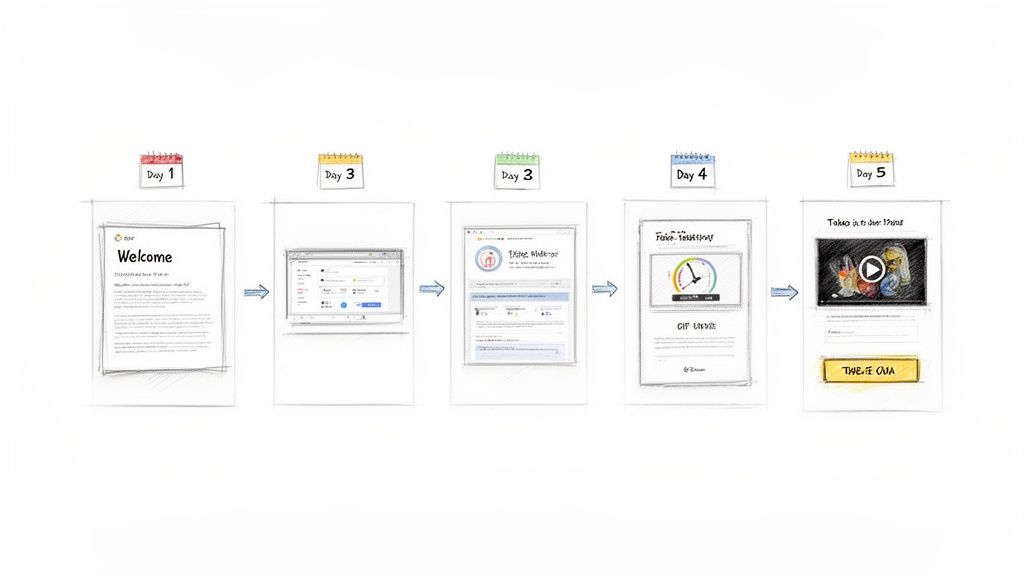
This approach is critical because it establishes product value immediately, reducing the risk of early churn. By breaking down the onboarding process into manageable steps, it prevents overwhelm and focuses users on high-impact actions that demonstrate the platform's core benefits.
Strategic Analysis: Why It Works
This method is highly effective because it aligns email content directly with the user's in-app journey. Instead of generic feature lists, each email is triggered by user behavior (or lack thereof), making the communication timely and relevant.
Drives Activation: By focusing on one key action per email, the series guides users toward activation milestones, like setting up their first project or inviting a team member.
Reduces Churn: It demonstrates value before the user loses interest. A well-executed series can significantly increase user retention in the first 30 days.
Scales Onboarding: It automates the educational process, ensuring every new user receives a consistent and high-quality onboarding experience without manual intervention.
Great examples include Slack's sequence that guides new teams through channel creation and integrations, or Notion's emails showcasing its versatile template gallery to inspire immediate use cases.
Actionable Takeaways & Template
To implement this, map out the 3-5 key actions a user must take to see value in your product. Then, build an email for each action.
Email 1: The Warm Welcome & First Step
Subject: Welcome to [Your Product]! Here's how to start.
Body: Greet the user, reiterate the core value proposition, and provide a single, clear call-to-action (CTA) for the very first step, such as "Create Your First Project."
Email 2: Highlight a Core Feature
Subject: [User Name], get your first win in 5 minutes
Body: Introduce a high-impact feature with a short GIF or video tutorial. Link directly to that feature within the app.
Email 3: Offer Support & Resources
Subject: Questions about [Your Product]? We're here to help.
Body: Proactively offer help with links to your knowledge base, video tutorials, or support chat. This builds trust and removes potential friction points.
For a deeper dive into crafting effective onboarding sequences, this video from UserOnboard provides excellent insights:
2. Account Expansion Upsell Campaign
An Account Expansion Upsell Campaign is a targeted email series designed to move existing customers from starter plans to higher-tier features or licenses. This strategic B2B email marketing example identifies expansion opportunities by monitoring product usage signals, such as teams approaching their seat limit or frequently using features adjacent to a premium offering. It then delivers personalized upgrade recommendations with ROI-focused messaging.
This approach is critical for maximizing annual recurring revenue (ARR) from your existing customer base. Instead of waiting for customers to discover upgrade paths on their own, this proactive campaign nurtures them toward a higher-value relationship, directly impacting net revenue retention (NRR).
Strategic Analysis: Why It Works
This method is highly effective because it uses product event data to trigger marketing messages at the precise moment a customer is experiencing the limitations of their current plan. The communication is not a random sales pitch; it's a helpful, context-aware solution to a problem the user is actively facing.
Maximizes Customer Lifetime Value (LTV): It costs significantly less to upsell an existing customer than to acquire a new one. This strategy focuses on extracting more value from established relationships.
Ties Value to Price: By highlighting how a premium feature solves a specific, demonstrated need, the campaign frames the upsell as a logical next step rather than just a cost increase.
Reduces Expansion Friction: Automating these triggers ensures no opportunity is missed and provides a consistent, data-driven path for customers to grow with your platform.
Powerful examples include Slack prompting growing teams to upgrade for unlimited message history and integrations, or Calendly targeting organizations with multiple users to adopt its enterprise-level team scheduling features.
Actionable Takeaways & Template
To build this campaign, identify the key usage milestones that indicate a customer is outgrowing their current plan. Use this data to create custom segments and trigger your email sequence.
Email 1: The Value-Driven Nudge
Subject: Unlock more power in [Your Product], [Company Name]
Body: Acknowledge their recent activity (e.g., "We noticed your team is close to its member limit."). Introduce the premium feature that solves this exact problem, focusing on the outcome, not just the feature itself.
Email 2: Social Proof & ROI
Subject: How [Similar Company] solved [Problem] with [Premium Feature]
Body: Include a short case study or testimonial from a similar company. Use a clear CTA like "See how [Feature Name] can boost your ROI."
Email 3: The Direct Offer
Subject: A special offer to upgrade your [Your Product] account
Body: Present a clear, time-sensitive offer or a direct invitation to speak with an account manager. Make the upgrade path as seamless as possible with a direct link to the billing page. For a more sophisticated approach, explore how to integrate these campaigns into a broader strategy by reading about multi-channel marketing automation.
3. Billing Recovery and Dunning Management
Billing Recovery and Dunning Management is an essential, often overlooked, b2b email marketing example focused on preventing involuntary churn. This automated email sequence triggers when a customer's recurring payment fails. Instead of a single harsh notification, it's a strategic series of communications designed to recover revenue, update payment information, and preserve the customer relationship.
This process is critical for any subscription-based B2B company. It directly protects recurring revenue by automating the recovery of failed payments, a common issue caused by expired cards, soft declines, or insufficient funds. A well-executed dunning sequence can recover a significant percentage of at-risk revenue without manual intervention.
Strategic Analysis: Why It Works
This method is effective because it treats a sensitive financial interaction with a customer-centric, multi-touch approach. It assumes the payment failure is accidental and provides a frictionless path to resolution, escalating in urgency only when necessary.
Reduces Involuntary Churn: It systematically addresses the leading cause of accidental customer loss, directly protecting your monthly recurring revenue (MRR).
Preserves Customer Relationships: A friendly, helpful tone avoids alienating customers who have simply forgotten to update their card information, turning a negative event into a positive support interaction.
Improves Cash Flow: By automating recovery attempts, it ensures predictable revenue streams and reduces the accounts receivable workload for finance teams.
Leading subscription platforms like Zuora and Recurly have perfected these sequences, and payment processors like Stripe offer built-in dunning logic. You can explore how to set up Stripe for dunning management to automate this process.
Actionable Takeaways & Template
To implement this, create a sequence that gently escalates in tone and frequency. Make it incredibly easy for the user to update their payment information.
Email 1: The Friendly Heads-Up (Day 1)
Subject: Action Required: There's an issue with your [Your Product] payment
Body: Keep it simple and non-accusatory. "Hi [User Name], we were unable to process your recent payment for your [Your Product] subscription. This can happen for a number of reasons. You can update your payment details here in just a few seconds."
Email 2: Gentle Reminder (Day 3 or 5)
Subject: Your [Your Product] account is at risk
Body: Introduce a bit more urgency but remain helpful. "To ensure uninterrupted access to [Your Product], please take a moment to update your billing information. We'd hate to see you go!"
Email 3: Final Notice (Day 10 or 14)
Subject: Final notice: Your [Your Product] subscription will be canceled
Body: Be direct and clear about the consequences. "Hi [User Name], we've tried to process your payment several times without success. Your account will be suspended in 24 hours. Update your payment method now to maintain access."
4. Win-Back Churn Recovery Campaign
A Win-Back Churn Recovery Campaign is an essential sequence for any B2B SaaS company looking to recapture lost revenue. This automated email series targets customers who have canceled their subscriptions, aiming to re-engage and reactivate them. It goes beyond simple "we miss you" messages by strategically combining new feature announcements, special incentives, and reminders of the value they've lost.
This strategy is crucial because it's often more cost-effective to win back a former customer than to acquire a new one. By addressing the potential reasons for churn, such as price or missing features, this campaign directly targets the friction points that led to cancellation and presents a compelling case for returning.
Strategic Analysis: Why It Works
This B2B email marketing example is effective because it's a highly targeted effort aimed at a pre-qualified audience that already understands your product's core value. The campaign leverages past user data to personalize the offer and message, making it far more relevant than a cold outreach campaign.
Recaptures Lost Revenue: Directly converts churned accounts back into active, paying customers, providing a measurable boost to MRR.
Highlights Product Evolution: It demonstrates that your product is continuously improving, potentially solving the very issue that caused the customer to leave in the first place.
Strengthens Brand Loyalty: A thoughtful, non-aggressive win-back attempt shows that you value the customer's business, which can repair a damaged relationship.
Prime examples include Adobe's offers to lapsed Creative Cloud users with a free month or Spotify's "Come back" campaigns that bundle a significant discount for the first three months.
Actionable Takeaways & Template
To build this, segment your churned users by their cancellation reason (e.g., price, lack of use, missing feature). Then, tailor a sequence for each segment, starting 30-60 days post-cancellation.
Email 1: The "Here's What You've Missed" Angle (30 days post-churn)
Subject: We've made some big changes since you've been gone
Body: Lead with 2-3 significant product updates or new features you've launched. Frame them as solutions to common pain points. End with a soft call-to-action (CTA) like "See what's new."
Email 2: The Special Incentive (60 days post-churn)
Subject: A special 30% off offer to welcome you back to [Your Product]
Body: Make a direct, time-sensitive offer to encourage immediate action. Reiterate the core value proposition and how they can achieve their goals with your tool.
Email 3: The Final Check-in & Feedback Request (90 days post-churn)
Subject: Is this goodbye for good?
Body: Use a low-pressure, personal tone. Acknowledge that they haven't returned and ask for feedback on why they left. This provides valuable insights even if it doesn't result in a win-back.
5. Feature Adoption and Engagement Nurture
A Feature Adoption and Engagement Nurture is an ongoing educational email series designed to drive deeper product engagement among active users. Instead of selling, these emails teach customers how to unlock more value from features they haven't discovered or are underutilizing. This proactive approach turns passive users into power users, increasing product stickiness and long-term retention.
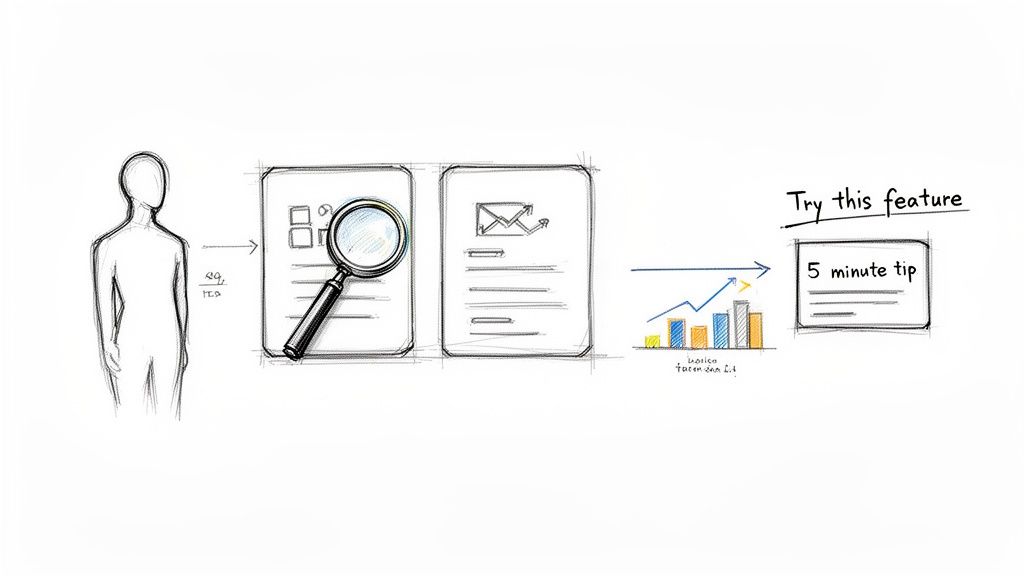
This strategy is vital for B2B SaaS companies because it directly combats user stagnation. By continuously showcasing the platform's full capabilities, you prevent users from hitting a plateau and reinforce the product's value proposition, making it an indispensable part of their workflow.
Strategic Analysis: Why It Works
This type of email works because it is highly targeted and value-driven, using in-app behavior to deliver relevant, timely education. It's one of the most effective b2b email marketing examples for boosting customer lifetime value.
Increases Product Stickiness: By showing users how to integrate more features into their daily tasks, the product becomes more difficult to replace.
Reduces Mid-Lifecycle Churn: It re-engages users who might be losing interest by revealing new and powerful ways to solve their problems.
Drives Expansion Revenue: Educating users on advanced features often creates a natural pathway to upgrading to higher-tier plans.
Excellent examples include Asana's weekly tips on advanced project management features or Google Workspace's emails that highlight new templates and functionalities within Docs or Sheets.
Actionable Takeaways & Template
Leverage product usage data to trigger these emails. Identify a valuable feature that a segment of users has not adopted after a certain period (e.g., 30 days).
Email 1: The "Did You Know?" Tip
Subject: A 5-minute trick in [Your Product] to save you hours
Body: Open with a common pain point. Introduce a specific feature that solves it, using a short GIF to show it in action. Provide a direct link to that feature in the app.
Email 2: Role-Based Use Case
Subject: For Marketing Managers: Streamline your campaign planning
Body: Segment your audience by role. Show how a specific set of features can be combined to solve a role-specific challenge. For example, "Combine [Feature A] with [Feature B] to build your content calendar."
Email 3: Advanced Feature Introduction
Subject: Ready to become a [Your Product] power user?
Body: For highly engaged users, introduce an advanced or complex feature like automation or integrations. Frame it as a way to level up their skills and offer a link to a detailed guide or webinar.
6. Sales Enablement and Social Selling
Sales Enablement and Social Selling emails are a powerful B2B email marketing example where marketing equips sales teams with on-brand, high-converting templates for direct outreach. These are not marketing blasts; they are pre-approved, value-driven messages designed for 1:1 communication on platforms like email and LinkedIn. This strategy bridges the gap between marketing's broad messaging and sales' targeted conversations.
This approach is crucial for maintaining brand consistency and scaling outreach efforts effectively. By providing a library of tested templates, marketing empowers sales reps to engage prospects with relevant content, insights, and solutions without having to create every message from scratch, thus accelerating the sales cycle.
Strategic Analysis: Why It Works
This method transforms marketing from a lead generation function into a direct revenue-enabling partner. The templates are assets that blend marketing's strategic messaging with the personalization required for successful sales conversations, making outreach both scalable and effective.
Increases Sales Velocity: Reps spend less time writing emails and more time selling. Standardized templates for common scenarios (cold outreach, follow-ups, objection handling) streamline their workflow.
Ensures Message Consistency: It guarantees that every prospect receives a polished, on-brand message that accurately reflects the company's value proposition.
Improves Performance: Marketing can analyze template performance, identify what resonates, and continuously optimize the messaging for better conversion rates across the entire sales team.
Great examples include HubSpot's extensive template library within its Sales Hub or LinkedIn Sales Navigator's InMail templates, which facilitate targeted, professional outreach.
Actionable Takeaways & Template
Build a tiered library of templates for different stages of the sales conversation.
Template 1: Cold Outreach (Value-First)
Subject: A thought on [Company Name]'s [specific goal]
Body: Hi [First Name], I saw your recent post about [topic] and noticed you're focused on [business objective]. Many leaders in [industry] struggle with [common pain point]. We helped [Similar Company] achieve [specific result]. Worth a brief chat next week?
Template 2: Warm Follow-Up (Post-Event/Content Download)
Subject: Following up on the [Event/Webinar Name]
Body: Hi [First Name], enjoyed your questions during the webinar. The point you raised about [specific topic] is a challenge we solve by [briefly explain solution]. If you're interested, I can share a quick case study on how we tackled this for a similar company.
Template 3: Objection Handling (Budget Concerns)
Subject: Re: Pricing
Body: Thanks for the transparency, [First Name]. I understand budget is a key consideration. To help, could we explore how [Your Product]'s ROI in [area of impact] could offset costs and align with your [Q3/Q4] financial goals?
7. Case Study and Social Proof Sequences
A Case Study and Social Proof Sequence is a multi-email campaign designed to build trust and credibility by showcasing real-world customer success. Instead of highlighting product features, this B2B email marketing example focuses on tangible outcomes, using case studies, testimonials, and data-backed results to prove value to prospects who are still in the consideration phase.
This sequence systematically demonstrates how your product solves specific problems for businesses similar to the prospect's. By drip-feeding compelling proof points over several days, it keeps your solution top-of-mind and addresses potential objections with validated success stories, making it a powerful tool for moving leads down the funnel.
Strategic Analysis: Why It Works
This method is highly effective because it shifts the conversation from "what our product does" to "what our product achieves for customers like you." It leverages the psychological principle of social proof, where people are more likely to adopt a solution if they see others, especially peers, benefiting from it.
Builds Credibility: Third-party validation from existing customers is more persuasive than direct marketing claims, establishing your brand as a trusted and effective partner.
Drives Consideration: By presenting relatable success stories, you help prospects visualize their own potential ROI, making the decision to engage further much easier.
Overcomes Objections: Case studies inherently address common pain points and demonstrate how your product solves them, proactively handling skepticism.
Prime examples include Salesforce's industry-specific case study campaigns that target verticals like healthcare or finance, and HubSpot's sequences tailored to different business sizes (SMBs, agencies, enterprises).
Actionable Takeaways & Template
Segment your audience by industry or company size to deliver the most relevant proof. Create a 3-5 email sequence that tells a compelling story of customer success.
Email 1: The High-Impact Opener
Subject: How [Customer Name] Increased Pipeline by 250%
Body: Open with your most impressive statistic. Briefly introduce the customer, the challenge they faced, and the incredible result they achieved with your solution. Link to the full case study.
Email 2: The Relatable Use Case
Subject: A success story for companies in [Prospect's Industry]
Body: Share a testimonial or short case study from a customer in the same vertical as your prospect. Use dynamic content to personalize the industry name. Focus on a specific, relatable pain point.
Email 3: The Video Testimonial
Subject: Hear directly from a [Job Title] at [Customer Name]
Body: Embed a short video testimonial. Hearing a peer speak authentically about their success is incredibly powerful and adds a human element to your campaign. End with a soft CTA, like "See how we can do the same for you."
8. Educational Content and Thought Leadership
An educational content series is a powerful B2B email marketing example focused on building trust and authority rather than making a direct sale. This strategy involves a consistent cadence of emails delivering high-value content like industry reports, webinars, or in-depth guides. It nurtures leads over a long sales cycle by positioning your brand as the go-to expert in its niche.
This approach is vital for complex B2B sales where buyers require significant education before making a decision. Instead of a hard sell, you provide genuine value, building a loyal audience that turns to you first when they are ready to purchase. It shifts the dynamic from vendor to trusted advisor.
Strategic Analysis: Why It Works
This method thrives because it addresses the buyer's need for information and insight, building a relationship long before a purchase is considered. It's a long-term play that generates highly qualified, inbound leads who are already convinced of your expertise.
Builds Authority & Trust: Consistently sharing expert content establishes your brand as a credible authority, making the sales process smoother when the time comes.
Nurtures Long Sales Cycles: It keeps your brand top-of-mind and provides continuous value to prospects who aren't ready to buy, preventing them from going cold.
Generates High-Quality Leads: Gating your most valuable assets (like whitepapers or original research) behind a form allows you to capture contact information from highly interested prospects.
Excellent examples include HubSpot's academy emails that teach marketing skills, or Drift's guides that evangelize conversational marketing, effectively creating demand for their own product category.
Actionable Takeaways & Template
To execute this, identify your audience's biggest pain points and create content that solves them. A consistent newsletter or content digest is an excellent format.
Email 1: The Weekly Insights Newsletter
Subject: The latest on [Industry Topic] | Your weekly brief
Body: Curate 2-3 of your best recent articles, a key statistic, and a link to a helpful external resource. Frame it as a must-read digest to save them time.
Email 2: The Gated Content Offer
Subject: New Report: The State of [Your Industry] in [Year]
Body: Tease the most compelling findings from your new research report or whitepaper. Use bullet points to highlight key takeaways and include a clear CTA to "Download the Full Report."
Email 3: The Webinar Invitation
Subject: Join our live session on [Webinar Topic]
Body: Introduce the expert speaker, outline the key learning objectives, and create urgency by mentioning limited spots. Provide clear registration details.
9. Product Launch and Feature Announcement
A Product Launch and Feature Announcement is a time-coordinated email campaign designed to generate excitement and drive adoption for new products or significant updates. This strategic sequence goes beyond a single "what's new" email. It's a multi-stage communication plan that builds anticipation, educates users on new capabilities, and encourages immediate engagement with the updated platform.
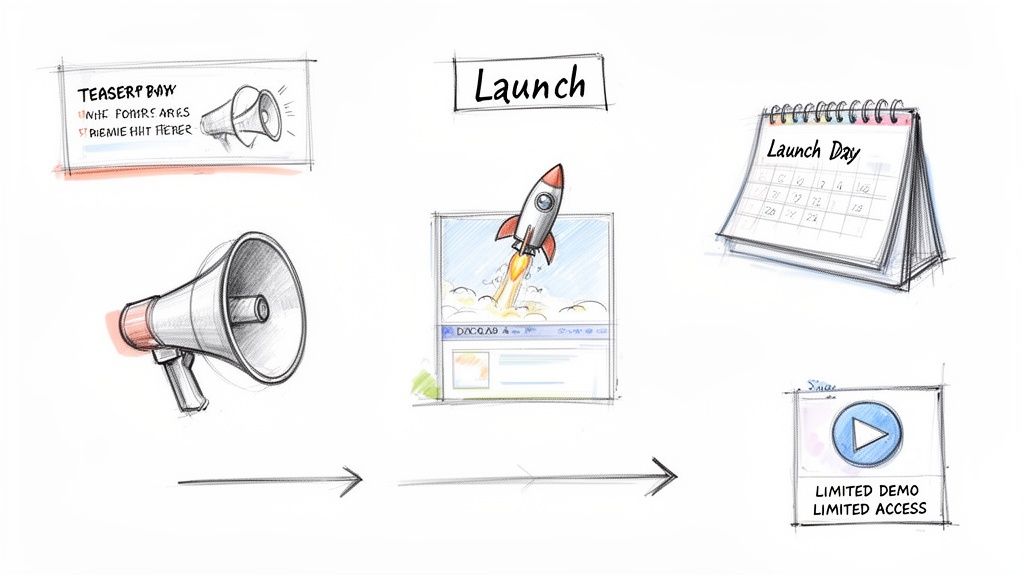
This approach is crucial for demonstrating ongoing product innovation and maintaining customer engagement. By framing updates around user benefits rather than just features, these campaigns reinforce the product's value and can re-engage dormant users, making it a powerful example of lifecycle B2B email marketing.
Strategic Analysis: Why It Works
This method succeeds because it transforms a simple update into a compelling event. It uses storytelling and segmentation to make the announcement feel personal and relevant, rather than like a generic broadcast.
Maximizes Awareness: A multi-email sequence (teaser, launch, follow-up) ensures the message cuts through the noise and reaches a larger portion of your audience.
Drives Immediate Adoption: By including clear CTAs, video demos, and direct links to the new feature, it removes friction and encourages users to try the new functionality right away.
Reinforces Customer Value: Announcing features that customers have requested ("You asked, we listened") shows that you are responsive to feedback, strengthening customer loyalty.
Prime examples include Notion's major release campaigns, which use detailed blog posts and video demos, and Slack's launches for features like Huddles, which are often segmented to specific user tiers for early access.
Actionable Takeaways & Template
To implement this, plan a 2-3 week campaign. Segment your audience by user type (e.g., power users, standard users) and tailor the messaging to their specific use cases.
Email 1: The Teaser (1 Week Before Launch)
Subject: Something big is coming to [Your Product]...
Body: Build anticipation with a vague but exciting message. Hint at the problem you're solving without revealing the full feature. Include a "stay tuned" message.
Email 2: The Official Launch
Subject: It's here: Introducing [Feature Name] in [Your Product]!
Body: Clearly announce the new feature and its primary benefit. Embed a short GIF or a link to a video walkthrough. The CTA should be a direct link to try the feature in-app.
Email 3: The Use Case Follow-Up (3-5 Days After Launch)
Subject: [User Name], see how [Feature Name] can help you [Achieve Specific Outcome]
Body: Segment this email based on user roles or industry. Showcase a specific use case relevant to that segment, explaining how the new feature solves a key pain point for them.
10. Personalized Account-Based Marketing (ABM) Campaign
A Personalized Account-Based Marketing (ABM) Campaign is a hyper-focused B2B strategy that treats individual high-value accounts as markets of one. Instead of casting a wide net, this email marketing example involves creating and deploying highly customized messaging for specific stakeholders within a handful of target companies, coordinating efforts across marketing and sales.
This approach is reserved for high-ACV (Annual Contract Value) deals where the investment in deep personalization is justified by the potential return. It's a strategic play designed to penetrate key accounts, build consensus among decision-makers, and accelerate the sales cycle for enterprise-level prospects.
Strategic Analysis: Why It Works
ABM email campaigns succeed because they are built on a foundation of relevance. By ditching generic messaging for content that speaks directly to a company's unique challenges, recent achievements, or industry position, you demonstrate a deep understanding of their business needs.
Maximizes Relevance: Each email is tailored using account-specific research, addressing multiple stakeholders with role-specific messaging (e.g., ROI for the CFO, integration for the CTO).
Increases Engagement: Hyper-personalization dramatically increases open and reply rates compared to broad-based campaigns, cutting through the noise in a crowded inbox.
Aligns Sales & Marketing: This coordinated approach ensures a consistent and seamless experience for the prospect, whether they are engaging with an email, a LinkedIn message, or a sales call.
Excellent examples include Salesforce's targeted campaigns for Fortune 500 companies or the playbooks executed by ABM platforms like Terminus and Demandbase for their own enterprise clients.
Actionable Takeaways & Template
Start by identifying 10-20 high-potential accounts. Research their recent press releases, executive changes, and technology stack. Use a tool with company enrichment capabilities to gather this data efficiently. Learn more about enriching your contact data on smashsend.com.
Email 1: The Insightful Opener (for a Director-level contact)
Subject: Idea for scaling [Specific Initiative] at [Company Name]
Body: Reference a recent company event (e.g., "I saw your recent funding announcement...") and connect it to a challenge your product solves. Keep it brief and focused on their world, not yours.
Email 2: The Value Prop for a Different Role (e.g., C-Level)
Subject: [Company Name] + [Your Company] = [Specific Business Outcome]
Body: Shift the focus to a higher-level business impact, like cost savings or revenue growth. Mention you've already shared technical details with their colleague, [Colleague's Name], demonstrating coordinated outreach.
Email 3: The Social Proof Angle
Subject: How [Similar Company in Their Industry] achieved [Result]
Body: Share a concise case study or testimonial from a similar company. This builds credibility and provides a tangible example of your product's value in their specific context.
B2B Email Marketing Examples: 10-Point Comparison
| Template | 🔄 Implementation complexity | ⚡ Resource requirements | ⭐📊 Expected outcomes | 💡 Ideal use cases | ⭐ Key advantages |
|---|---|---|---|---|---|
| Welcome Series with Product Tour | Medium — multi-email timing & behavioral triggers | Moderate — copy, videos/GIFs, segmentation, CRM automations | ⭐ High activation & adoption; typical CTR 30–40% | New users in PLG SaaS needing fast time-to-value | Rapid user activation; collects baseline behavior data |
| Account Expansion Upsell Campaign | Medium — usage tracking + personalized offers | Moderate‑High — product analytics, pricing logic, case studies | ⭐📊 Increased ARR/CLV (≈20–30% uplift) from existing customers | Accounts approaching seat/feature limits or high adopters | Targets warm audiences; high ROI on existing customers |
| Billing Recovery and Dunning Management | High — complex escalation logic & compliance | Moderate — payment integrations, retry automation, legal review | ⭐📊 Recovers ~35–50% of failed transactions; reduces involuntary churn | Subscription businesses with recurring payments | Recovers revenue automatically; high deliverability (transactional) |
| Win-Back Churn Recovery Campaign | Medium — segmentation by churn reason & timing | Moderate — offers, messaging, cohort analysis | ⭐📊 Reactivation rates 15–25% with targeted incentives | Lapsed/churned customers within reactivation window | Lower CAC vs new acquisition; leverages prior relationship |
| Feature Adoption and Engagement Nurture | Medium — event-driven triggers & personalization | Moderate — product analytics, educational content, videos | ⭐ Increased feature usage, improved retention and NPS | Active users underutilizing specific features | Boosts stickiness; reduces support load |
| Sales Enablement and Social Selling | Low–Medium — template library + rep adoption | Low — templates, training, lightweight personalization | ⭐ Faster sales cycles; more consistent outreach | SDR/AE teams doing email/LinkedIn outreach | Improves rep productivity; consistent messaging at scale |
| Case Study and Social Proof Sequences | Medium — curate case studies & permissions | Moderate — customer interviews, metrics, segmentation | ⭐📊 Builds trust; shortens sales cycle (≈20–30% lift) | Prospects needing proof by industry/use case | High credibility; repurposes customer content efficiently |
| Educational Content and Thought Leadership | Medium — editorial cadence & research | High — ongoing content production and expertise | ⭐ Long-term authority; nurtures 6–12+ month pipelines | Long B2B sales cycles and top-of-funnel nurturing | Builds brand authority; improves subscriber expectations |
| Product Launch and Feature Announcement | High — cross-functional timing & sequencing | Moderate‑High — assets, demos, segmented lists, PR coordination | ⭐📊 Spike in awareness & early adoption; PR momentum | Major feature/product releases to customers & prospects | Drives concentrated adoption; leverages launch urgency |
| Personalized Account-Based Marketing (ABM) Campaign | Very High — account research + multi-stakeholder flows | Very High — bespoke content, sales coordination, ad spend | ⭐📊 2–3x conversion lift for targeted high‑ACV accounts | Enterprise/strategic accounts (20–50 targets) | Maximizes ROI on high-value deals; strong sales alignment |
Turn These Examples Into Your Revenue Engine
We've journeyed through a comprehensive collection of B2B email marketing examples, moving far beyond generic templates to uncover the strategic machinery that drives real business results. From welcoming new users to winning back churned accounts, the common thread is clear: successful B2B email marketing is a science of precision, personalization, and perpetual optimization. It's not about sending more emails; it's about sending the right emails at the right time to the right people.
The examples we analyzed, from sophisticated ABM campaigns to elegant dunning sequences, demonstrate that every message is an opportunity. It's a chance to build trust, provide value, and guide your customer smoothly through their lifecycle with your product. Simply copying and pasting these examples won't unlock their power. The real magic happens when you adapt the underlying principles to your unique audience and business model.
Your Blueprint for B2B Email Success
As you move from inspiration to implementation, remember the core strategic pillars that unite the most effective campaigns. These are the non-negotiable elements that transform a simple email into a powerful revenue-generating asset.
Segmentation is Your Superpower: The days of one-size-fits-all B2B communication are over. Success hinges on your ability to segment your audience based on firmographics, behavior, product usage, and lifecycle stage. The personalized ABM and feature adoption examples prove that a well-defined segment is the foundation of a high-performing campaign.
Value Precedes the Ask: Every email, even a transactional one, must deliver value first. Whether it's an educational resource, a helpful product tip, or a compelling case study, you earn the right to ask for a renewal, upsell, or demo by consistently helping your customer achieve their goals.
Data-Driven Iteration is Key: The most successful email marketers are relentless testers. They don't just "set and forget." They constantly analyze open rates, click-through rates, and conversion metrics to refine subject lines, copy, and CTAs. Treat every send as an experiment that provides valuable data for the next one.
Actionable Next Steps: From Insight to Impact
Reading about powerful b2b email marketing examples is the first step; turning them into a predictable growth engine for your company is the next. Here's how to start making an immediate impact:
Conduct a Lifecycle Audit: Map out your current customer journey. Identify the gaps where communication is weak or non-existent. Where are you losing trial users? At what point do customers become ripe for an upsell? Use the examples in this article as a guide to plug those holes.
Prioritize Your First Campaign: Don't try to implement everything at once. Choose one high-impact area to focus on first. Is it your welcome series? Your churn recovery sequence? Pick the campaign that promises the biggest ROI and build from there.
Optimize Your Collection Points: Your email strategy is only as good as the leads you generate. The most brilliant welcome email is useless if your signup forms are turning potential customers away. To truly maximize the revenue potential of your B2B email campaigns, it's essential to optimize every touchpoint.
Ultimately, mastering B2B email marketing is about building a scalable, automated system for relationship-building. It's your direct line to your customers, empowering you to educate, engage, and expand your accounts with surgical precision. By applying the strategies and frameworks we've discussed, you can move beyond basic email blasts and build a sophisticated communication engine that drives sustainable, long-term growth.
Ready to implement these advanced B2B email strategies with a platform built for performance? SMASHSEND provides the powerful segmentation, automation, and deliverability tools you need to turn these examples into your reality. Start building smarter, higher-converting email campaigns today with SMASHSEND.