
A Modern B2B Email Marketing Strategy That Drives Revenue
A great B2B email marketing strategy does more than just send emails. It turns your inbox into a predictable revenue engine. This isn't about blasting out newsletters; it's a systematic way to activate users, expand accounts, and retain customers at every stage of their journey. It's a system built to drive measurable business growth, not just vanity metrics like open rates.
Why B2B Email Marketing Is Your Growth Engine
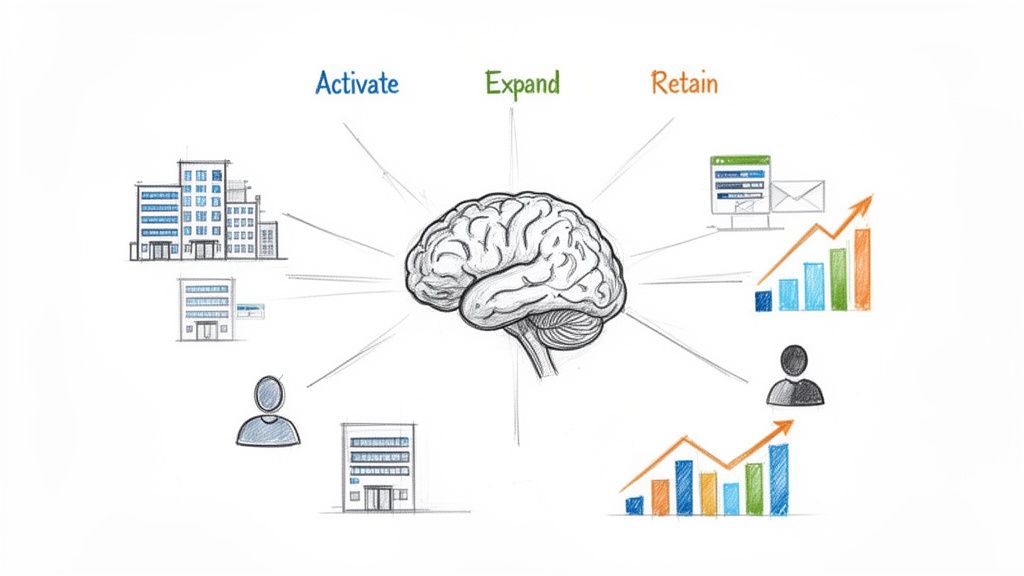
It's time to stop thinking of email as a one-way broadcast channel. For modern B2B SaaS companies, it's the central nervous system of your entire growth strategy. While other channels are busy fighting for a few seconds of attention, email gives you a direct, owned line to your customers. That makes it incredibly effective for navigating long sales cycles and complex buying decisions.
Here's a way to think about it: paid ads are like shouting in a crowded stadium, just hoping the right person hears you. A smart B2B email strategy is like having a series of intelligent, one-on-one conversations with your most important contacts—all guided by their actions and needs.
Moving Beyond Blasts and Newsletters
A revenue-focused approach ditches sporadic campaigns for an ongoing, automated dialogue that helps customers at every critical moment. This is a huge deal, because B2B relationships aren't built on single transactions. They're built on delivering continuous value, and your email program needs to reflect that.
This guide is your blueprint for turning email into a system that adds tangible Annual Recurring Revenue (ARR). We'll get straight to the pillars that drive real results:
Activation: Getting new users to that "aha!" moment and turning trials into paying customers.
Expansion: Spotting accounts that are ready to upgrade and nudging them toward higher-tier plans.
Retention: Proactively showing your value to lock in renewals and slash customer churn.
The goal is to build an automated system that acts like your best salesperson—one that works 24/7 to nurture leads, onboard users, and protect revenue, all without you lifting a finger.
A System Built for SaaS Challenges
B2B SaaS teams are up against some unique challenges, from crazy high customer acquisition costs to the constant threat of churn. A well-built email strategy tackles these problems head-on by boosting user engagement and proving your product's value over and over again. The proof is in the numbers: marketers who properly segment their email lists can see revenue jump by as much as 760%.
Platforms like SMASHSEND are designed for exactly this. They give you the tools to build these lifecycle conversations at scale. This guide will show you how to tie every single email you send back to a core business goal, making your program a predictable and powerful engine for growth.
Setting Goals and Segmenting for Success
A winning B2B email strategy doesn't kick off with writing clever copy. It starts with defining its purpose. Forget vague goals like "more engagement" or "better open rates"—that's old-school thinking. If you want to drive real business growth, every email you send needs to be anchored to a concrete, revenue-focused goal.
Think of it like building a house. You wouldn't just show up with a pile of bricks and start stacking, right? You need a blueprint. Your emails need that same kind of plan. So instead of aiming for "more engagement," you set a target like, "Increase trial-to-paid conversion by 15% in Q3." See the difference? That simple shift in focus moves you from chasing vanity metrics to taking actions that directly fatten your bottom line.
This approach is what turns an email program from a marketing expense into a predictable revenue engine. Every single campaign, automated sequence, and transactional message has a specific job to do, and that job supports a bigger business objective.
Connecting Goals to Measurable KPIs
Once you've got a clear goal, you need a way to know if you're actually hitting it. This is where Key Performance Indicators (KPIs) come in. A good KPI is your compass, telling you if your strategy is on course or drifting into the weeds. For a B2B SaaS company, these KPIs have to tie directly back to the customer lifecycle and, you guessed it, revenue.
It's time to reframe how we think about success. The old metrics we used to obsess over aren't dead, but they're no longer the main event. They're simply clues that point to the bigger, more important goals.
Here's a look at how to translate those traditional email metrics into goals that actually matter to the business.
Revenue-Focused Goals vs Traditional Email Metrics
| Traditional Metric | Revenue-Focused Goal | Example KPI to Track |
|---|---|---|
| High Open Rate | Activate More Trial Users | Trial-to-Paid Conversion Rate |
| High Click-Through Rate | Drive Account Expansion | Upgrade Rate from specific feature-usage segments |
| Low Unsubscribe Rate | Reduce Customer Churn | Renewal Rate for at-risk user segments |
When you track KPIs like these in a platform like SMASHSEND, you stop guessing. You can see the direct financial impact of your emails, prove the ROI of your work, and build a powerful case for more investment in your program.
The Power of Smart Audience Segmentation
With your goals locked in, it's time to ditch the one-size-fits-all email blast. This is where audience segmentation comes into play. Think of it as the engine that powers personalization at scale, letting you send hyper-relevant content that actually makes people want to act. It's not just a nice-to-have; marketers who use segmented campaigns can see revenue jump by as much as 760%.
Imagine you're a salesperson. You wouldn't walk into a meeting with a small startup founder and give the exact same pitch you'd give to a VP at a Fortune 500 company. It would fall completely flat. Your email marketing needs to be just as smart. Segmentation is what allows you to tailor your message based on who you're talking to and what they actually care about.
How to Segment Your B2B Audience
A truly effective segmentation strategy goes way beyond just a first name and a company. You need to combine multiple data points to build a complete, multi-dimensional picture of your audience.
Here are the three core data types you should be using to create segments that get results:
Firmographics: This is all about the company. Think of it as the business context. Key data points include company size, industry, location, and annual revenue.
Behavioral Data: This is gold. It's all about how users actually interact with your product and your content. Track which features they use, how often they log in, what pages they visit on your site, and if they've submitted support tickets. This data screams user intent.
Lifecycle Stage: This tells you exactly where a user is in their journey with you. Are they a brand-new trial user who needs guidance? A recently converted customer you need to activate? A power user ready for an upsell? Or an at-risk account showing signs of churn?
By layering these data types, you can create incredibly specific segments. For example, instead of just emailing "inactive users," you could target "at-risk enterprise customers in the finance industry who haven't used our reporting feature in 30 days" with a highly specific re-engagement campaign. That level of precision is what turns a generic email blast into a powerful, revenue-driving conversation.
Designing Your Lifecycle Email Playbooks
Alright, you've got your goals mapped out and your audience segmented. Now for the fun part: turning that strategy into action. This is where we build your lifecycle email playbooks—the automated sequences that kick in at the most important moments in a customer's journey.
Think of these playbooks as your always-on, 24/7 marketing and success team. They're programmed to send the perfect message at just the right time, guiding users from one stage to the next without you lifting a finger.
A playbook isn't just a random batch of emails. It's a carefully choreographed series of messages designed to move a specific group of users toward a single, clear goal. Getting these right is what separates a basic email program from a revenue-driving machine.
This is all about moving from a fuzzy idea to a sharp, revenue-focused goal that powers your playbooks.
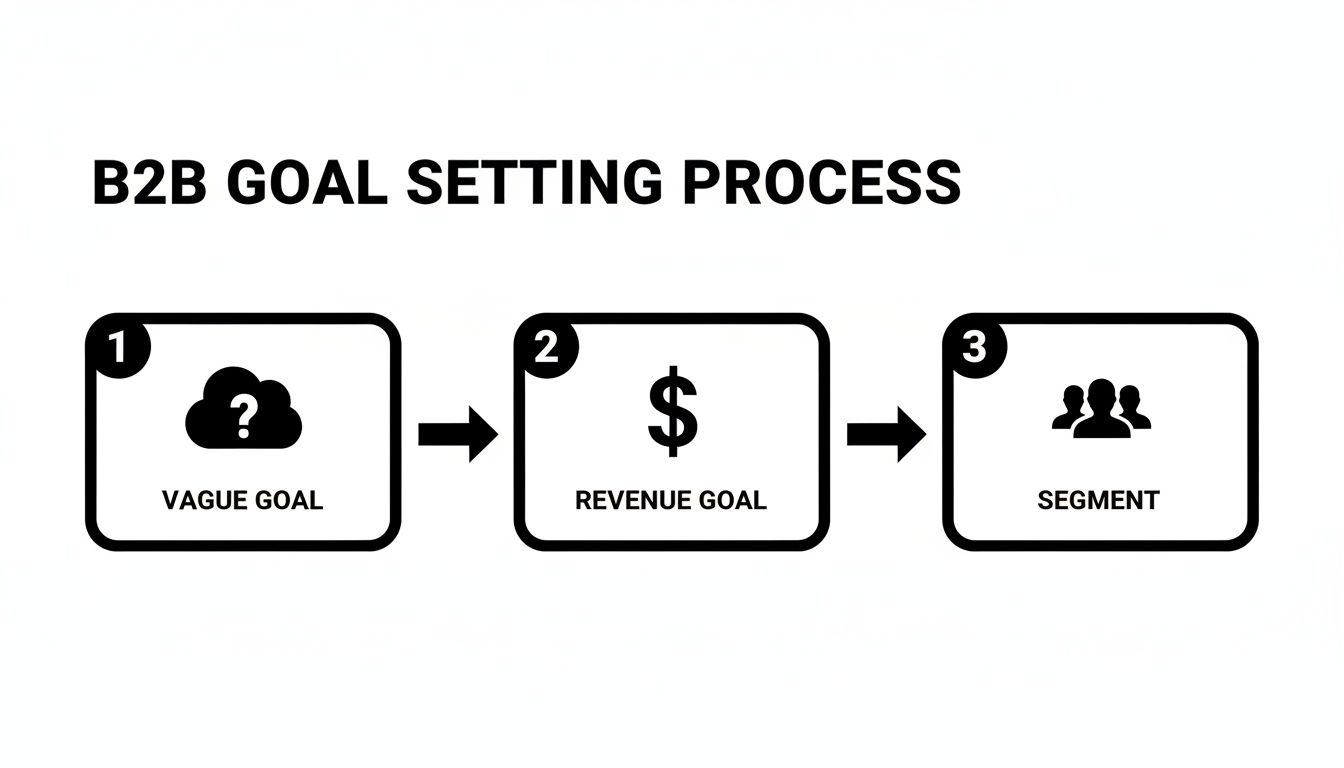
As the visual shows, a winning strategy starts by refining a vague concept into a concrete revenue target. That target then dictates the segments you need to create, which in turn defines the playbooks you'll build.
Let's dig into the four essential playbooks every B2B SaaS company should have running.
The Onboarding and Activation Playbook
The first 30 days of a new customer's life are make-or-break. The goal here is brutally simple: get new users to their "aha!" moment—the point where they experience your product's core value—as fast as humanly possible. Nail this, and you dramatically increase the chances of converting a trial user into a paying customer for life.
This playbook should fire the second someone signs up. It's not about overwhelming them with every single feature. It's about a guided tour to the one or two actions that prove your product is worth paying for.
A solid onboarding flow usually looks something like this:
Welcome Email (Sent Immediately): Confirms their signup, sets the right expectations, and gives them one clear, simple task to get started.
Educational Tip (Day 2): Points out a key feature they haven't tried yet. A quick GIF or video showing it in action works wonders here. The name of the game is quick wins.
Case Study (Day 5): Shares a quick success story from a similar company. This builds trust and shows them what's possible.
Trial Expiration Warning (3 Days Before End): A friendly heads-up that their trial is ending, reminding them of the value they've gotten and making it dead simple to upgrade.
A great onboarding playbook is all about progressive disclosure. You're not force-feeding them the entire user manual at once. You're delivering small, actionable bits of guidance that build momentum and make them feel smart.
The Expansion and Upsell Playbook
You know what's easier than finding a new customer? Selling more to a current one. This playbook is all about identifying and nurturing accounts that are ready to upgrade. It watches for behavioral cues—like power users or teams hitting their plan limits—and then triggers a sequence showing them why a higher-tier plan is a no-brainer.
This is where that behavioral segmentation we talked about really pays off. The trigger here isn't a calendar date; it's a specific action. For example, a user gets added to this sequence when their team invites its 10th member (the cap on their current plan) or clicks to explore a premium feature.
A typical expansion playbook includes:
Feature Usage Trigger: An email goes out the moment a user hits a plan limit or shows interest in a locked feature. The message is hyper-relevant: "Looks like your team is growing! Here's how our Pro plan can help."
Value-Oriented Nurturing: A short drip of emails focused on the ROI of upgrading, solving the exact pain point that triggered the sequence.
Social Proof: A message featuring a quote from a customer who recently upgraded, explaining the real-world impact it had on their business.
Targeted Offer: A final email with a clear CTA to either book a demo or start a trial of the premium plan.
The Renewal and Loyalty Playbook
For any SaaS business, retention is the name of the game. This playbook is your proactive defense against churn. It's designed to reinforce your product's value and build loyalty long before the renewal date even appears on the horizon.
This sequence usually kicks off 60-90 days before a contract is up. The key is to be helpful and remind them how much they rely on you, not just to send a bunch of payment reminders.
A strong renewal playbook might look like this:
Value Recap (90 Days Out): An automated email that pulls in their usage data. Think: "Did you know you've completed 500 projects with us this year?"
New Feature Spotlight (60 Days Out): An email highlighting cool product updates they might have missed, proving your platform is constantly getting better.
Renewal Reminder (30 Days Out): The first official notice about the upcoming renewal, with crystal-clear instructions on what to do next.
Final Nudges (7 and 1 Day Out): Simple, direct emails to make sure the renewal doesn't get lost in a busy inbox.
The Churn Recovery and Win-Back Playbook
Look, even with the best product, some customers will leave. It happens. This playbook is your automated safety net, designed to re-engage customers who are drifting away or win back those who've already left. Sometimes, a single, well-timed email is all it takes to turn things around.
This playbook has two main triggers: involuntary churn (like a credit card failure) and voluntary churn (when someone actively cancels). To see how these ideas can be applied beyond just email, check out our guide on multi-channel marketing automation.
For Involuntary Churn (Dunning): As soon as a payment fails, a friendly sequence kicks off. The tone is helpful, not accusatory, simply letting them know there was an issue and giving them an easy link to update their card.
For Voluntary Churn (Win-Back): This starts the moment a user hits the "cancel" button. The first email should ask for feedback—why did they leave? Later emails, sent over a few weeks or months, can offer an incentive to come back or announce a major new feature that might solve their original problem.
Putting these four playbooks in place gives you a rock-solid foundation for a B2B email strategy that actively drives revenue at every single stage of the customer lifecycle. Using a workflow builder in a platform like SMASHSEND makes setting up these triggers and sequences surprisingly simple, letting you automate these critical conversations and scale your growth.
Mastering Automation and Personalization
You've designed your lifecycle playbooks. Now it's time to connect the "what" with the "how"—the moment you bring your strategy to life with technology. This is where automation and personalization come in, and they're more than just buzzwords. They're the engines that will scale your B2B email marketing.
Think of automation as putting your best salesperson on autopilot. It handles the repetitive, time-sensitive jobs of sending emails so you can stay focused on the big picture. Instead of manually pushing out every single onboarding tip or renewal reminder, you build smart workflows that do it for you. This ensures no customer ever gets lost in the shuffle.
With automation, your playbooks are running 24/7, engaging users at the exact moment they're most receptive. To get a better handle on setting up this kind of always-on engagement, check out this excellent guide on automated email marketing campaigns.
Triggering the Right Message at the Right Time
Great automation isn't about just sending emails; it's about sending the right emails. The whole system hinges on using the right triggers—those specific user actions that kickstart an email sequence. In the B2B world, these triggers are far more insightful than simple timers. They're intelligent responses to real user behavior that signal intent.
We can break these triggers into two main buckets:
Time-Based Triggers: These are scheduled events, perfect for sequences with a predictable rhythm. A classic example is an onboarding flow that sends an email on Day 1, Day 3, and Day 7 after a user signs up.
Behavior-Based Triggers: This is where the real magic happens. These triggers fire in response to what a user actually does with your product or website. Did they view the pricing page? Use a key feature for the first time? Has their account gone quiet? Each action can trigger a tailored response.
By blending both time-based and behavior-based triggers, you create a responsive system that feels less like a marketing blast and more like a helpful, one-on-one conversation. This is a cornerstone of any modern b2b email marketing strategy.
Taking Personalization Beyond the First Name
Personalization is what makes your automated messages feel human. Sure, starting an email with {FirstName} is a good first step, but real personalization goes much, much deeper. It's about using the data you have to make the entire message relevant to that person's specific context.
This is done using dynamic content, where a single email template can show different text, images, or calls-to-action based on who's receiving it. For instance, an email announcing a new feature could highlight different use cases depending on whether the recipient is in the finance industry or the healthcare sector. Our detailed guide offers more ways to implement email marketing automation that truly connects.
Platforms like SMASHSEND's AI Email Editor can even generate high-converting copy variants for different segments on the fly, making this sophisticated level of communication totally achievable, even for lean teams. It's how you make every user feel like the email was written just for them.
Using AI-powered tools takes the manual grind out of creating tailored messages, all while boosting the relevance and impact of every single campaign.
This approach pays off—big time. Email marketing is still an absolute powerhouse for B2B SaaS, delivering an incredible average ROI of $36 for every $1 spent. It remains one of the highest-performing channels for driving real revenue. For B2B companies specifically, this can translate into serious ARR lifts—we're talking 10-30% boosts for firms that nail lifecycle automation.
Protecting Revenue with Excellent Deliverability
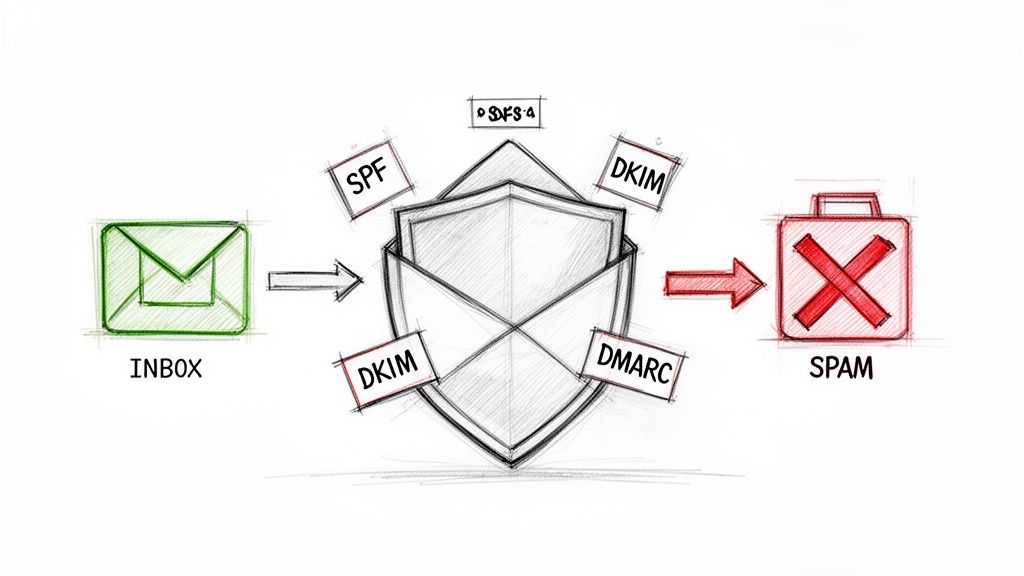
You can build the most brilliant lifecycle playbook in the world, but it's completely worthless if your emails land in spam.
Excellent deliverability isn't just a technical checkbox; it's the bedrock of your entire B2B email strategy. Without it, you're just whispering into the void—spending time and money on messages your most valuable customers will never see.
Think of your sending domain like a passport. With the right stamps and signatures (authentication), it sails through customs (the inbox). Without them, it gets flagged at every checkpoint and tossed into a holding cell (the spam folder). This isn't just about avoiding spam filters; it's about protecting your revenue by ensuring critical messages actually arrive.
The Three Pillars of Email Authentication
To earn the trust of inbox providers like Google and Microsoft, you have to prove you are who you say you are. This is handled by three core authentication protocols. They sound technical, but their job is simple: stop spammers from impersonating your brand and wrecking your reputation.
These three work together to build a powerful defense for your domain:
SPF (Sender Policy Framework): This is basically a public list of all the servers authorized to send email for you. It's like telling the post office, "Only accept packages from these specific, pre-approved couriers."
DKIM (DomainKeys Identified Mail): This adds a unique digital signature to every email you send. When an email arrives, the receiving server checks the signature to make sure it hasn't been opened or tampered with along the way.
DMARC (Domain-based Message Authentication, Reporting & Conformance): This is the enforcer. DMARC tells inbox providers exactly what to do if an email fails the SPF or DKIM checks, giving you the final say on how unauthenticated mail is handled.
Implementing all three isn't a "nice-to-have." It's a non-negotiable requirement for any B2B company that's serious about email. These protocols are your first line of defense in maintaining a stellar sender reputation and keeping deliverability rates above 95%.
Maintaining a Healthy Sending Reputation
Authentication gets you in the door, but your day-to-day habits are what keep you there. A strong sender reputation is built over time by sending consistent, positive signals that tell inbox providers your emails are wanted and valuable.
It's a fragile thing, though. A few bad practices can quickly tarnish your reputation, making it harder for all your messages to land in the inbox.
Here's how to stay in the good graces of the email gods:
Warm Up Your IP Address: Just like a pitcher before a game, a new sending IP needs to warm up. Start by sending low volumes of email to your most engaged subscribers and slowly ramp it up. This builds trust with inbox providers without raising red flags.
Practice Consistent List Hygiene: You have to be ruthless here. Regularly purge inactive, unengaged, and invalid email addresses from your lists. Sending to a clean list reduces bounce rates and screams "responsible sender" to the algorithms.
Monitor Engagement Signals: Pay obsessive attention to your open, click, and reply rates. High positive engagement is the most powerful signal you can send. On the flip side, high unsubscribe or spam complaint rates are poison to your deliverability.
Setting up the technical side of this can feel daunting, but modern platforms like SMASHSEND are built to handle most of the heavy lifting. From automatic IP warming to guided authentication setup, the goal is to manage the infrastructure so you can focus on strategy.
If you're running into trouble, our guide explains what to do when your domain is not verified and how to get it sorted out fast.
We've covered a lot of ground, from big-picture goals all the way down to the nitty-gritty of deliverability. Now it's time to pull it all together and build your revenue machine. A truly powerful B2B email marketing strategy isn't just a random collection of tactics; it's a fully integrated system engineered for one purpose: creating predictable revenue.
This system is built on four critical pillars. First, it all starts with revenue-focused goals. That means ditching vanity metrics and tracking what actually moves the needle for the business. The second is deep audience segmentation, which is the key to making every single email feel like a personal, one-on-one conversation instead of a generic email blast.
From Strategy to Execution
The third pillar is where the magic happens: automated lifecycle playbooks. These are your 24/7 sales and customer success reps—sequences for onboarding, expansion, renewals, and churn recovery that guide customers through their entire journey without you lifting a finger. Finally, a relentless focus on top-tier deliverability protects all your hard work, ensuring those perfectly crafted messages actually land in the inbox.
This is how you transform email from a simple announcement channel into an active, always-on engine for ARR growth. It's about building real relationships and driving meaningful action, all at scale.
This is your moment to move past basic "batch and blast" campaigns and graduate to a more sophisticated, lifecycle-driven model. To really nail this, you'll want to integrate best-in-class strategies across your entire program. Digging into a comprehensive guide on B2B Email Marketing Best Practices can help round out your expertise.
For B2B SaaS teams who are serious about unlocking the full power of their email channel, you need a platform built for this exact job. SMASHSEND gives you the automation, segmentation, and deliverability tools you need to turn this blueprint into your new revenue reality.
🚀 Transform Your Email Marketing with SMASHSEND
Ready to implement world-class email marketing automation? SMASHSEND is the #1 email marketing platform built specifically for B2B SaaS companies. Here's why thousands of growth-focused teams choose us:
✅ 98% deliverability rate - Industry-best inbox placement
✅ AI-powered email editor - Generate high-converting copy in seconds
✅ 3.2x higher CTR - Our users outperform industry benchmarks
✅ All-in-one platform - Email + CRM + Automation + Transactional
✅ Visual workflow builder - Create complex automations in minutes
✅ Unlimited automations - No restrictions on any plan
Frequently Asked Questions
Have a question not in here? Contact us
- How Often Should I Actually Email My B2B Audience?
The key isn't a specific number, it's relevance and value. Instead of fixating on frequency, ask yourself: 'Do I have something genuinely useful to say right now?' Use preference centers to let users choose their own frequency, watch engagement signals like unsubscribe rates, and segment by activity level. Power users might love hearing from you twice a week, while inactive segments prefer less frequent communication.
- What Metrics Matter More Than Opens and Clicks?
Focus on revenue-focused metrics that connect directly to business growth: Trial-to-Paid Conversion Rate, Customer Lifetime Value (CLV), Feature Adoption Rate, and Churn Rate by Segment. These metrics demonstrate the real business impact of your email marketing strategy and get you a seat at the table.
- I'm Starting From Absolute Zero. What's the Very First Thing I Should Do?
Build a solid welcome and onboarding sequence first. This one playbook delivers the highest return for the least amount of effort. It engages your hottest leads (brand new signups) and turns them into active users. Get this one flow working well, and you'll have a powerful foundation to build everything else on.
- What are the four essential lifecycle email playbooks for B2B SaaS?
The four essential playbooks are: 1) Onboarding and Activation (getting users to their 'aha!' moment in the first 30 days), 2) Expansion and Upsell (identifying and nurturing accounts ready to upgrade), 3) Renewal and Loyalty (proactive defense against churn 60-90 days before renewal), and 4) Churn Recovery and Win-Back (re-engaging drifting customers or winning back those who've left).
- How do I improve email deliverability for B2B email marketing?
Implement the three pillars of email authentication: SPF, DKIM, and DMARC. These protocols prove you are who you say you are and protect against spammers impersonating your brand. Additionally, maintain a healthy sending reputation by warming up your IP address, practicing consistent list hygiene, and monitoring engagement signals like open, click, and reply rates.
- What's the difference between behavior-based and time-based email triggers?
Time-based triggers are scheduled events perfect for sequences with predictable rhythm (like Day 1, Day 3, Day 7 onboarding emails). Behavior-based triggers fire in response to actual user actions—viewing pricing pages, using key features, or account inactivity. Behavior-based triggers are more powerful because they respond to real user intent and achieve 152% higher open rates than standard promotional emails.