
Mastering Conversion Rate in Sales for B2B SaaS Growth
At its core, conversion rate in sales is about one simple thing: turning potential customers into actual customers. It's the percentage of people who take the specific action you want them to, moving from a curious prospect to someone actively engaged in your sales process.
Think of it as the ultimate report card for your entire sales and marketing effort. It tells you, in no uncertain terms, how effectively your team is guiding people from "just looking" to a confident "yes."
What Is the Conversion Rate in Sales for SaaS?
Picture your sales process as a series of handoffs, like a relay race. Marketing generates a lead and passes the baton to a sales development rep. That rep qualifies the lead and passes it to an account executive for a demo. Finally, the AE carries it across the finish line as a new paying customer.
The conversion rate isn't just a single number; it's a measure of success at each of those handoffs. This metric is the pulse of your revenue engine. A high conversion rate means your marketing message is hitting the mark, your sales process is slick, and your product is delivering on its promise. A low rate? That's a red flag signaling a disconnect somewhere that needs fixing, fast.
The most straightforward way to calculate it uses a simple formula:
(Total Number of Sales / Total Number of Leads) x 100 = Sales Conversion Rate %
So, if you generated 500 leads last quarter and closed 25 new deals, your overall sales conversion rate is 5%. But the real magic happens when you apply this formula to each specific stage of your funnel. That's how you spot exactly where prospects are dropping off and where your team can make the biggest impact.
Why This Metric Is Critical for Growth
Tracking your conversion rate isn't just about hitting quota. It's a powerful diagnostic tool that reveals the truth about your business performance.
It Pinpoints Funnel Weaknesses: A low conversion rate shines a spotlight on the exact "leaks" in your process. Are the leads from marketing low-quality? Is the demo falling flat? The numbers don't lie.
It Makes Your Revenue Predictable: When you know your conversion rates, you can forecast future revenue with far greater accuracy. This helps you plan hiring, allocate resources, and set growth targets you can actually hit.
It Validates Your Strategy: Think of it as direct feedback from the market. Is your pricing right? Is your messaging resonating? A rising conversion rate is a clear sign you're on the right track.
It Boosts Efficiency: Instead of blindly chasing more leads, improving your conversion rate helps you get more value from the leads you already have. This directly increases the ROI of every dollar you spend on marketing.
Ultimately, mastering your sales conversion rates is how you build a scalable, predictable revenue machine. It turns fuzzy data into clear, actionable insights—a non-negotiable step for any B2B SaaS company serious about growth. To dig deeper, check out our insights on B2B SaaS marketing strategies that fuel these conversions.
Breaking Down Key Sales Conversion Metrics
Your overall sales conversion rate is a decent starting point, but it's a vanity metric. It gives you a bird's-eye view when what you really need is to get on the ground and inspect the machinery. A single, blended rate can easily hide the exact spot where your revenue engine is breaking down.
To get a real diagnosis, you have to measure the conversion rate in sales at each critical handoff in the customer journey.
Think of your sales process less like a single funnel and more like a series of gates. A prospect can't get to the next stage until they pass through the current one. If one gate is rusted shut or too narrow, it doesn't matter how wide open the others are—you've got a bottleneck. Our job is to find and fix those bottlenecks.
This diagram offers a simple but powerful visual of how a large pool of initial leads gets whittled down at each stage to become paying customers.
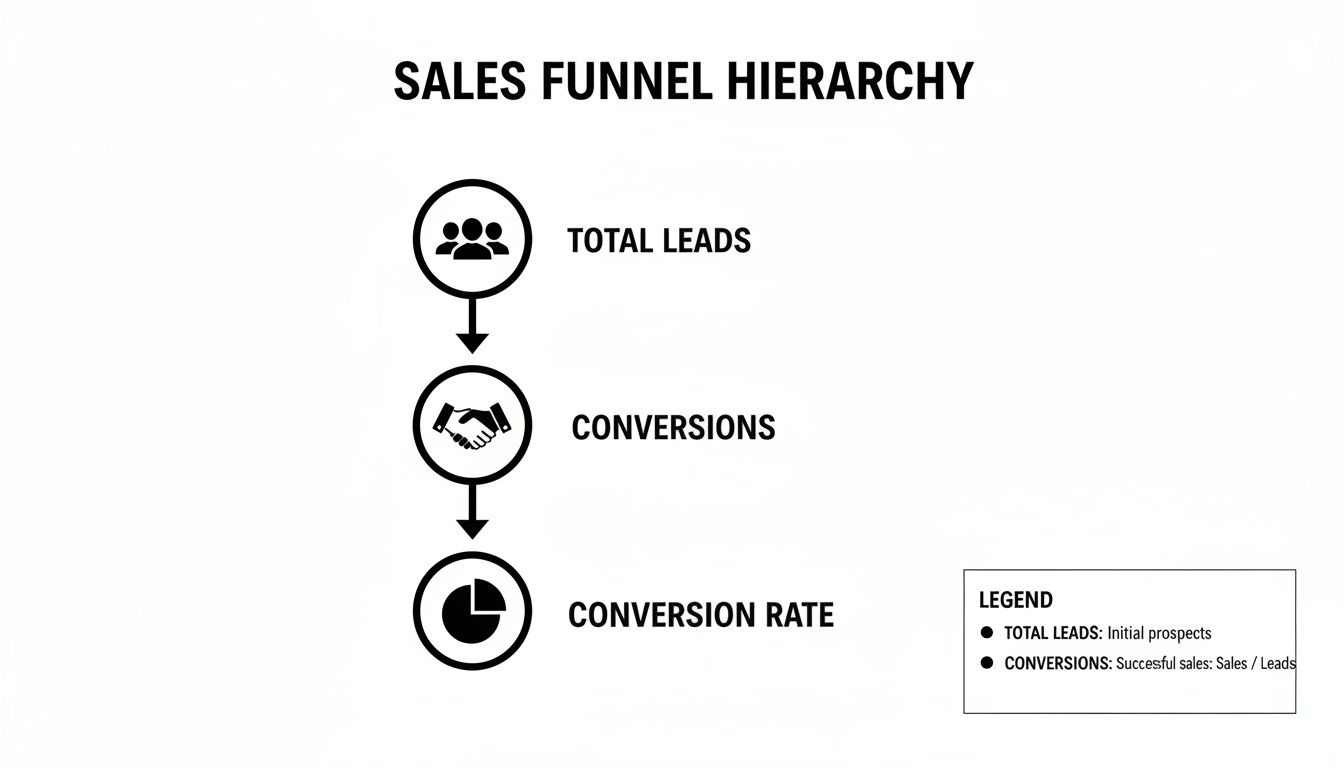
It's a great reminder that to lift the final number, you have to optimize the handoffs at every single step that comes before it.
To help you get started, here's a quick look at the most important conversion metrics you should be tracking, what they mean, and why they matter.
Key B2B SaaS Conversion Metrics Across the Funnel
| Conversion Metric | Formula | What It Measures | Key Business Question Answered |
|---|---|---|---|
| Lead → MQL Rate | (Total MQLs / Total Leads) x 100 | The quality and relevance of your top-of-funnel lead sources. | Are our marketing campaigns attracting the right audience? |
| MQL → SQL Rate | (Total SQLs / Total MQLs) x 100 | The alignment between your marketing and sales teams. | Do marketing and sales agree on what a "good lead" looks like? |
| SQL → Opportunity Rate | (Total Opportunities / Total SQLs) x 100 | The effectiveness of your SDRs in creating real pipeline. | Is our initial sales outreach effectively uncovering pain points and booking demos? |
| Trial → Paid Rate | (New Paid Customers / New Free Trials) x 100 | Your product's ability to demonstrate value quickly. | Does our product's "aha!" moment happen fast enough to convince users to pay? |
| Renewal Rate | (Renewing Customers / Customers Up for Renewal) x 100 | Overall customer satisfaction and long-term product stickiness. | Are we delivering enough ongoing value to keep our customers? |
| Expansion Rate | (Expansion MRR / Beginning of Period MRR) x 100 | Your ability to grow revenue from your existing customer base. | Are our customers' needs growing, and is our product growing with them? |
Each of these metrics tells a different part of your growth story. A dip in one is an early warning signal that allows you to intervene before it impacts your bottom line.
From Lead to Marketing Qualified Lead (MQL)
This is the very top of your funnel, the first real handoff. The Lead-to-MQL conversion rate tells you what percentage of your raw inbound interest (think newsletter signups, ebook downloads) is good enough to even warrant a marketer's time.
The criteria here might be things like company size, industry, or specific high-intent actions on your site. If this rate is high, your top-of-funnel content is hitting the mark. If it's low, you're likely casting too wide a net and attracting people who will never buy your product.
From MQL to Sales Qualified Lead (SQL)
The MQL-to-SQL conversion rate is where the rubber meets the road between marketing and sales. It's the ultimate test of alignment. This metric tracks how many leads marketing deems "qualified" are actually accepted by the sales team as being ready for a one-on-one conversation.
This is a classic friction point. If the MQL-to-SQL rate is in the gutter, it's almost always one of two things:
Marketing is off-target: They're passing over leads that sales considers junk.
Sales isn't following up: The team is letting perfectly good leads go stale.
A solid MQL-to-SQL rate is the sign of a healthy partnership where both teams are working from the same playbook. If your rate drops below 13%, it's a huge red flag that you've got a process or definition problem that needs to be fixed immediately.
From SQL to Opportunity
Once sales accepts a lead, the clock starts ticking. The SQL-to-Opportunity conversion rate measures how many of those initial conversations blossom into a legitimate, formal deal in your pipeline, complete with an estimated value and close date.
This metric is a direct reflection of your sales development reps' (SDRs) skills. A low rate here suggests they might be struggling to articulate the value proposition, uncover real business pain, or secure that all-important next step, like a product demo.
From Trial to Paid Customer
For any product-led B2B SaaS company, the Trial-to-Paid conversion rate is the moment of truth. It's simple: what percentage of people who sign up for your free trial or freemium plan actually pull out a credit card and become a paying customer?
This number is a direct proxy for your product's value and the quality of your user onboarding experience. A high rate is proof that users are quickly finding that "aha!" moment. A low rate is a blaring alarm that something is wrong—the product might be confusing, the onboarding might be broken, or the price might be scaring people away.
Beyond the First Sale: Expansion and Renewal
The game doesn't end once you've closed the deal. For a subscription business, the real money is made over the long haul. That's why two of the most important conversion metrics happen after the initial sale.
Expansion Rate: This tracks conversions from existing customers to bigger things—upgrading to a higher plan, buying an add-on, or adding more seats. It's how you achieve negative churn and it proves your product can scale with your customers' success.
Renewal Rate: This is the big one. It's the percentage of customers who stick around and renew their subscription when the time comes. This is your ultimate report card on customer satisfaction and product-market fit.
By breaking down the journey and tracking each of these "micro-conversions," you go from staring at a blurry, out-of-focus picture to having a high-definition, actionable map of your entire revenue engine.
How to Benchmark Your B2B SaaS Conversion Rates
Knowing your conversion rates is one thing. Knowing if they're good is another game entirely. Benchmarking is supposed to give you that context, but honestly, it's a double-edged sword. While industry numbers can be a useful gut-check, obsessing over them can send you down a rabbit hole.
The hard truth? There's no magic "good" conversion rate in sales for B2B SaaS. Your ideal numbers are a direct reflection of your business model, who you sell to, and what you charge. A self-serve, product-led company selling a $50/month tool is playing a completely different sport than an enterprise business with a six-figure average deal size.
Instead of chasing someone else's numbers, the real goal of benchmarking is to set a baseline for internal improvement. Your most important competitor is who you were last quarter.
Differentiating Between Sales Models
Your go-to-market strategy is the single biggest variable that dictates what "good" looks like for you. Figuring out where you fit is the first step to setting expectations that are actually realistic.
Self-Serve/Product-Led: Companies with a low-touch model often see higher numbers at the top of the funnel (think website visitor to free trial), but can struggle with the trial-to-paid conversion. Success here lives and dies by a frictionless user experience and a killer onboarding process. If this is you, our guide on designing a high-converting onboarding email sequence might be exactly what you need.
Sales-Led/Enterprise: High-touch sales models work differently. They typically have lower volume at the top, but the conversion rates at later stages are much, much higher. An MQL-to-SQL conversion rate of 20% or more isn't unheard of, simply because every single lead is being carefully vetted and qualified by a human.
Understanding Key Channel Benchmarks
It's not just who converts, but where they came from. Different channels attract people with wildly different levels of intent, and that directly impacts your conversion rates.
For B2B SaaS companies, some channels are just built different. For instance, did you know that email marketing consistently punches above its weight, with an average conversion rate of around 2.6%? When you compare that to organic search (2.7%) or paid search (3.2%), email's cost-effectiveness and scalability make it a true powerhouse. You can read the full research about industry benchmarks for a deeper dive into the 2025 numbers.
This just drives home a critical point: world-class email automation and deliverability aren't just "marketing things"—they are core drivers of your entire sales engine.
The primary purpose of benchmarking isn't to perfectly match an external number. It's to identify the biggest gaps in your own funnel and focus your energy on the areas with the highest potential for growth.
Setting Realistic Internal Goals
Once you have the context of your model and channels, you can stop looking over your shoulder and start focusing on your own game. The first step is to map out your current funnel performance, from the very first lead to the final close.
Find the leak. Where's the biggest drop-off? Is it MQL-to-SQL? Or maybe the dreaded trial-to-paid stage? That's your starting line.
From there, set a tangible, realistic goal. Don't aim to double your numbers overnight. Aim to increase your trial-to-paid conversion from 15% to 18% over the next quarter. This kind of focused, iterative improvement is what builds sustainable growth, and it's far more effective than chasing a generic number you saw in a report.
Common Mistakes That Hurt Sales Conversion Rates
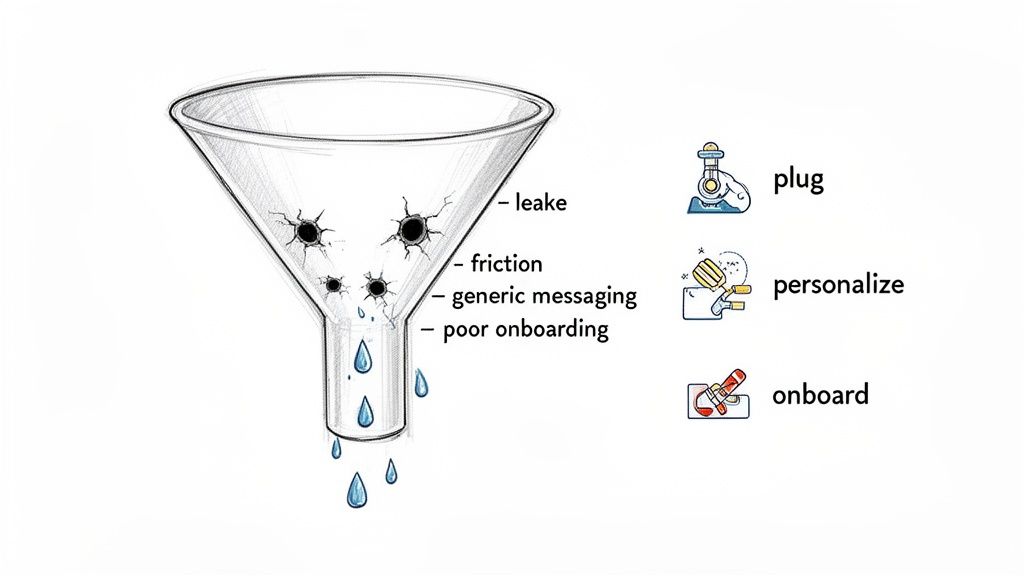
Even the slickest sales funnels can spring a leak. I've found that the biggest jumps in conversion rates rarely come from some groundbreaking new strategy. More often, they come from finding and plugging the quiet, hidden holes that are slowly draining your revenue.
Too many teams fall into the trap of focusing only on top-of-funnel, assuming that just cramming more leads in will solve their problems. That's like trying to fill a leaky bucket by turning the hose on full blast. The smarter move is to fix the bucket first, making sure every lead you already have gets the best possible shot at converting.
Let's walk through some of the most common—and costly—mistakes I see B2B SaaS companies make, and more importantly, how to fix them.
A Disjointed Customer Journey
One of the fastest ways to kill a deal is to make your prospect feel like they're starting from scratch with every person they talk to. A potential customer should never have to re-explain their business needs to a marketer, then to an SDR, and then again to an Account Executive.
This kind of disjointed experience screams "we're disorganized" and creates a ton of frustration. When someone has to repeat themselves, their confidence in your ability to solve their actual problems takes a nosedive.
Key Takeaway: A seamless customer journey isn't a nice-to-have; it's fundamental to building trust. The handoffs between marketing, sales, and product need to be completely invisible to the customer.
The fix? Make your CRM the undisputed source of truth. Every single interaction—from a downloaded whitepaper to a quick support chat—should be logged and instantly visible to anyone on your team. This creates a continuous, context-rich conversation that makes the prospect feel like you actually get them.
Generic, One-Size-Fits-All Messaging
Modern buyers have zero patience for irrelevant content. A generic email blast or a canned sales pitch that doesn't speak directly to their industry, their specific role, or their unique pain points is a one-way ticket to the trash folder.
Sending the exact same onboarding sequence to a startup founder and an enterprise manager is a classic example of this mistake. The founder is probably worried about speed and cost, while the manager is thinking about security, team features, and how it will scale. Using the same message for both means you're guaranteed to miss the mark with at least one of them, if not both.
This lack of personalization is a huge conversion killer, especially further down the funnel where people expect a solution that feels made for them.
Unnecessary Friction in the Process
Every extra field on a signup form, every needless click in the checkout flow, and every hour you delay a follow-up is friction. And friction is the mortal enemy of conversion.
Think about these common friction points:
Overly Complex Forms: Do you really need their phone number, company size, and annual revenue just for a free trial? Probably not. Study after study shows that cutting form fields directly boosts completion rates.
Slow Lead Response: The odds of qualifying a lead plummet after just five minutes. When you're slow to follow up, you're telling a hot lead that their business just isn't a priority for you.
Confusing Onboarding: If a user signs up for a trial and can't figure out where to start, they won't blame themselves—they'll blame your product. A clunky "first-run" experience is one of the biggest reasons people abandon trials.
Your mission should be to make it ridiculously easy for a qualified prospect to take the next step. Go through every single stage of your funnel and relentlessly ask, "Can we make this simpler, faster, or clearer?" Every bit of friction you eliminate is a direct lift to your sales conversion rate.
Actionable Strategies to Boost Your Conversion Rates
Alright, you've done the diagnostic work and found the leaks in your funnel. Now for the fun part: plugging them. Moving the needle on your conversion rate in sales isn't about some massive, ground-up rebuild. It's usually about making a series of smart, targeted tweaks that make the journey feel smoother, more personal, and way more compelling for your prospects.
This is where we get systematic. We're building a process to turn more leads into customers and, just as importantly, more customers into raving fans. Let's dive into some high-impact tactics you can start using right away to see a real lift in your numbers.
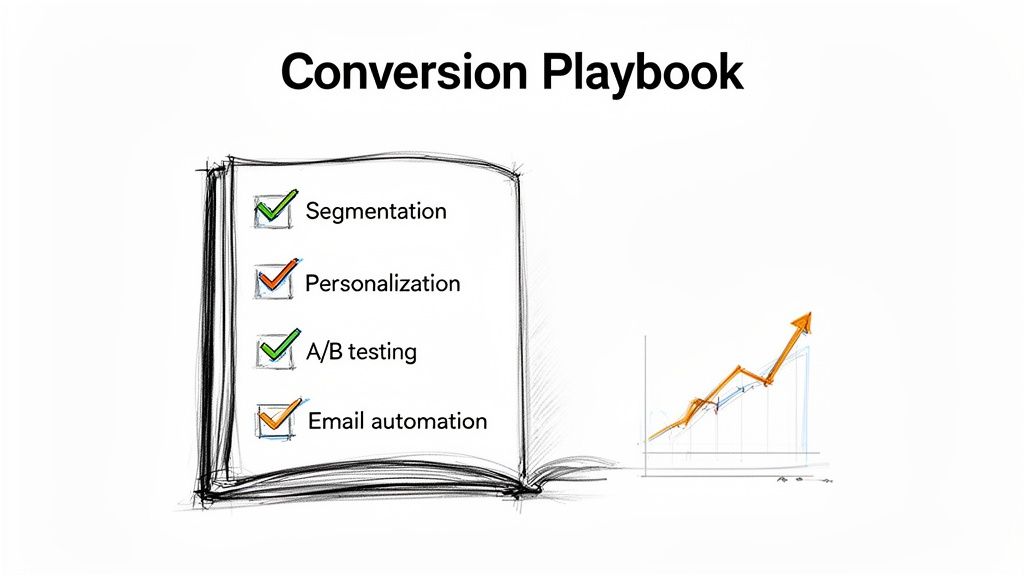
Master Advanced Segmentation and Personalization
Let's be blunt: the "one-size-fits-all" marketing email is dead. Today's buyers have zero patience for generic messages. If your communication doesn't speak to their specific world—their needs, their industry, their problems—you're getting ignored. And that kills every conversion metric down the line.
Your first line of defense is smart segmentation. Go beyond just grouping contacts by a single tag. It's time to create dynamic segments that combine multiple attributes for a much clearer picture of who you're talking to.
Behavioral Data: Group people by what they do, not just who they are. Think: features they've used, how often they log in, or specific pages they've visited on your site.
Firmographic Data: Layer in details like company size, industry, and location. This helps you frame your solution in a context that actually makes sense for their business.
Lifecycle Stage: A brand new trial user needs a totally different conversation than an engaged power user or a customer who's showing signs of churning. Segment them accordingly.
Once you have these sharp segments, personalization becomes your superpower. You can use dynamic content to swap out parts of your emails or website based on the viewer. That welcome email? It could show a case study from a fintech company to one user and a healthcare example to another.
This level of relevance isn't just a nice-to-have; it's a game-changer. While global e-commerce conversion rates have hovered between 2.5% and 2.95%, the top players using advanced personalization are seeing rates climb over 11%. These 2025 figures show just how powerful a tailored experience can be.
Build Powerful Email Automation Workflows
Automation is how you deliver that personalized touch at scale. It ensures no lead ever falls through the cracks and lets you send the perfect message at the perfect moment, all triggered by user behavior. No manual effort required.
If you're a B2B SaaS company, here are three automation workflows that are absolutely non-negotiable:
Trial Onboarding Sequence: This is probably the most important automation you'll ever build. Your goal is to guide new trial users to their "aha!" moment as quickly as possible with a series of emails highlighting key features, sharing best practices, and offering help.
Lead Nurturing Campaigns: Most leads aren't ready to buy the second they sign up. Nurture them. Create drip campaigns that provide genuine value over time, educating them and keeping your solution top-of-mind for when they are ready to talk.
Churn Prevention & Win-Back: Use behavioral triggers (like a sudden drop in activity) to spot at-risk customers. Automatically send an email to check in, offer help, or ask for feedback. It's much easier to save a customer than to find a new one.
These automated systems become your 24/7 sales assistants, creating a consistent, helpful experience that builds trust and drives conversions. To dig deeper, check out this proven framework for how to increase website conversion rate using a variety of strategies.
Optimize Email Deliverability and A/B Test Everything
You could write the most persuasive email in history, but it's completely worthless if it lands in the spam folder. Email deliverability—simply getting your emails into the inbox—is the bedrock of your entire marketing strategy. Bad deliverability crushes your open rates, which means your conversion rates never even get a chance.
Key Insight: Deliverability isn't just a technical chore for your IT team; it's a strategic priority. Make sure your email platform has proper SPF, DKIM, and DMARC authentication set up. And please, regularly clean your lists to get rid of inactive subscribers.
Finally, you have to build a culture of experimentation. Never, ever assume you know what works best. A/B testing is your secret weapon for finding out what truly resonates with your audience by systematically testing one variable at a time.
You can—and should—test almost everything:
Subject Lines: Try a short, punchy question versus a longer, benefit-driven statement.
Call-to-Action (CTA): Test the button color, the text ("Get Started" vs. "Start My Free Trial"), and its placement in the email.
Email Copy: Pit a long-form, story-driven email against a short, direct message with bullet points.
Timing: Does sending on Tuesday morning beat sending on Thursday afternoon? Test it and find out.
Every test gives you a valuable piece of data that makes your strategy smarter over time. This continuous cycle—segment, personalize, automate, and test—is the engine that powers sustainable growth. It all starts with a solid foundation, like knowing how to design a great lead capture form to fuel your funnel.
Common Questions About Sales Conversion Rates
Even with a solid grasp of the basics, a few specific questions always pop up when you start getting into the weeds of conversion rate in sales. Let's tackle some of the most common ones head-on.
Think of this as your go-to cheat sheet for clearing up confusion and putting these ideas into practice with confidence.
What Is a Good Sales Conversion Rate for B2B SaaS?
Honestly, there's no single magic number. The "right" answer depends entirely on your sales model, average contract value (ACV), and the niche you operate in. A product-led growth (PLG) company might celebrate a 2-5% website visitor-to-trial rate, while a high-touch enterprise SaaS business would see much lower numbers at the top of the funnel but much higher conversion rates between sales stages.
For instance, trial-to-paid conversion rates can swing from 15% in a sales-assisted model to over 25% for a really slick self-serve product. The best move is to stop obsessing over industry averages and start benchmarking against your own historical data. Focus on making steady, measurable improvements at each stage of your funnel.
How Can I Accurately Track My Conversion Rates?
Accurate tracking is impossible without connecting your core systems. If your tools aren't talking to each other, you're flying blind and just making educated guesses.
Here's the essential tech stack for getting a clear picture:
Web Analytics: This is your top-of-funnel lens. You have to use UTM parameters consistently on all your campaigns to know where your leads are actually coming from.
CRM Platform: Your CRM is mission control. It's where you'll track a lead's entire journey from MQL to SQL and, hopefully, to a closed-won deal.
Marketing Automation Platform: This tool gives you the campaign-level details, showing you which email click-throughs led to demo requests or which content downloads created the most pipeline.
When you stitch the data together from these three sources, you get a complete, high-definition view of what's actually moving the needle. It's the only way to truly understand—and improve—your conversion rates.
Which Conversion Metric Should I Improve First?
For the biggest and fastest impact, find the biggest "leak" in your sales funnel. Don't spread your efforts thin trying to fix a dozen small things at once. Map out your customer journey and pinpoint the stage with the most dramatic drop-off.
A classic example: you're generating tons of Marketing Qualified Leads (MQLs), but almost none are converting into Sales Qualified Leads (SQLs). That points to a problem with either lead quality or your handoff process. On the other hand, if you have a ton of trial signups but very few convert to paying customers, you need to pour all your energy into your product onboarding and user activation experience.
Fixing the weakest link in the chain will always give you the most bang for your buck.
Ready to turn more of your hard-earned leads into loyal customers? SMASHSEND gives B2B SaaS teams the powerful email automation, segmentation, and deliverability tools you need to boost conversions at every single stage of the customer journey. Start driving more revenue today.