
A Modern B2B SaaS Marketing Guide for Sustainable Growth
B2B SaaS marketing isn't just about selling software subscriptions to other companies. It's a completely different ballgame. You're not focused on one-off transactions; you're building long-term relationships and proving value over the entire customer lifecycle—from the first time they hear your name to the day they renew and upgrade.
Moving Beyond the Funnel to a Growth Flywheel
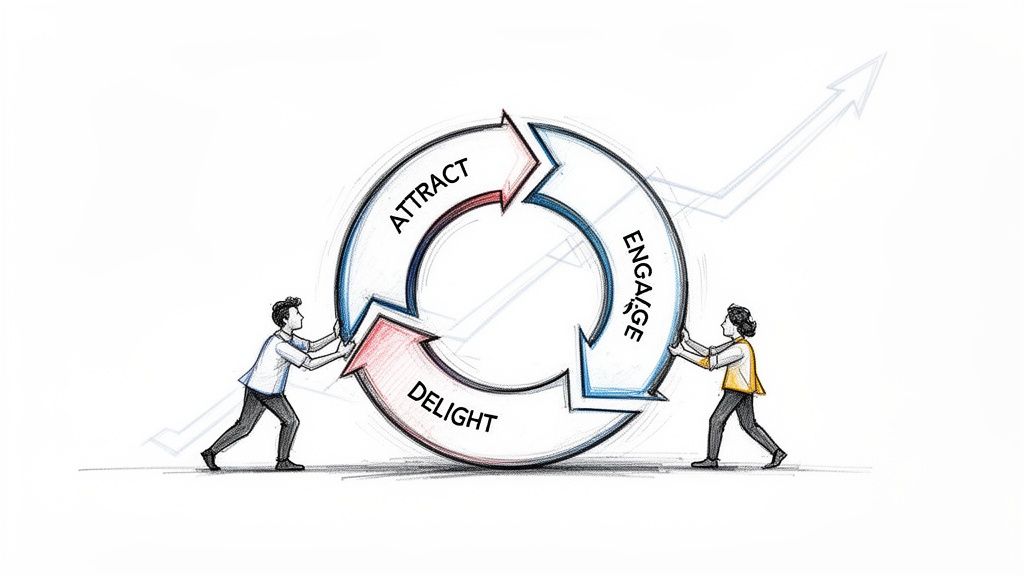
For decades, we've all been taught to worship the marketing funnel. It's a simple model: prospects go in the top, and paying customers pop out the bottom. Done. But for SaaS, this model has a fatal flaw. It treats customers like an afterthought—an output, not an engine for growth. Once a deal closes, the funnel just... stops. This completely ignores the single most valuable asset a subscription business has.
In today's crowded market where acquiring a new customer is brutally expensive, this one-way street just doesn't cut it anymore. That's why the sharpest growth teams are ditching the funnel for a far more powerful model: the growth flywheel.
Why the Flywheel Wins in B2B SaaS
Picture a heavy, spinning flywheel. It takes a lot of effort to get it moving initially. But once it's spinning, every single push adds to its momentum, making it spin faster and more efficiently with less and less effort. In B2B SaaS, your happy customers are the force that propels this wheel.
The flywheel model is built around a continuous, self-reinforcing cycle:
Attract: You pull prospects in with genuinely helpful content and elegant solutions to their problems, turning strangers into engaged visitors.
Engage: You start building a real relationship. You offer insights and guide them to experience your product's value firsthand, turning visitors into activated users.
Delight: You deliver an exceptional, white-glove customer experience. This turns happy users into true advocates who champion your brand and bring in new customers themselves.
This delight stage is the secret sauce. When customers truly succeed with your product, they create a tidal wave of positive word-of-mouth, write glowing reviews, and become killer case studies. All of this acts as powerful, organic fuel to attract new prospects, spinning the flywheel faster and faster.
This isn't just a trendy concept; it's a strategic necessity. With the global SaaS market now exceeding $300 billion and growing at over 15% annually, the competition is fierce. In this environment, a model that generates its own momentum through customer happiness isn't just a nice-to-have—it's a massive competitive advantage.
As you shift away from the leaky, old funnel, adopting a modern product-led growth strategy can be a game-changer. This approach puts your product at the absolute center of the customer journey, which aligns perfectly with the flywheel concept. To see how the best companies are doing this, check out these excellent product-led growth examples. The rest of this guide will give you the tactical playbooks to build and accelerate your own growth flywheel.
Building Your Customer Acquisition Engine
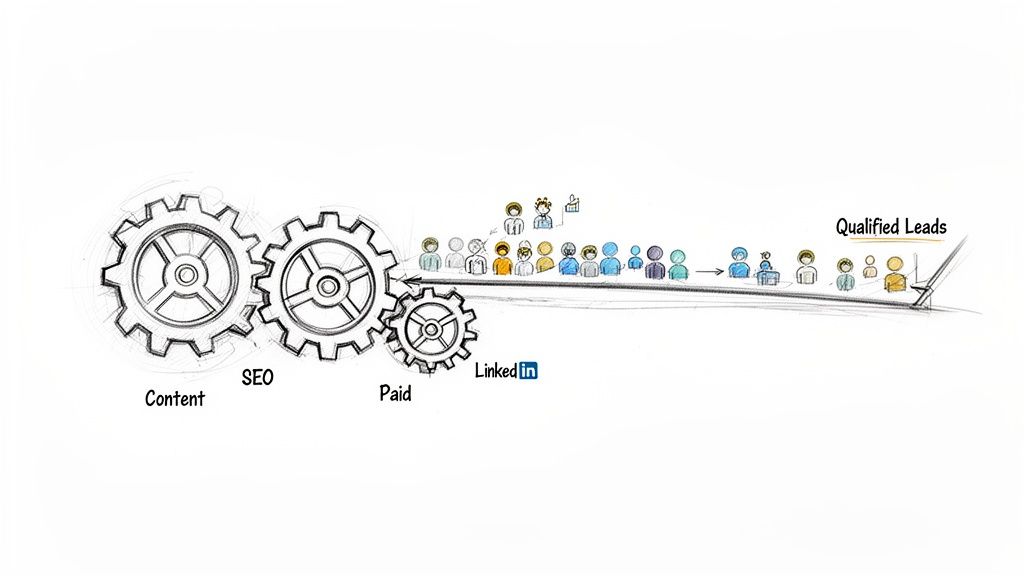
Alright, you've got your flywheel model mapped out. Now, we need to build the engine that actually makes it spin. This is your customer acquisition strategy—a disciplined, multi-channel approach to attracting the right kind of customers, not just anyone with a pulse.
For a growing B2B SaaS company, this isn't about chasing every shiny new trend. It's about mastering a handful of channels that deliver consistent, high-quality leads.
Think of your acquisition strategy like a balanced investment portfolio. You wouldn't dump all your cash into one volatile stock, so don't bet your company's entire future on a single marketing channel. A resilient B2B SaaS marketing engine blends long-term, compounding assets with short-term, targeted initiatives that get you quick wins.
Dominating Your Niche with Content and SEO
Content marketing and Search Engine Optimization (SEO) are the bedrock of any sustainable lead generation plan. No, they aren't quick wins. But they build an invaluable asset over time: a steady stream of organic traffic from people actively looking for the exact solutions you provide. This is how you establish real authority—by showing your expertise, not just talking about it.
It all starts with identifying high-intent keywords. These are the specific phrases your ideal customers type into Google when they're ready to solve a problem. Forget broad terms. You need to focus on long-tail keywords that signal a clear and urgent need.
For example, instead of targeting "project management software," you'd have much better luck with "Gantt chart software for construction teams." That kind of precision attracts fewer visitors, but the ones who do show up are far more qualified.
Once you've nailed down your keywords, the mission is to create "pillar content"—comprehensive guides, original reports, or free tools that become the definitive resource on that topic. This killer content acts like a magnet for backlinks and establishes your site as an authority, which in turn boosts your ranking for dozens of related keywords.
Your content's number one job is to be incredibly helpful. When you solve a small part of your audience's problem for free, you earn the trust they need to believe you can solve their entire problem with your paid product.
Fueling Growth with Strategic Paid Acquisition
While content and SEO build that slow, compounding momentum, paid acquisition is your rocket fuel. It delivers immediate, predictable traffic right when you need it. Platforms like LinkedIn and Google Ads let you place your solution directly in front of a hyper-targeted audience based on job title, industry, company size, and online behavior.
The key to winning with paid ads is a ruthless focus on measurement. Don't just track clicks; track the entire journey from the first ad impression all the way to a closed-won deal. This means you absolutely have to connect your ad platforms to your CRM to see which campaigns are actually making you money.
A classic mistake is spreading your budget too thin across too many channels. Don't do it. Instead, find the one or two channels where your ideal customers live and breathe, and aim to dominate them. For many B2B SaaS companies, that channel is LinkedIn, which offers targeting capabilities that are second to none.
SaaS Acquisition Channel Prioritization Matrix
Deciding where to invest first can be tough. This matrix breaks down the top channels to help you prioritize based on your growth model and resources.
| Channel | Best For | Typical CAC | Time to ROI |
|---|---|---|---|
| Content & SEO | PLG & Sales-Led | Low (but high upfront effort) | 6-12 Months |
| Paid Social (LinkedIn) | Sales-Led | High | 1-3 Months |
| Paid Search (Google) | PLG & Sales-Led | Medium-High | 1-3 Months |
| Cold Outreach | Sales-Led (High ACV) | Medium | 2-4 Months |
| Affiliates/Partnerships | PLG & Sales-Led | Low (Rev-Share) | 3-6 Months |
This isn't a one-size-fits-all map, but it's a solid starting point for allocating your budget and setting realistic expectations for when you'll start seeing a return.
Blending Channels for a Hybrid Strategy
The most effective acquisition engines don't rely on a single channel in isolation. They create a system where each channel supports the others, creating a powerful compounding effect.
For instance, you can run paid ads to promote your pillar content, which accelerates its reach and gives its SEO value a serious boost. Or you can retarget people who read a blog post with a specific ad for a product demo.
Email and lifecycle marketing are the connective tissue that ties all of this together. While people often think of email as a retention tool, it's a massive part of acquisition. A well-maintained email list is one of the most valuable assets you'll ever own. If you're starting from square one, check out our guide on how to build an email list the right way.
This blended approach is backed by hard data. While content marketing drives 3x more MQLs than outbound sales and SEO fuels 30–60% of pipelines, marketers report that in-person events (52%) and webinars (51%) still outperform email newsletters (37%) for lead generation. This just highlights the power of combining digital reach with high-touch engagement.
Your ultimate goal is to build a diversified, measurable, and scalable customer acquisition machine that keeps your flywheel spinning faster and faster.
Mastering User Onboarding and Activation
Getting someone to sign up is a victory, but let's be honest, it's not the finish line. In B2B SaaS, the real work starts the second a new user logs into your product. This is the make-or-break moment where you either guide them to value or lose them to the churn vortex.
A killer onboarding process is the ultimate handoff from marketing to product. It's your one chance to deliver on the promises your slick ad campaigns and landing pages made. The goal isn't just a feature tour; it's about getting every single user to their "aha!" moment as fast as humanly possible—that instant where they see exactly how your tool solves their problem.
The First Five Minutes Are Everything
A user's first few minutes inside your app are a powerful predictor of their future. If they feel lost, overwhelmed, or confused, they're gone. Probably for good.
A great onboarding flow feels effortless. It's hyper-focused on one thing: delivering a quick win. This could be creating their first report, inviting a teammate, or connecting their first integration. That initial taste of success builds momentum and pulls them deeper into the product. To get them there, you need a coordinated attack across a few key channels:
Welcome Email Sequence: This isn't a single, lonely "hello." It's a series of 3-5 emails that hammer home your value, show them the first critical steps, and offer a lifeline if they get stuck.
In-App Guidance: Use checklists, tooltips, and interactive walkthroughs right inside the product to steer them toward those key activation milestones. Don't make them guess what to do next.
Behavioral Triggers: Set up automations based on what users do (or don't do). Did they get stuck after creating a project? Send a helpful nudge. Did they hit a milestone? Pop some digital confetti and celebrate their progress.
Onboarding is the bridge between the perceived value that got someone to sign up and the experienced value that will get them to stay. If that bridge is broken, your acquisition efforts are wasted. A weak onboarding process is one of the biggest silent killers of growth for SaaS businesses.
Designing for Activation, Not Just Education
Here's where so many companies get it wrong: they blast new users with a firehose of feature tutorials. That's education, not activation. Your goal should be activation, which is the point where a user has truly experienced your product's core value and is on the path to becoming a paying customer.
Your entire onboarding process needs to be reverse-engineered to hit this milestone.
First, you have to define what "activation" even means for your product. Is it when a user invites two teammates? When they run their first report? When they integrate with Salesforce? Once you have a crystal-clear definition, you can build a guided path that gets every user to that specific outcome.
This product-led approach is non-negotiable if you want to scale. A shocking 36.3% of B2B SaaS companies generate zero self-serve revenue. But here's the kicker: companies with a strong self-serve motion see nearly double the profitability and 25.9% better free-to-paid conversion rates. As recent industry research demonstrates, a seamless onboarding experience is the foundation of a winning self-serve model.
Connecting Onboarding to Long-Term Value
A successful activation is a huge win, but it's just the first step in a long journey. The work doesn't stop after week one. You need to keep guiding users and helping them discover more value over time.
Think about how you can use lifecycle email automation to introduce secondary features, share advanced use cases, or announce new product updates. Every message should be tied to user behavior, making it relevant and genuinely helpful. This constant, value-driven engagement is what separates companies with high retention from those who are constantly fighting churn.
By turning newly activated users into deeply engaged fans, you directly impact your bottom line. You can dive deeper into these strategies in our guide on how to increase customer lifetime value to learn more about building lasting relationships that fuel growth.
Automating the Customer Lifecycle to Drive Revenue
If your acquisition engine is what gets the flywheel spinning, then lifecycle automation is the well-oiled bearing that keeps it humming 24/7. This is where you graduate from one-time signups to long-term, high-value partnerships. It's all about sending the perfect message to the right user at the exact moment they need it—all without you lifting a finger.
This isn't about blasting out generic newsletters. Real B2B SaaS marketing is built on targeted, behavior-driven messages that feel personal and actually help the user. By automating these key touchpoints, you build a revenue machine that activates, retains, and expands your customer base on autopilot.
The Five Essential Lifecycle Playbooks
Every single SaaS business, no matter its size, needs five core automation playbooks. Think of them as your foundational safety nets and growth levers. They ensure no user slips through the cracks and every chance for revenue growth is seized.
The whole thing kicks off with onboarding, which is where your very first automated playbook comes into play. It's the most critical one.
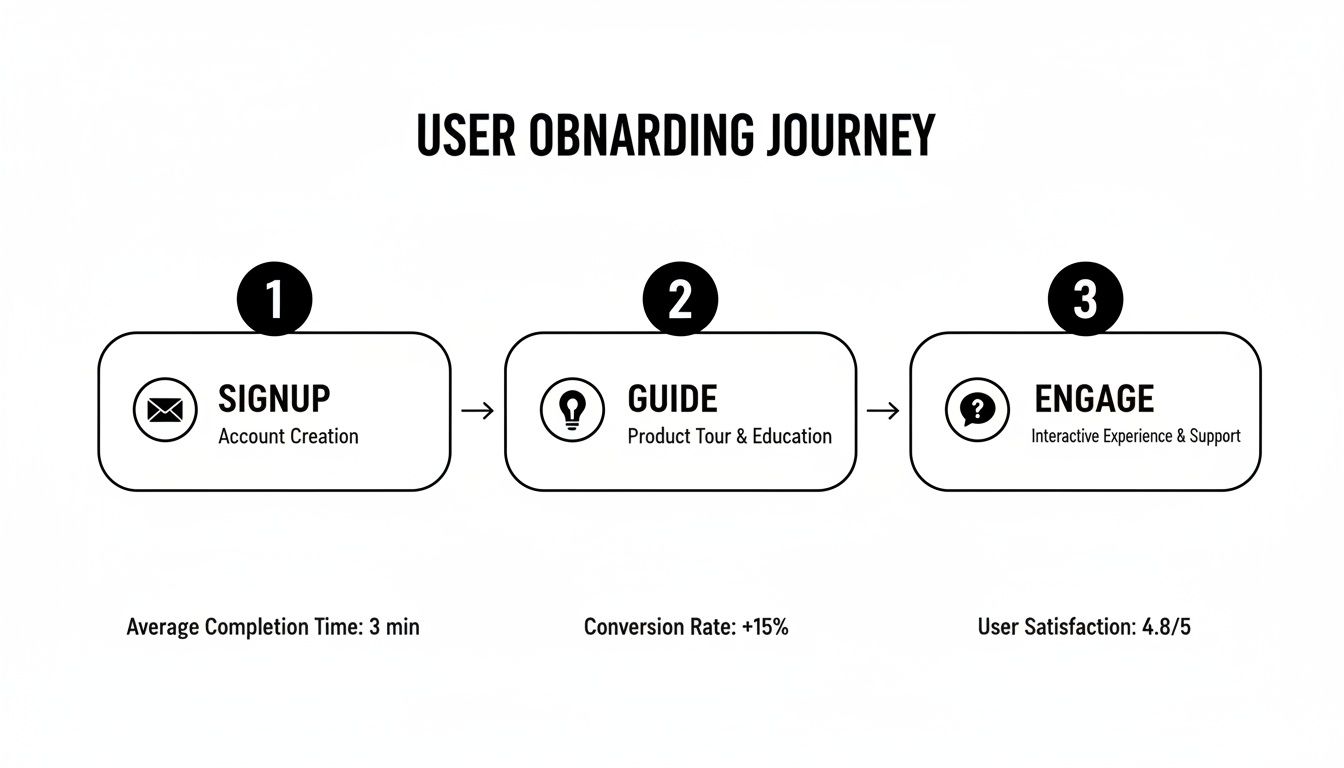
This journey from signup to real engagement is where your welcome and activation sequence does all the heavy lifting.
Below are the five playbooks that form the backbone of any strong lifecycle strategy.
1. Welcome and Activation Campaigns
This is your first, and best, shot at getting a new user to that magical "aha!" moment. This isn't a single "Welcome aboard!" email. It's a carefully designed sequence that pushes users to take specific actions that unlock your product's core value.
Goal: Guide new trial or freemium users to complete key setup actions and experience the product's core value within their first 7-14 days.
Triggers: New user signup, project created, teammate invited (or, just as importantly, not invited after 3 days).
Email Concept: A 3-5 part series that showcases the top 3 features, shares a quick-start video, and offers a helping hand if the user seems stuck.
2. Feature Adoption and Expansion
Once a user is activated, the job's not done. Now it's time to deepen their engagement and show them the full power of your platform. This is how you pave the way for upgrades and expansion revenue.
Goal: Increase the use of sticky features and spot Product Qualified Leads (PQLs) who are ready for a higher-tier plan.
Triggers: User tries a specific feature for the first time, team size approaches a plan limit, or usage of a key metric (like API calls or contacts) hits 80% of their current plan's limit.
Email Concept: A hyper-targeted email that says something like, "We noticed you just used our reporting feature. Here are three advanced ways to get even more out of it."
Lifecycle automation is the art of showing up at the perfect time with the perfect piece of advice. It turns your email platform from a simple megaphone into a smart, proactive customer success manager that scales infinitely.
3. Renewal Reminders
For annual contracts, renewals can't be an afterthought. An automated reminder sequence removes all the friction and slashes the risk of customers churning by accident.
Goal: Ensure a smooth renewal process and lock in commitment for another year.
Triggers: 60, 30, and 7 days before the annual contract renewal date.
Email Concept: A friendly sequence that reminds them of the upcoming date, summarizes the value they've gotten (e.g., "You've saved 200 hours with our tool this year!"), and gives them dead-simple instructions to renew.
4. Billing Failure and Dunning
This is the definition of low-hanging fruit. A huge chunk of churn is completely involuntary—caused by expired credit cards or simple processing failures. A solid dunning campaign can claw back a massive amount of this revenue. For a company in the $1M–$30M ARR range spending 8% of revenue on marketing, every dollar saved here goes straight to the bottom line.
Goal: Automatically recover failed payments and prevent involuntary churn.
Triggers: A credit card payment fails or a card is about to expire.
Email Concept: A multi-step sequence that instantly notifies the user of the problem, gives them a direct link to update their billing info, and sends a few friendly pings before their account gets suspended.
5. Churn Recovery and Win-Back Campaigns
When a customer cancels, it doesn't always have to be the end of the road. A well-timed win-back campaign can reignite that relationship and bring valuable customers back into the fold.
Goal: Re-engage users who have canceled their subscriptions and convince them to come back.
Triggers: User completes the cancellation flow or a trial expires without converting.
Email Concept: An email sent 30-60 days after cancellation that offers a special incentive to return. Another great angle is a simple survey asking for feedback, which opens the door for a 1-on-1 conversation.
To tie it all together, these five automated workflows are your operational backbone for customer marketing. They systematically plug revenue leaks and create new opportunities for growth.
Essential B2B SaaS Lifecycle Automation Playbooks
| Playbook | Primary Goal | Example Triggers | Impact on ARR |
|---|---|---|---|
| Welcome & Activation | Drive users to their "aha!" moment | User signs up, hasn't invited a teammate | Increases trial-to-paid conversion rate |
| Feature Adoption | Deepen engagement, identify PQLs | Hits 80% of plan usage limit, tries a new feature | Drives expansion and upgrade revenue |
| Renewal Reminders | Secure annual contract renewals | 60, 30, 7 days before renewal date | Protects existing revenue, reduces churn |
| Billing Failure (Dunning) | Recover failed payments | Credit card payment fails | Recovers involuntary churn, easy revenue win |
| Churn Recovery | Win back canceled customers | User cancels subscription, trial expires | Reclaims lost revenue, improves net retention |
Implementing these five playbooks creates a powerful, automated system that plugs revenue leaks and actively drives growth at every stage of the customer journey. This is how you build a scalable revenue engine that works for you, even when you're sleeping.
Protecting Your Most Valuable Marketing Channel
So, you've built a brilliant set of lifecycle automations. The copy is perfect, the timing is flawless. But what if those emails never even get seen?
It's a harsh reality: all that strategic work is completely worthless if your emails land in the spam folder. Email is your direct line to customers—it's one of the most powerful and profitable channels in your entire marketing stack. So, protecting its integrity isn't just a technical chore; it's a critical business function.
Think of your sending domain as having a reputation score, a lot like a credit score. Every single email you send either builds that score up or chips away at it. ISPs like Gmail and Outlook are the credit bureaus, watching everything you do. They use this reputation to decide if you're a trustworthy business or just another spammer clogging up their network.
Nail this, and you get higher open rates, more activated users, and more revenue. Get it wrong, and your messages disappear into a digital black hole, your customer acquisition costs spike, and your brand takes a serious hit.
The Three Pillars of Email Deliverability
Deliverability isn't some mystical dark art. It's a science built on three core pillars. If you master these, your messages will consistently hit the inbox, where they belong.
Technical Authentication (The Handshake): This is how you prove to the world's inboxes that you are who you say you are. It's handled by setting up a few simple DNS records—SPF, DKIM, and DMARC. Think of these as your domain's official ID card, preventing scammers from impersonating you and trashing your good name. Any modern email platform should guide you through this or even handle it automatically.
Sender Reputation (The Trust Score): This is the health score ISPs assign to your sending domain and the IP addresses you use. It's a living metric, influenced by everything from bounce rates and spam complaints to how many people actually open and click your emails. A high reputation score is like getting a VIP pass straight to the primary inbox.
Content Quality (The Message): Even with perfect authentication and a stellar reputation, you can still get flagged for sending junk. Avoid spammy trigger words ("Free!", "Act now!"), shady subject lines, and sloppy, image-only emails. The goal is simple: send valuable, relevant content that people actually want to read.
Your sender reputation is one of your most valuable—and fragile—marketing assets. It can take months of consistent, good behavior to build, but it can be destroyed in a single afternoon with one bad send. Protect it at all costs.
Best Practices for Staying Out of Spam
Great deliverability requires ongoing discipline. It's not a "set it and forget it" kind of thing. Consistently applying these best practices will safeguard your reputation and squeeze every last drop of ROI from your email program.
Warm Up Your Domain: Never, ever send a massive blast from a brand-new domain or IP address. You have to earn the trust of ISPs by gradually increasing your sending volume over several weeks. This "warming up" process shows them you're a legitimate sender building a positive history, not a spammer trying a smash-and-grab.
Practice Strict List Hygiene: This is huge. Regularly clean your email list by removing inactive subscribers, invalid addresses, and anyone who hasn't engaged in over 90 days. Sending emails to a clean, engaged list is the single most important factor in maintaining a high sender reputation.
Monitor Engagement Metrics: Keep a close eye on your open rates, click-through rates, and especially your bounce rates. A sudden drop in engagement or a spike in bounces is the canary in the coal mine—it's an early warning that something is seriously wrong with your deliverability.
Choosing Your Tools and Measuring What Matters
A brilliant strategy is useless if you can't execute it and prove it's actually working. This all comes down to connecting every marketing dollar you spend to a tangible business result. To do that, you need two things: the right tools and the right metrics.
Let's get one thing straight: vanity metrics like website traffic or social media followers don't pay the bills. For a growing SaaS business, the only numbers that tell the real story are tied directly to revenue.
Your goal is to build a lean, powerful marketing tech stack where everything talks to each other. When your tools are disconnected, you get data silos, and it becomes impossible to see the full customer journey. You want a unified view that lets you trace a user's path from their very first ad click all the way to their latest renewal payment. That's how you prove marketing's impact on the bottom line. The right email marketing platform serves as the central hub that connects all these touchpoints and drives measurable results.
Focusing on Revenue-Centric KPIs
In B2B SaaS, a few core metrics cut through all the noise. They give you a brutally honest picture of your business's health and whether your marketing spend is smart or wasteful.
Customer Acquisition Cost (CAC): This is your total sales and marketing cost to bring in one new customer. Simple enough. A low CAC is good, but it's totally meaningless without its partner in crime, LTV.
Lifetime Value (LTV): This is the total revenue you can realistically expect from a single customer over the entire time they're with you.
LTV to CAC Ratio: This is the magic number. It pits the value of a customer against what you paid to get them. For a healthy, growing SaaS business, you're aiming for a ratio of 3:1 or higher. This means for every dollar you spend on acquisition, you get at least three dollars back.
If your LTV:CAC ratio is sinking below 3:1, you're probably burning cash too fast on acquisition—an unsustainable path. On the flip side, if you're at 5:1 or higher, you're getting a fantastic return and should seriously consider pouring more fuel on the fire to grow faster.
Reporting on What Actually Drives Growth
Beyond the LTV:CAC ratio, you need to track how well you're keeping and growing the revenue from the customers you already have. This is where the real power of the subscription model kicks in.
Net Revenue Retention (NRR) is arguably the single most important metric for any SaaS company. It measures the recurring revenue from your existing customers, factoring in both churn (lost customers) and expansion (upgrades, cross-sells).
An NRR over 100% is the holy grail. It means your business is growing even if you don't acquire a single new customer. That's a powerful signal that you have a sticky product and happy customers who are willing to pay you more over time.
When you build your dashboards around these KPIs—CAC, LTV, and NRR—you fundamentally change the conversation. It's no longer about marketing activities; it's about marketing outcomes. This simple framework helps you set realistic goals and prove exactly how your B2B SaaS marketing efforts are directly fueling the company's growth and profitability.
Got Questions About B2B SaaS Marketing? We Have Answers.
Running a SaaS business means you're constantly staring down tough questions. I get it. Below, I've tackled some of the most common ones I hear from founders and marketers, with straight-up, actionable answers to help you build your B2B SaaS marketing engine.
What's the Single Most Important Metric to Track?
Everyone gets obsessed with MQLs and conversion rates. And while those are good for checking the pulse of your funnel, they don't tell the whole story. The one metric that truly matters is Net Revenue Retention (NRR).
NRR tells you how much your revenue from existing customers grew (or shrank) over a specific period. It bundles in all the good stuff—upgrades and expansion—and subtracts the bad, like churn and downgrades.
An NRR over 100% is the holy grail for a SaaS business. It means you're growing from your existing customer base alone, even if you didn't acquire a single new customer. That's the ultimate proof of product-market fit and the sign of a flywheel that's actually spinning.
Focusing on NRR forces you to think about the entire customer journey, not just getting them in the door.
How Much Should We Actually Spend on Marketing?
There's no magic formula here, but a solid benchmark for SaaS companies in the $1M–$30M ARR range is to invest somewhere between 20-40% of your Annual Recurring Revenue into marketing.
But honestly, the raw percentage isn't what's important. It's all about the efficiency of that spend.
The real key is to be absolutely relentless about tracking your LTV:CAC ratio. A healthy goal to shoot for is 3:1 or higher. In plain English, this means for every dollar you spend to acquire a customer, they should generate at least three dollars in lifetime value. Pumping your budget into scalable, long-term channels like SEO, content, and lifecycle automation is the surest way to get that ratio looking good.
Should We Go with Product-Led or Sales-Led Growth?
Why not both? The smartest SaaS companies today don't choose one over the other; they run a hybrid model.
Product-Led Growth (PLG) is your secret weapon for efficient acquisition. A freemium plan or a free trial lets the product do the selling for you, dramatically lowering your CAC and letting you scale up fast.
But for those big, juicy enterprise contracts, you still need a human touch. That's where a sales team comes in. The best playbook is to build a strong PLG foundation that pulls in users and shows them value, then layer a sales-assist team on top. They can identify the most engaged accounts and personally guide them to higher-tier plans. You get the best of both worlds: scalable growth on the bottom and high-value deals on top.
Ready to turn your email program into a 24/7 revenue engine? SMASHSEND provides the automation, deliverability, and analytics B2B SaaS teams need to activate users, expand accounts, and win back churn. Start driving more ARR today.