10 Proven SaaS Customer Retention Strategies for B2B Growth in 2026
In the world of B2B SaaS, the initial sale is just the starting line. Real, sustainable growth isn't about chasing an endless stream of new logos; it's about systematically keeping the customers you've already won and expanding their value over time. For many SaaS companies navigating the $1M–$30M ARR stage, customer retention often feels like a reactive, chaotic process. Teams firefight churn instead of proactively preventing it, leading to leaky revenue buckets and stalled growth momentum.
The solution lies in shifting from scattered tactics to an intentional retention engine. This requires building a system powered by smart automation and a deep, data-driven understanding of the customer lifecycle. This article provides a comprehensive blueprint, breaking down 10 proven SaaS customer retention strategies you can implement immediately to protect and grow your revenue base.
We'll move beyond generic advice and dive directly into actionable playbooks, specific KPIs to track, and practical segmentation examples. You will find concrete steps for everything from lifecycle email automation and behavioral segmentation to proactive churn prevention and effective dunning management. We will also demonstrate how to use a platform like SMASHSEND to turn these strategies into automated workflows that transform your customer lifecycle into a powerful and predictable growth driver. This guide is designed to help you build a retention framework that not only reduces churn but actively increases customer lifetime value.
1. Lifecycle Email Marketing & Automation
Lifecycle email marketing is a cornerstone of effective SaaS customer retention strategies. It involves creating automated communication sequences that correspond to specific stages in the customer journey, from initial onboarding to long-term advocacy. By delivering the right message at the right time, this approach proactively addresses user needs, prevents disengagement, and guides customers toward realizing your product's full value.
Instead of generic newsletters, lifecycle automation uses behavioral triggers to send highly relevant content. This maintains a consistent, valuable dialogue with your users, ensuring they never feel forgotten after the initial sale. For B2B SaaS companies, this direct line of communication is crucial for demonstrating ongoing ROI and preventing churn before it happens.
How It Works in Practice
A powerful lifecycle strategy maps out critical moments and automates responses. For instance, Slack excels at this by sending a series of onboarding emails that highlight key features like channels and integrations, encouraging deeper product adoption from day one. Similarly, HubSpot uses complex workflows to nurture users, identifying expansion opportunities when a customer starts using advanced features.
Key Insight: The goal is to move beyond time-based campaigns (e.g., "Day 7 email") to behavior-based triggers (e.g., "user invited 3 teammates" or "user hasn't logged in for 14 days"). This shift makes communication feel personal and immediately useful.
Actionable Implementation Steps
Map Core Journeys: Start by defining essential customer stages: Welcome & Onboarding, Feature Activation, Mid-Cycle Check-in, Pre-Renewal Nudge, and Churn Recovery (Win-back).
Implement Behavioral Triggers: Use a platform like SMASHSEND to create rules based on user actions. For example, trigger a helpful guide when a user engages with a complex feature for the first time or send a re-engagement email if their login frequency drops.
Segment Your Audience: Don't send the same message to everyone. Create segments based on user roles (Admin vs. User), subscription tier (Basic vs. Enterprise), or product usage levels to deliver hyper-personalized content.
Integrate and Optimize: Combine your marketing messages with transactional emails (like billing receipts or password resets) for a cohesive brand experience. Continuously A/B test subject lines, CTAs, and send times to maximize engagement.
To dive deeper into setting up these automated workflows, explore our complete guide to email marketing automation.
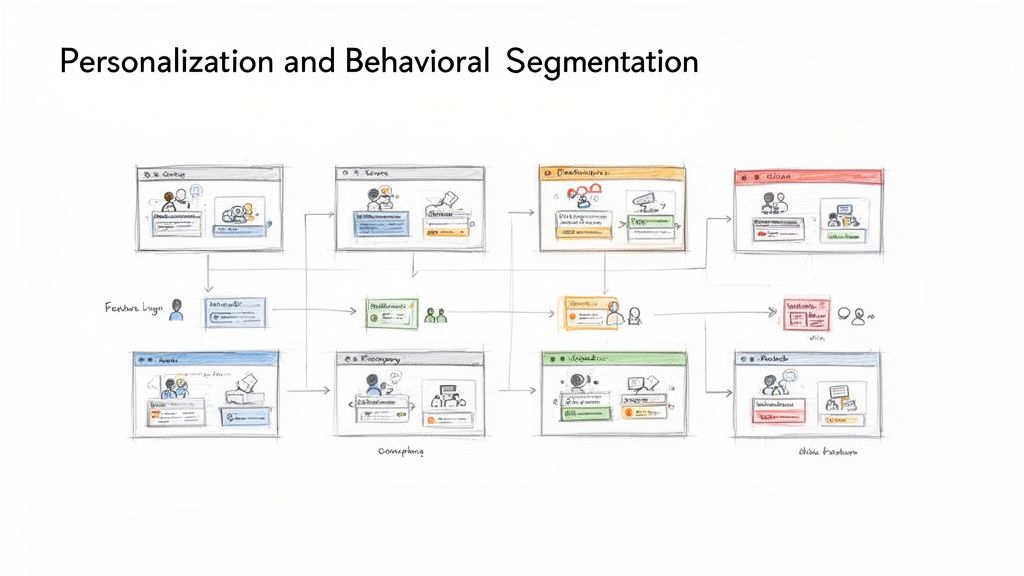
2. Personalization & Behavioral Segmentation
Personalization and behavioral segmentation are critical SaaS customer retention strategies that move beyond one-size-fits-all communication. This approach involves leveraging rich customer data—like in-app behavior, feature usage, and company firmographics—to deliver messages that are uniquely relevant to each user's context. By doing so, you demonstrate a deep understanding of their needs and guide them toward success with your product.
Instead of broadcasting generic updates, you can tailor content to specific user actions and profiles, significantly boosting engagement and perceived value. For B2B SaaS, this means an admin at a large enterprise receives different guidance than a new user at a small startup, ensuring every message resonates and strengthens the customer relationship.
How It Works in Practice
Effective segmentation allows for powerful, targeted campaigns. For example, Intercom uses product-triggered messages to engage users based on their real-time activity, such as offering a tutorial when they first navigate to a complex feature. Similarly, Netflix's recommendation engine is a masterclass in behavioral personalization, using viewing history to create a unique experience that keeps users subscribed month after month.
Key Insight: True personalization goes beyond using a customer's first name. It involves dynamically changing content, CTAs, and offers based on a user's behavior, subscription plan, and engagement level to make every interaction feel like a one-to-one conversation.
Actionable Implementation Steps
Define Key Behavioral Segments: Start by creating core segments in your platform. Common examples include Power Users (high login frequency, deep feature adoption), Inactive Users (no login in 30+ days), and Users Nearing Limits (approaching their plan's usage cap).
Leverage Product Telemetry: Use a tool like SMASHSEND to track in-app actions. Create rules that trigger messages based on events like "first-time feature use," "integration connected," or "report generated" to provide timely, contextual support.
Enrich Data with Firmographics: Combine behavioral data with firmographic details like company size, industry, and job role. This allows you to send targeted use cases and benchmarks that are highly relevant to each account's specific business context.
Test and Iterate: Begin with simple personalization like dynamic subject lines and move toward more complex, conditional content blocks within your emails. Continuously monitor engagement metrics for each segment to refine your strategy and ensure maximum impact.
3. Proactive Churn Prevention & Win-Back Campaigns
Proactive churn prevention is one of the most impactful SaaS customer retention strategies available. It involves identifying at-risk customers before they cancel and launching targeted campaigns to address their concerns, offer solutions, or provide incentives to stay. This strategy moves beyond reactive support, using predictive analytics and behavioral data to intervene at the first sign of disengagement.
Instead of waiting for a cancellation email, this approach combines customer health scoring and personalized messaging to prevent churn before it happens. For a B2B SaaS company, detecting a drop in feature usage or an increase in support tickets allows you to step in with educational content or a personal check-in, demonstrating that you value their business and are invested in their success.
How It Works in Practice
A robust churn prevention strategy relies on automated triggers based on customer health. For example, Calendly notices when an active user hasn't scheduled a meeting for several weeks and sends a helpful email with tips for getting more value. Similarly, platforms like Stripe use automated dunning sequences to tackle involuntary churn from billing failures, recovering revenue that would otherwise be lost.
Key Insight: The most effective churn prevention isn't about last-ditch discounts. It's about re-engaging users by reminding them of the core value they signed up for, often by highlighting an underutilized feature that solves a key pain point.
Actionable Implementation Steps
Define Your Churn Signals: Identify key risk indicators, such as a login frequency drop (e.g., no login for 30+ days), a decline in core feature usage, a spike in support complaints, or repeated billing failures.
Build a Customer Health Score: Combine usage, engagement, and support sentiment data into a simple score. This allows you to prioritize outreach efforts on accounts that are most at risk and have the highest value.
Trigger Automated Win-Back Flows: Use a platform like SMASHSEND to automatically enroll users in a win-back campaign when their health score drops below a set threshold. This ensures timely intervention without manual effort.
Personalize Your Offers: Segment at-risk users and tailor your messaging. A user with low feature adoption might need an educational guide, while an account with billing issues needs a simple way to update their payment info. A/B test different offers to see what resonates.
4. Upsell & Cross-Sell Through Lifecycle Messaging
Upselling and cross-selling are not just sales tactics; they are powerful SaaS customer retention strategies when integrated into lifecycle messaging. This approach involves strategically presenting product expansion offers based on customer usage patterns, account maturity, and identified needs. The goal is to educate customers on how premium features or additional products can solve their evolving challenges, thereby increasing their lifetime value.
Instead of deploying aggressive sales pitches, this strategy uses automated, contextual messaging to guide users toward greater value. For a growing B2B SaaS, this is critical because expansion revenue from existing customers is significantly more efficient and profitable to acquire than revenue from new logos. It strengthens the customer relationship by proving you understand their growth journey.
How It Works in Practice
Effective expansion messaging is triggered by specific user achievements or limitations. For example, Figma intelligently prompts users to upgrade to a paid plan when their team member count grows and they start hitting collaboration limits. Similarly, Notion suggests template and database add-ons to power users who are maximizing the platform's core functionalities, making the offer feel like a natural next step rather than an interruption.
Key Insight: The most successful expansion offers are positioned as solutions, not sales. Frame your upsell message around a user's recent activity or milestone, demonstrating how the upgrade will help them achieve their next goal more efficiently.
Actionable Implementation Steps
Identify Expansion Triggers: Use your product analytics to pinpoint key usage milestones that signal a need for more features. Common triggers include hitting seat limits, nearing storage caps, or frequent use of an advanced feature's free version.
Automate Contextual Offers: Build automated workflows in a platform like SMASHSEND that trigger when a user hits a predefined milestone. For instance, send an email showcasing the benefits of a Pro plan after a user has invited their fifth teammate.
Segment Your Messaging: Tailor offers based on user segments. High-value enterprise accounts might receive a personalized outreach from sales, while smaller accounts receive an automated email offer with a clear call-to-action.
Educate, Don't Just Sell: Create content like case studies or short video tutorials that demonstrate the ROI of premium features. Link to this content within your expansion emails to help users make an informed decision and see the long-term value.
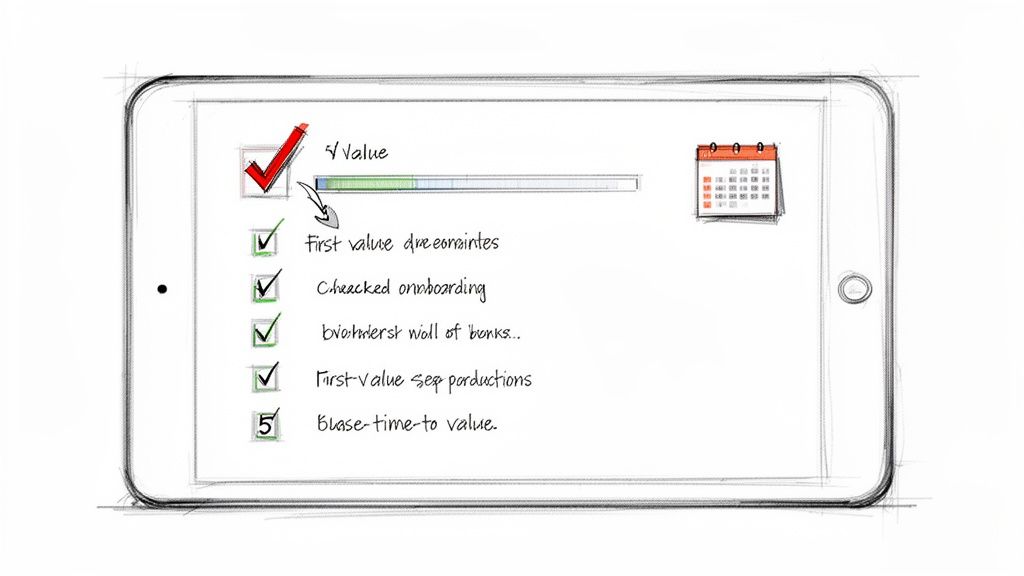
5. Onboarding & Time-to-Value Acceleration
A customer's first few interactions with your product are the most critical in predicting long-term retention. Onboarding is the process of guiding new users to their first "aha!" moment as quickly as possible, accelerating their time-to-value (TTV). An effective onboarding strategy dramatically reduces early-stage churn by proving your product's worth before a user has a chance to disengage.
For B2B SaaS, this isn't just about a welcome tour; it's a structured sequence of educational touchpoints, from emails to in-app guides, designed to drive activation. When a customer achieves a meaningful win fast, they are far more likely to integrate your solution into their daily workflow, making it indispensable.
How It Works in Practice
Top-tier SaaS companies build onboarding experiences that feel less like training and more like a guided success plan. For example, Asana provides project templates and interactive tutorials that help teams set up their first project in minutes. Similarly, Zapier's onboarding focuses entirely on helping a user build their first "Zap", instantly demonstrating the power of automation and delivering immediate value.
Key Insight: The primary goal of onboarding is not to showcase every feature. It is to eliminate friction and guide the user to perform the one or two key actions that unlock the core value of your product, cementing its role in their workflow.
Actionable Implementation Steps
Map the "First Win" Journey: Identify the minimum steps a user must take to see value. Is it inviting a teammate, creating a report, or integrating another app? Build your onboarding around this critical path.
Segment Onboarding Paths: Create tailored experiences based on user roles (e.g., Admin vs. Contributor) or use cases. A technical user may need API documentation, while a marketing manager might want a campaign template.
Combine Email and In-App Messaging: Use a platform like SMASHSEND to trigger welcome emails that complement in-app tours and tooltips. This creates a cohesive, multi-channel experience that reinforces learning.
Track Completion Rates: Monitor how many users complete your onboarding checklist or key activation events. Identify drop-off points and optimize those steps to reduce friction. To ensure users quickly grasp your product's value and stay engaged, consider implementing these 10 actionable SaaS onboarding best practices.
6. Billing & Payment Recovery (Dunning Management)
Billing and payment recovery, often called dunning management, is a critical yet frequently overlooked SaaS customer retention strategy. It is a systematic process for handling failed payments to prevent involuntary churn, which occurs when a customer's subscription is canceled due to a billing issue, not a conscious decision to leave. Since involuntary churn can account for 20-40% of total churn, an effective dunning process is a high-leverage way to protect your revenue base.
This strategy involves automated communication sequences and payment retry logic designed to recover failed transactions before they result in a canceled account. Rather than immediately cutting off access, dunning gives customers a grace period and clear instructions to update their payment information, preserving the customer relationship and securing otherwise lost revenue. For B2B SaaS, this process is essential for maintaining stable monthly recurring revenue (MRR).
How It Works in Practice
Effective dunning management goes beyond a single "payment failed" email. For instance, Stripe provides robust, pre-built dunning logic that SaaS companies can implement to automatically retry failed charges on an optimized schedule. Similarly, platforms like Recurly and Chargify specialize in sending a series of polite, helpful emails that guide users to update their credit card details, significantly increasing the payment recovery rate.
Key Insight: The goal of dunning is not to aggressively demand payment, but to empathetically help the customer resolve a technical issue. Frame your communication around being helpful, providing one-click links to update billing details and preserving a positive customer experience.
Actionable Implementation Steps
Implement Intelligent Retry Logic: Configure your payment gateway to automatically retry failed payments. A common schedule is to retry on day 1, day 3-4, and day 7-8 before suspending the account. This avoids permanently losing customers due to temporary issues like insufficient funds.
Craft Empathetic Dunning Emails: Use a platform like SMASHSEND to trigger a sequence of emails when a payment fails. Focus the copy on helping the customer fix the problem, not blaming them. Many companies use tools that create automated payment reminders to streamline this process.
Provide Simple Update Paths: Ensure your emails contain a clear, one-click call-to-action that takes the user directly to a secure page to update their payment method. The less friction, the higher the recovery rate.
Integrate and Automate: Connect your payment processor with your email automation platform for a seamless workflow. By integrating SMASHSEND with Stripe, you can trigger highly personalized dunning campaigns based on real-time billing events. You can learn more about how to integrate Stripe for automated billing communication.
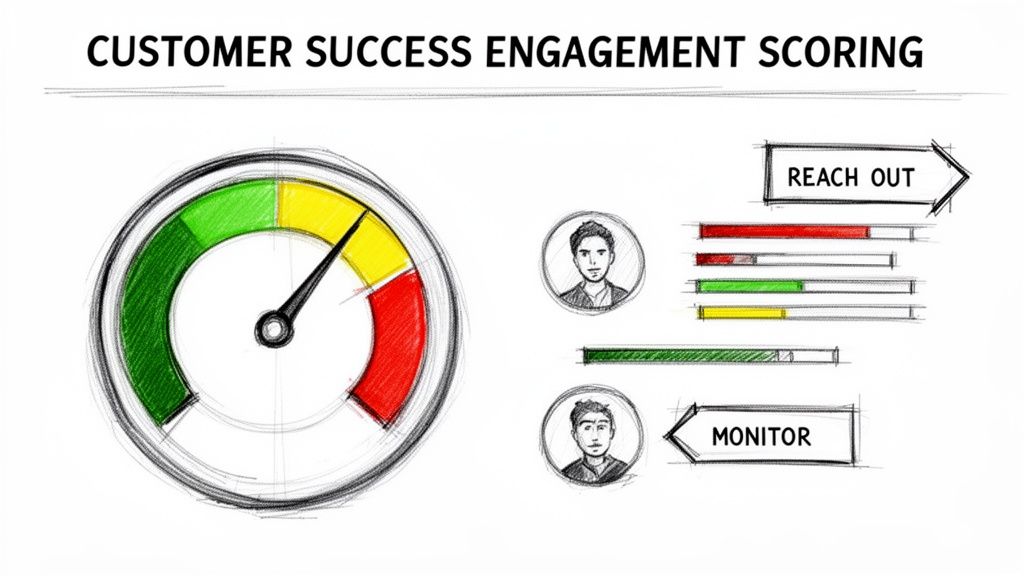
7. Customer Success & Engagement Scoring
Proactively managing customer health is one of the most effective SaaS customer retention strategies available. Customer success and engagement scoring models create a data-driven system to identify which customers are thriving, which are at risk of churning, and which are primed for expansion. By combining various data points into a single, actionable score, you can allocate your customer success resources with precision.
Instead of guessing which accounts need attention, an engagement score quantifies customer health based on their actual behavior. This metric typically blends product usage data, support ticket sentiment, and even email engagement into a holistic view. For B2B SaaS companies, this allows customer success managers (CSMs) to prioritize their efforts on accounts that show early warning signs of disengagement, long before they hit the cancellation button.
How It Works in Practice
Leading customer success platforms like Gainsight and Totango have built their businesses on this concept. They create comprehensive health profiles by tracking metrics like feature adoption rates, login frequency, support ticket volume, and NPS scores. For example, a customer whose weekly login frequency drops by 50% and has a recent negative support interaction would see their health score plummet, triggering an automated alert for their CSM to intervene.
Key Insight: An effective engagement score is predictive, not just descriptive. It shouldn't just tell you a customer is disengaged; it should identify the leading indicators of churn so you can act before it's too late. The goal is prevention, not just reaction.
Actionable Implementation Steps
Define Key Health Indicators: Start with a few core metrics. Good starting points include login frequency, adoption of "sticky" features, number of active users per account, and recent support ticket sentiment.
Assign and Weight Scores: Assign points to each indicator. For instance, logging in daily might be +5 points, while not logging in for 30 days is -20. Weight factors that have a high correlation with churn, like a drop in core feature usage, more heavily.
Create Tiers and Playbooks: Segment customers into health tiers based on their score (e.g., Healthy, At-Risk, Critical). Develop specific action plans for each tier, such as a strategic business review for healthy accounts or a proactive outreach campaign for at-risk ones.
Integrate and Automate: Connect your product analytics and CRM data to calculate scores automatically. Use a platform like SMASHSEND to trigger automated email sequences when a customer's score drops into an "At-Risk" category, offering help or educational resources.
8. Renewal & Contract Management Workflows
Proactive renewal and contract management workflows are a critical component of successful SaaS customer retention strategies. This approach involves automating communication sequences that begin well before a contract's expiration date, ensuring renewals are a deliberate, value-focused process rather than a last-minute scramble. It transforms the renewal from a simple transaction into a strategic opportunity to reinforce value, address potential issues, and drive expansion.
For B2B SaaS, where contracts are often annual, a significant portion of customers can be passive about renewal decisions. A structured workflow prevents these accounts from churning due to simple oversight and provides a clear runway to negotiate upsells. By automating the initial outreach, you ensure no customer is forgotten and free up your sales or success teams to focus on high-value conversations.
How It Works in Practice
A well-designed renewal workflow moves customers seamlessly toward a decision. For example, Salesforce initiates renewal conversations 90 days out, often including a report on usage and ROI to anchor the discussion in value. Similarly, Zendesk uses its renewal window to highlight new features released during the contract term, demonstrating continuous product improvement and justifying the ongoing investment.
Key Insight: The most effective renewal workflows don't start with the ask. They begin by reminding the customer of the value they've already received, using their own data to build an undeniable case for continuing the partnership.
Actionable Implementation Steps
Create a Multi-Touch Sequence: Start renewal outreach 90 days before the contract ends. This provides ample time for internal discussions and budget approvals on the client's side.
Lead with Value, Not an Invoice: Your first email (90 days out) should focus on the ROI and value delivered over the past year. Use a platform like SMASHSEND to pull in dynamic data, such as "You've saved your team X hours" or "You closed Y more deals."
Introduce New Opportunities: In your second email (60 days out), introduce new features or higher-tier plans relevant to the customer's usage patterns. This plants the seed for expansion.
Coordinate with Sales: For high-value or complex accounts, trigger a notification for the account manager to initiate a personal call. Automate the initial touchpoints, but ensure a human is involved for strategic negotiations.
Track and Optimize: Monitor renewal rates by sequence. A/B test your messaging, timing, and offers to understand what drives the highest retention and expansion rates.
9. Behavioral Trigger-Based Communication
Behavioral trigger-based communication is one of the most powerful SaaS customer retention strategies because it delivers hyper-relevant messages at the exact moment a customer is most receptive. This approach moves away from fixed, time-based schedules and instead uses specific user actions (or inactions) to trigger automated outreach. It's an event-driven model that maximizes relevance and engagement.
Instead of sending a generic "weekly tips" email, this strategy sends a message directly related to something a user just did. Because the communication is contextual and timely, triggered emails often see 2-3x higher open and click-through rates compared to traditional batch-and-blast campaigns, directly accelerating feature adoption and demonstrating product value.
How It Works in Practice
This strategy excels by focusing on critical micro-moments in the user journey. For example, Figma sends a congratulatory message when a user creates their first collaborative board, reinforcing positive behavior. Similarly, Stripe sends an instant payment confirmation receipt after a transaction, building trust and providing immediate value. These automated touchpoints make the user feel seen and guided.
Key Insight: The power of this strategy lies in its immediacy and context. A message triggered by an error state is infinitely more helpful than a generic FAQ link sent a week later. It solves a user's problem in real-time, preventing frustration that leads to churn.
Actionable Implementation Steps
Identify High-Impact Triggers: Map out key user actions that signal engagement or risk. Start with high-value triggers like first feature use, reaching a usage limit, a period of inactivity (e.g., 14 days without login), or encountering a common error.
Implement with Conditional Logic: Use a platform like SMASHSEND to build sophisticated workflows. For example, create a rule: If a user on a free plan uses an advanced feature three times, then trigger an email highlighting the benefits of the paid tier that includes it.
Test and Optimize Timing: Don't assume immediate is always best. A/B test trigger delays. An onboarding tip might be best sent an hour after first login, while a re-engagement email might be more effective after seven days of inactivity.
Use Throttling to Avoid Overload: Prevent message fatigue by setting frequency caps. For instance, limit triggered communications to a maximum of one per user per day to ensure each message has impact without overwhelming the customer.
To learn how to coordinate these triggers across different platforms, explore our guide to multi-channel marketing automation.
10. Content, Education & Community-Based Retention
This approach to customer retention shifts the focus from simply selling features to actively helping customers succeed with your product and in their industry. It involves creating valuable educational resources and fostering vibrant communities where users can learn, share best practices, and connect with peers. By investing in customer education and community, you build loyalty that transcends product functionality, positioning your brand as an indispensable partner in their growth.
Instead of waiting for customers to ask for help, this strategy proactively provides them with the knowledge to maximize your product's value. For B2B SaaS, this is a powerful way to demonstrate ongoing ROI. When customers are empowered, proficient, and connected to a network of fellow users, they are far less likely to churn and more likely to become advocates.
How It Works in Practice
Leading SaaS companies use this strategy to create deep, lasting relationships. HubSpot Academy, for example, offers free certifications that not only teach users how to use their platform but also enhance their professional skills, creating immense loyalty. Similarly, Figma's Community allows users to share templates and plugins, which reduces onboarding friction and accelerates time-to-value for new customers. These initiatives turn a software tool into a comprehensive ecosystem.
Key Insight: The most effective content and community strategies solve the customer's core business problems, not just their product-related questions. When you help them get better at their job, your product becomes an integral part of their success.
Actionable Implementation Steps
Create Journey-Based Content: Develop resources tailored to each customer stage: onboarding guides for new users, advanced strategy webinars for power users, and case studies for those nearing renewal.
Leverage Usage Data for Proactive Delivery: Use a platform like SMASHSEND to trigger educational content based on user behavior. If a user engages with a complex feature, automatically send them an advanced guide. If they show signs of disengagement, send them a "best practices" article.
Build a Knowledge-Sharing Hub: Choose a platform that fits your audience, like a Slack group for tech-savvy users or a dedicated forum for broader discussions. Seed it with initial content and empower community champions to drive engagement.
Measure Impact on Retention: Track content engagement metrics (views, downloads, completions) and community participation. Correlate this data with key retention metrics like churn rate, LTV, and expansion revenue to prove the ROI of your efforts.
📊 SaaS Retention Strategies: 10-Point Comparison
| Strategy | 🔄 Implementation Complexity | 💡 Resource Requirements | ⭐ Expected Outcomes | 📊 Ideal Use Cases | ⚡ Key Advantages |
|---|---|---|---|---|---|
| Lifecycle Email Marketing & Automation | 🔄 Moderate — journey mapping and multi-step workflows | 💡 Medium — email platform, integrations, templates, analytics | ⭐ High — improved engagement and lower churn | 📊 Onboarding, renewal, ongoing engagement for SaaS customers | ⚡ Scalable 24/7 messaging with higher ROI than batch sends |
| Personalization & Behavioral Segmentation | 🔄 High — dynamic content, conditional logic, real-time personalization | 💡 High — clean data infrastructure, enrichment, product telemetry | ⭐ Very High — higher open/CTR, conversions, increased LTV | 📊 Targeted onboarding, tailored upsells, precise re-engagement | ⚡ Highly relevant messaging that boosts conversion and retention |
| Proactive Churn Prevention & Win-Back Campaigns | 🔄 High — predictive models and health-score driven workflows | 💡 Medium–High — analytics, CS coordination, automation | ⭐ High — recovers at-risk customers and reduces churn | 📊 Intervening on declining-health or high-value at-risk accounts | ⚡ Early intervention with strong ROI on recovered ARR |
| Upsell & Cross-Sell Through Lifecycle Messaging | 🔄 Moderate — usage thresholds and timed expansion workflows | 💡 Medium — product analytics, content, sales/CS alignment | ⭐ High — increased expansion revenue and NRR | 📊 Accounts hitting limits or maturing teams ready to expand | ⚡ Cheaper revenue growth by expanding existing customers |
| Onboarding & Time-to-Value Acceleration | 🔄 Moderate — sequence design plus in-product guidance | 💡 Medium — content, in-app tooling, automation resources | ⭐ Very High — faster activation; significantly reduced early churn | 📊 New signups, trials, first-time user activation flows | ⚡ Speeds time-to-value and lowers early-stage churn/support load |
| Billing & Payment Recovery (Dunning Management) | 🔄 Low–Moderate — retry logic and compliance-aware sequences | 💡 Low–Medium — billing integration and payment processor links | ⭐ Moderate — recovers ~10–15% of involuntary churn | 📊 Failed payments and involuntary churn recovery | ⚡ Easy-to-implement automation with measurable recovery ROI |
| Customer Success & Engagement Scoring | 🔄 High — multi-source scoring models and ongoing validation | 💡 High — data integrations (product, support, CRM), analytics, CS processes | ⭐ High — prioritizes outreach and improves retention decisions | 📊 Resource allocation, identifying expansion-ready or at-risk accounts | ⚡ Efficient prioritization of CS effort to maximize impact |
| Renewal & Contract Management Workflows | 🔄 Moderate — scheduling, contract data and escalation paths | 💡 Medium — CRM/billing integration and cross-team coordination | ⭐ High — prevents accidental non-renewals and aids upsell timing | 📊 Contracted customers approaching renewal windows | ⚡ Improves revenue predictability and reduces last-minute churn |
| Behavioral Trigger-Based Communication | 🔄 High — real-time event tracking, API wiring and throttling | 💡 High — instrumentation, automation platform, product hooks | ⭐ Very High — 2–3× engagement; faster feature adoption | 📊 Micro-moments: signup, first feature use, inactivity or errors | ⚡ Timely, contextually relevant messages that change behavior fast |
| Content, Education & Community-Based Retention | 🔄 Moderate–High — continuous content strategy and community management | 💡 High — content creators, platform tooling, community moderators | ⭐ High — stronger adoption, advocacy, long-term retention | 📊 Scaling education, peer support, building product champions | ⚡ Scales knowledge and advocacy; generates UGC and reduced support burden |
From Strategy to System: Building Your Retention Flywheel
Navigating the landscape of B2B SaaS growth reveals a fundamental truth: acquisition opens the door, but retention builds the house. Throughout this guide, we've deconstructed the ten core pillars of modern SaaS customer retention strategies, moving from high-level concepts to granular, actionable playbooks. We've explored everything from the critical first impression of onboarding and time-to-value acceleration to the nuanced science of proactive churn prevention and the revenue-multiplying power of strategic upsell and cross-sell messaging.
The central theme connecting these tactics is a shift in mindset. Retention is not a series of disconnected campaigns or a last-ditch effort to save a canceling customer. Instead, it is a cohesive, interconnected system—a flywheel. Each strategy you implement, whether it's a behavioral trigger-based email or a sophisticated dunning management workflow, adds momentum to this flywheel, creating a self-reinforcing cycle of customer value, engagement, and loyalty.
Key Takeaways: From Individual Tactics to a Unified Engine
If you walk away with only a few core principles, let them be these:
Data is the Foundation: Every effective retention strategy begins with clean, accessible customer data. Behavioral segmentation isn't a "nice-to-have"; it's the engine that powers personalization, allowing you to move beyond generic blasts and deliver hyper-relevant communication that anticipates customer needs.
Automation is Your Scalpel: For SaaS companies in the $1M–$30M ARR range, manual efforts are unsustainable. Lifecycle automation is your tool for delivering precise, timely interventions at scale. From welcome sequences to renewal reminders and churn recovery flows, automation ensures no customer falls through the cracks.
Proactivity Trumps Reactivity: The most successful retention programs don't wait for cancellation signals. They use engagement scoring, product usage data, and behavioral triggers to identify at-risk accounts before they churn. This proactive stance transforms the customer success function from a reactive fire-fighting team into a strategic growth driver.
Your Actionable Next Steps
Building a comprehensive retention engine can feel daunting. The key is to start with a focused, high-impact approach. Don't try to boil the ocean by implementing all ten strategies at once.
Start with the Leakiest Buckets: Begin by auditing your customer journey. Is your biggest drop-off during onboarding? Is it involuntary churn from failed payments? Pinpoint your one or two most significant churn drivers and tackle them first. For many, this means prioritizing Onboarding & Time-to-Value Acceleration and Billing & Payment Recovery.
Implement One Core Automation Flow: Choose a single, high-leverage workflow to build out. A behavioral-based "feature adoption" campaign or a simple "at-risk user" re-engagement sequence can deliver measurable lift quickly and build internal momentum for more ambitious projects.
Unify Your Communication Stack: Ensure your transactional messages, marketing emails, and in-app notifications are all drawing from the same data source. A platform with a robust transactional API and deep segmentation capabilities is essential for creating the seamless, context-aware experience that defines elite SaaS customer retention strategies.
Ultimately, mastering customer retention is about building relationships at scale. It's about demonstrating value at every single touchpoint, from the first login to the tenth renewal. By systematically implementing these data-driven strategies, you do more than just lower your churn rate. You increase Net Revenue Retention (NRR), boost Customer Lifetime Value (CLV), and cultivate a base of loyal advocates who become your most powerful marketing channel. This is how sustainable, capital-efficient growth is achieved.
Ready to turn these retention strategies into automated, revenue-driving workflows? SMASHSEND provides the complete toolkit—from its AI-powered email editor and deep behavioral segmentation to a developer-friendly transactional API—designed to help you execute every playbook in this guide. See how SMASHSEND can help you build your retention flywheel today.
Frequently Asked Questions
Have a question not in here? Contact us
- What are the most effective SaaS customer retention strategies?
The most effective SaaS customer retention strategies include lifecycle email marketing automation, behavioral segmentation, proactive churn prevention, strategic upselling through lifecycle messaging, accelerated onboarding, dunning management for billing recovery, engagement scoring, renewal workflows, behavioral trigger-based communication, and content/community-based retention. These strategies work together to create a comprehensive retention flywheel.
- How can I reduce SaaS churn with automation?
You can reduce SaaS churn with automation by implementing behavioral trigger-based emails that respond to user actions in real-time, setting up automated win-back campaigns for at-risk customers, creating lifecycle email sequences that guide users to value, automating dunning sequences for failed payments, and using engagement scoring to identify and proactively address at-risk accounts before they churn.
- What is the best customer retention rate for B2B SaaS?
For B2B SaaS companies, a good annual retention rate is 85-90%, while excellent companies achieve 90-95%. Monthly churn rates should ideally be below 5% for B2B SaaS. However, retention rates vary by industry, customer size (enterprise customers typically have higher retention), and product maturity. The key is to benchmark against your specific segment and continuously improve.
- How do I implement behavioral segmentation for customer retention?
Implement behavioral segmentation by first defining key user actions and engagement levels (power users, inactive users, users nearing limits), then using your product analytics to track these behaviors. Create segments based on login frequency, feature adoption, support interactions, and subscription tier. Use a platform like SMASHSEND to trigger automated, personalized messages based on these behavioral segments.
- What metrics should I track for SaaS customer retention?
Key SaaS retention metrics include: Customer Churn Rate, Net Revenue Retention (NRR), Customer Lifetime Value (CLV), Time-to-Value (TTV), Product Adoption Rate, Customer Health Score, Expansion Revenue Rate, and Support Ticket Volume. Monitor both leading indicators (engagement, feature adoption) and lagging indicators (churn, revenue) to get a complete picture of customer health.
- How does email marketing automation improve customer retention?
Email marketing automation improves customer retention by delivering timely, relevant messages throughout the customer lifecycle. It ensures consistent communication, personalizes the user experience at scale, proactively addresses user needs before problems arise, guides users to value faster through onboarding sequences, and re-engages dormant users with win-back campaigns. Automated emails generate 320% more revenue than non-automated emails.