
The 12 Top Marketing Automation Platforms for B2B SaaS in 2026
Choosing from the top marketing automation platforms is a strategic decision that directly impacts your ability to activate users, expand accounts, and increase Annual Recurring Revenue (ARR). The right platform acts as a 24/7 engine for your growth, automating critical touchpoints across the entire customer lifecycle, from initial onboarding to long-term retention.
However, the market is crowded with options, from all-in-one CRM suites to specialized, revenue-focused tools. This guide cuts through the noise to provide a detailed, practical comparison of the 12 best options for B2B SaaS companies today. We analyze each platform's core strengths, honest limitations, and ideal use cases to help you identify the perfect fit for your team's specific goals. To fully grasp the capabilities and benefits of the platforms discussed, it's helpful to first understand What is Marketing Automation?.
This resource is designed for growth marketers, product-led teams, and revenue leaders seeking higher ROI. Whether you're migrating from a basic tool like Mailchimp or scaling a sophisticated lifecycle strategy, you will find actionable insights here. We skip the generic marketing copy and focus on what truly matters:
In-depth feature analysis: We look at automation, deliverability, API capabilities, and CRM functions.
Real-world use cases: See how each platform performs for specific B2B SaaS needs.
Practical considerations: We cover pricing tiers, implementation challenges, and migration notes.
Each review includes screenshots and direct links, giving you everything needed to build your shortlist and make an informed decision without wading through countless vendor websites. Let's find the automation engine that will power your company's growth.
1. SMASHSEND
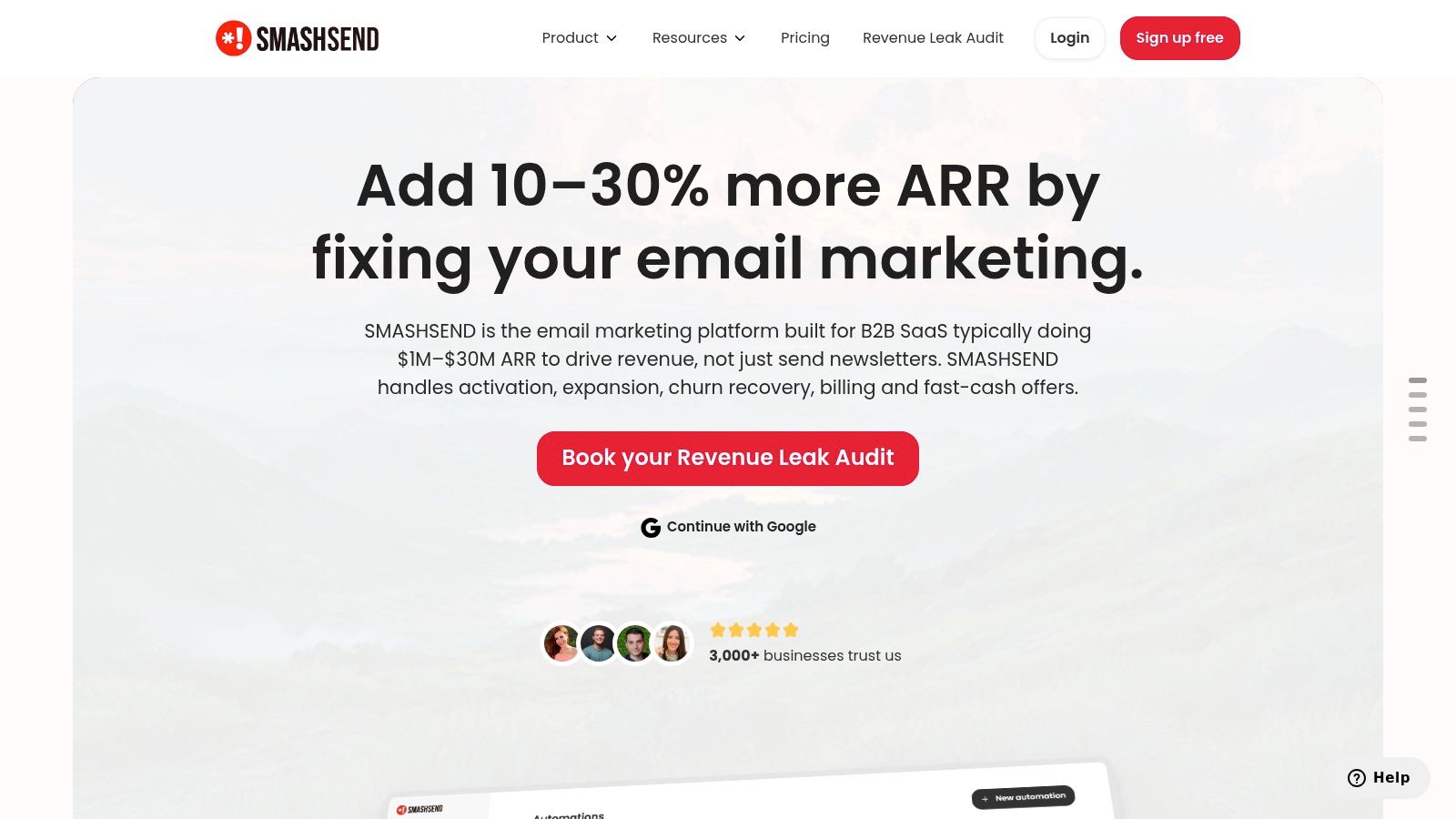
SMASHSEND positions itself as a revenue-first email platform, making it a compelling choice for B2B SaaS companies in the $1M–$30M ARR range. Unlike generic tools focused on newsletters, its entire feature set is engineered to directly impact key financial metrics. The platform combines lifecycle CRM, powerful automation workflows, and transactional email to activate users, drive expansion revenue, and reduce churn.
The platform's core promise is to add 10–30% more ARR through intelligent, automated lifecycle communications that run 24/7. This focus on tangible financial outcomes makes it one of the top marketing automation platforms for growth-stage SaaS businesses where every marketing dollar must be justified.
Key Differentiators and Use Cases
SMASHSEND's strength lies in its specialized approach. The doc-like AI Email Editor, powered by models like GPT-5 and Claude, enables teams to create highly personalized campaigns efficiently. Features like conditional content blocks and dynamic merge fields, enriched with behavioral and firmographic data (company size, industry), allow for tailored messaging that resonates.
Practical Use Cases:
Onboarding: Trigger automated sequences based on user actions (or inactions) to guide new signups toward activation milestones.
Billing Recovery: Automatically run dunning campaigns to recover failed payments and prevent involuntary churn.
Expansion Revenue: Use behavioral segmentation to identify engaged users and trigger upsell or cross-sell campaigns for higher-tier plans.
Win-back Flows: Re-engage inactive or canceled users with targeted offers based on their past usage patterns.
Deliverability and Integration
A standout feature is the platform's obsessive focus on deliverability. SMASHSEND provides dedicated IP pools, automated warmup, and guided SPF/DKIM/DMARC setup to ensure emails land in the inbox, not the spam folder. This is a critical factor for SaaS companies relying on transactional and lifecycle emails to function.
For developers and operations teams, the platform is built to be integration-friendly. It offers a fully documented API, webhooks, and a native Zapier integration. A streamlined migration path from tools like Mailchimp is also provided to reduce the friction of switching platforms. If you're looking to explore the advantages of this type of system, you can learn more about the benefits of marketing automation from SMASHSEND.
Best For: B2B SaaS companies, product-led growth teams, and revenue leaders seeking to directly tie email marketing efforts to ARR growth.
| Feature Highlights | Assessment |
|---|---|
| Automation Focus | Revenue Lifecycle (Onboarding, Upsell, Churn Recovery) |
| Deliverability Stack | Excellent (Dedicated IPs, Auto-Warmup, Expert Setup) |
| Core Strengths | AI-powered editor, behavioral segmentation, ARR-focused workflows |
| Limitations | SOC2 and GDPR compliance are in progress; transactional email is in BETA |
Pricing: Specific pricing tiers are not listed. SMASHSEND offers a free sign-up and encourages booking a "Revenue Leak Audit" or a growth strategy session for detailed plans.
2. HubSpot Marketing Hub
HubSpot Marketing Hub stands out as an all-in-one solution, making it one of the top marketing automation platforms for teams seeking a unified system. Its core strength lies in its tight integration with the native HubSpot CRM, which centralizes all customer data from marketing, sales, and service interactions. This provides a single source of truth, enabling highly personalized and context-aware automation without complex third-party integrations.
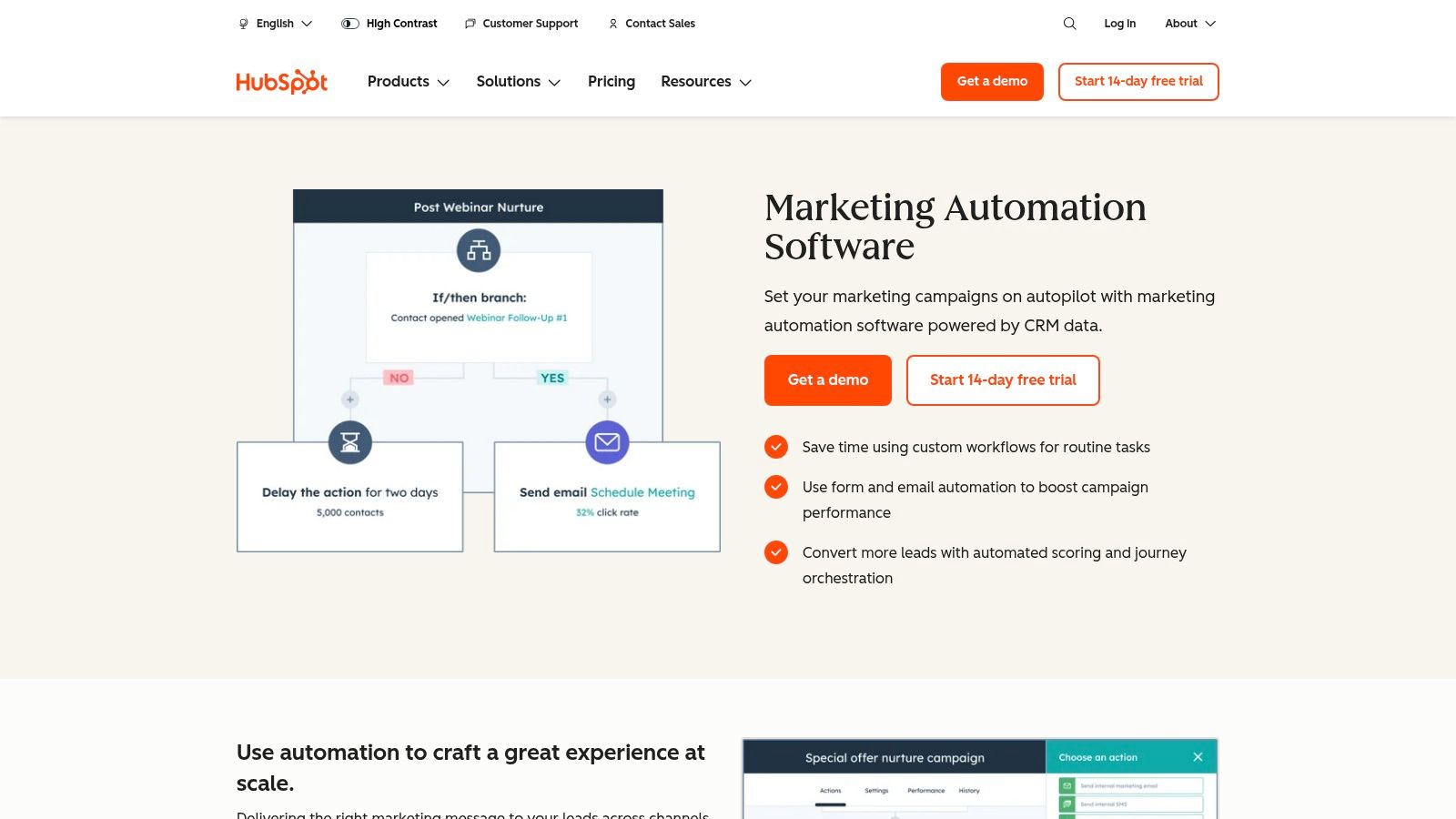
The platform is best suited for B2B SaaS companies that prioritize ease of use and a comprehensive feature set over granular API-level control. Its visual workflow builder simplifies the creation of sophisticated lead nurturing sequences, internal notifications, and data management tasks. For SaaS businesses, this means you can automate everything from trial onboarding emails to re-engagement campaigns based on in-app user behavior tracked via custom events.
Key Features and Considerations
HubSpot excels in providing a robust, user-friendly experience backed by extensive educational resources and support, which is invaluable for growing teams. However, the convenience comes at a price.
Pricing: Tiers are transparent and published online, starting with a limited free plan and scaling up to Enterprise. Costs increase significantly based on marketing contact count and the number of paid seats, which can become a major expense for fast-growing databases.
Onboarding: Professional and Enterprise tiers require a mandatory paid onboarding fee, which can range from a few thousand to several thousand dollars. This ensures proper setup but adds to the initial investment.
Best For: Teams that need a single platform for marketing, sales, and service and want to avoid the technical overhead of managing separate tools. If your team is already invested in the HubSpot ecosystem, this is a natural and powerful choice for your automation needs. Explore more about how platforms like this support a wider strategy in this guide to multi-channel marketing automation on smashsend.com.
3. ActiveCampaign
ActiveCampaign positions itself as a customer experience automation platform, extending beyond traditional email marketing to include multi-channel communication and a built-in CRM. Its primary advantage lies in the depth and flexibility of its automation builder, which allows for sophisticated logic, segmentation, and personalization. This makes it a strong contender among the top marketing automation platforms for SMBs and mid-market B2B companies that have outgrown simpler tools and need more granular control over their customer journeys.
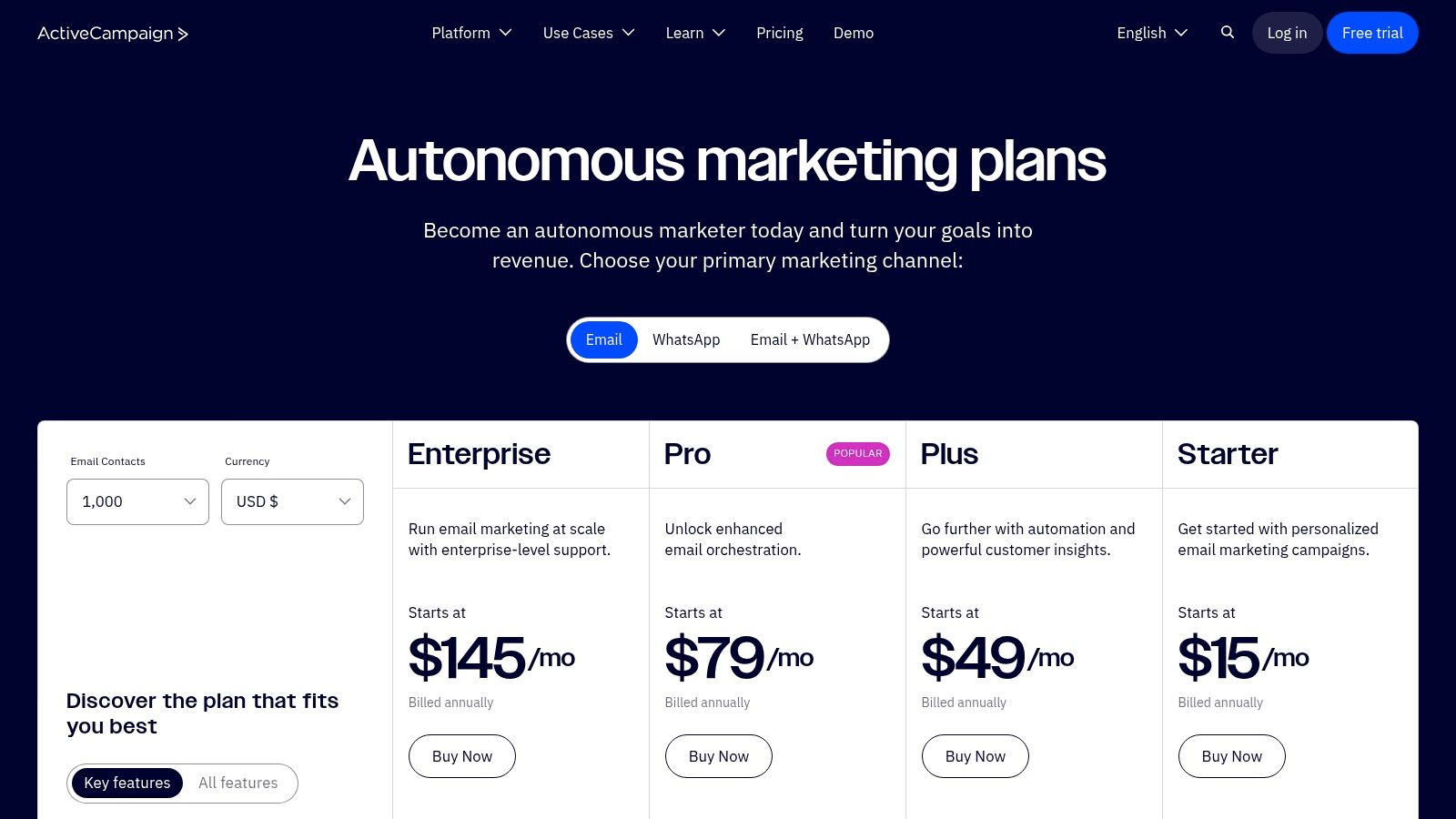
The platform is best suited for businesses that require powerful automation without the enterprise-level price tag of platforms like HubSpot. For SaaS companies, this means you can create highly specific workflows based on user behavior, trial status, or subscription events. The addition of channels like SMS and WhatsApp, combined with native CRM automation, provides a more holistic view and engagement strategy for the entire customer lifecycle.
Key Features and Considerations
ActiveCampaign excels at providing advanced automation capabilities at a competitive price point, supported by valuable resources like free migrations and training workshops. However, its pricing and complexity can be a double-edged sword.
Pricing: Plans are organized by primary channel (Email & Automation, Sales, etc.) and scale with contact count. While some tiers are published, many higher-level plans are quote-based, requiring direct contact with sales to understand the full investment.
Onboarding: The platform offers extensive support resources, including ActiveTraining and workshops, which are crucial for mastering its powerful features. The learning curve can be steeper than all-in-one solutions, especially for complex database structures.
Best For: Growth-focused teams needing robust, multi-step automation sequences and segmentation. Its powerful features are ideal for implementing strategies like those discussed in guides to workflow marketing automation on smashsend.com, making it a great fit for businesses ready to graduate from basic email marketing.
4. Mailchimp
Mailchimp is often the first platform teams encounter when they begin email marketing, making it a familiar name among marketing automation platforms. Its primary appeal lies in its simplicity and approachable user interface, which lowers the barrier to entry for small businesses and early-stage B2B SaaS companies just starting to build their email lists. The platform offers a straightforward path from simple newsletters to more complex, automated customer journeys.
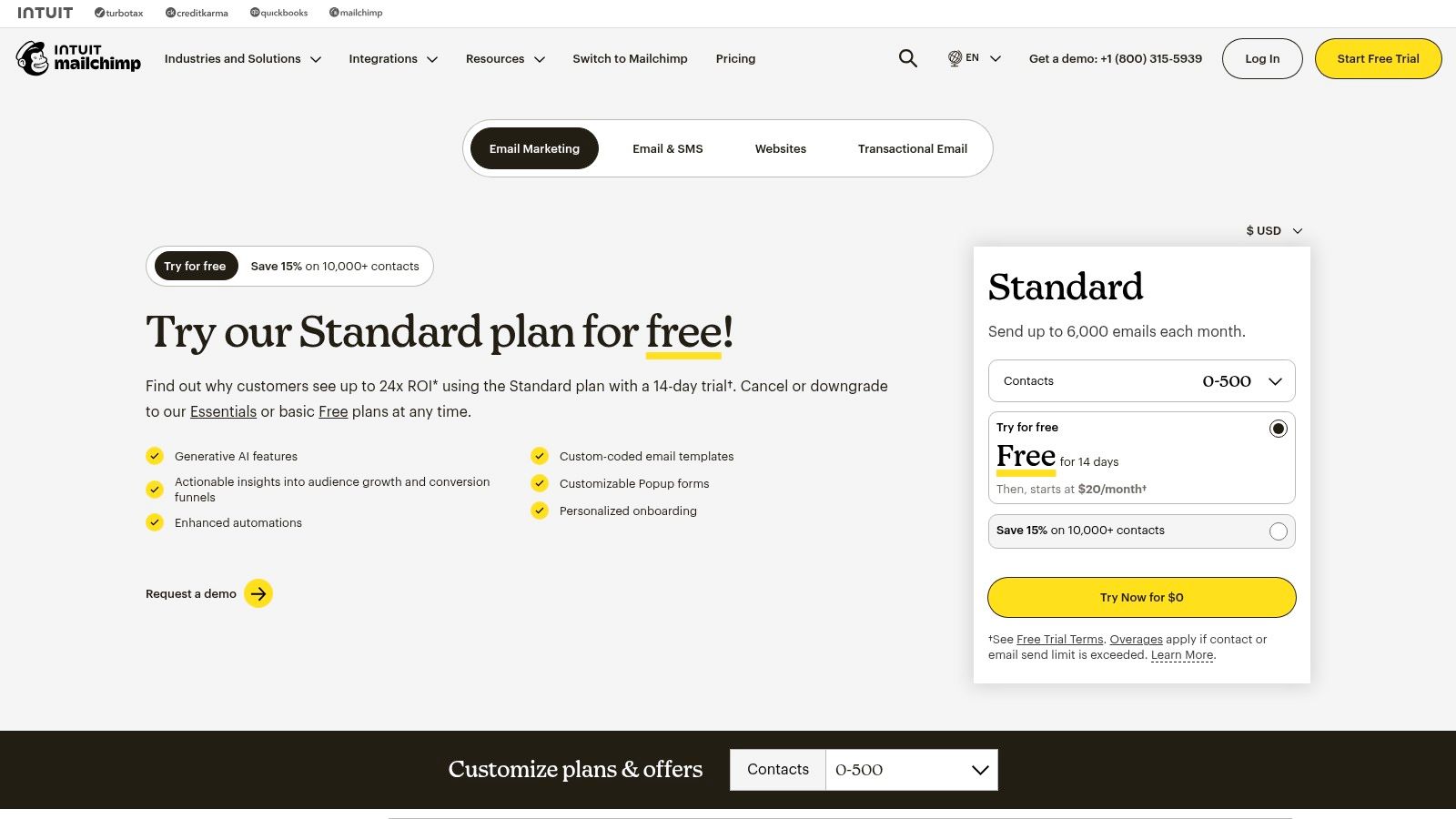
The platform is best suited for businesses with simple automation needs, such as welcome series, abandoned cart reminders, or basic re-engagement campaigns. Its pre-built journey templates and AI-assisted content tools help teams launch campaigns quickly without a steep learning curve. For a SaaS company, this could mean setting up a basic onboarding sequence or announcing new features to a segmented list with minimal technical setup.
Key Features and Considerations
Mailchimp excels at user-friendly email creation and campaign management but can become limiting and costly as a company's automation requirements grow more sophisticated.
Pricing: Mailchimp offers a free plan with tight limits on contacts and sends. Paid plans scale based on contact count, and costs can escalate quickly, especially when adding features like advanced segmentation or SMS, which is available as a paid add-on.
Onboarding: The platform is entirely self-serve, with an extensive knowledge base and a large library of templates. This makes it easy to get started without mandatory setup fees, which is a major advantage for budget-conscious teams.
Best For: Startups and SMBs that need an easy-to-use tool for fundamental email marketing and automation. It is an excellent starting point, but fast-growing SaaS companies often migrate to more powerful platforms as they require deeper integrations and more advanced workflow capabilities.
5. Adobe Marketo Engage
Adobe Marketo Engage is a true enterprise-grade solution, solidifying its place among the top marketing automation platforms for large, complex B2B organizations. Its primary strength is its profound focus on lead management, account-based marketing (ABM), and advanced revenue attribution. This makes it an ideal choice for companies with long sales cycles and multiple decision-makers, where understanding the entire customer journey is critical.
The platform is designed for deep integration, particularly with major CRMs like Salesforce and Microsoft Dynamics. This allows for sophisticated, bidirectional data synchronization that powers highly targeted campaigns and provides sales teams with critical marketing intelligence. For B2B SaaS, this means you can orchestrate complex ABM plays, score accounts based on multi-touch engagement, and deliver detailed attribution reports directly within your sales team's native environment.
Key Features and Considerations
Marketo's power lies in its scalability and depth, but this comes with significant complexity and cost, making it less suitable for teams without dedicated marketing operations resources.
Pricing: All pricing is sales-quoted with no public figures available. Packages (Growth, Select, Prime, Ultimate) are based on database size, feature sets, and API access, making it one of the more expensive options on the market.
Onboarding: Implementations are typically heavy and often require specialized consultants or extensive internal expertise. This is not a plug-and-play solution and demands a significant upfront investment in time and resources to configure correctly.
Best For: Enterprise-level B2B companies with a mature marketing operations function already using Salesforce or Microsoft Dynamics. If your organization requires granular control, advanced ABM capabilities, and multi-touch revenue attribution at scale, Marketo is a formidable contender.
6. Salesforce Marketing Cloud Account Engagement (Pardot)
Salesforce Marketing Cloud Account Engagement, widely known by its former name Pardot, is one of the top marketing automation platforms specifically built for B2B companies whose sales process lives within the Salesforce ecosystem. Its primary strength is its native, deep integration with Salesforce CRM. This connection allows marketing and sales teams to work from a unified dataset, enabling seamless lead handoffs, synchronized campaign data, and highly targeted automation based on CRM objects and activities.
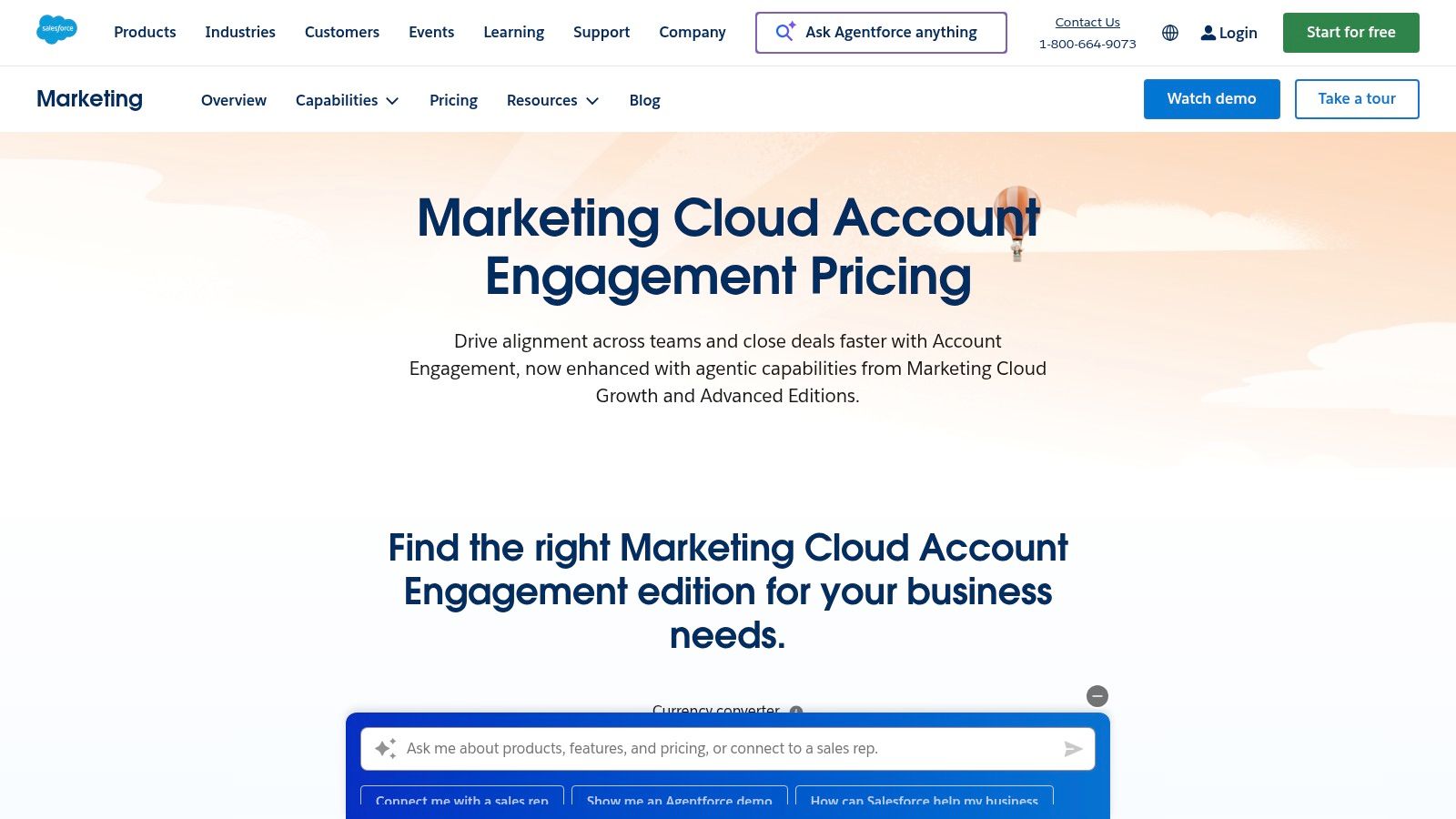
The platform is best suited for established enterprise B2B organizations where Salesforce is the undisputed system of record. Its powerful lead scoring and grading models help marketing qualify leads before they ever reach a sales rep, while its sophisticated nurturing workflows guide prospects through complex, long buying cycles. Features like business units and sandboxes in higher-tier plans provide the governance and testing environments required by larger, more complex companies.
Key Features and Considerations
Pardot excels at creating tight alignment between marketing efforts and sales outcomes, offering comprehensive reporting that directly ties marketing campaigns to pipeline and revenue within Salesforce. However, this enterprise-grade power comes with complexity and significant cost.
Pricing: US pricing is published online and starts at a high entry point, with four editions available. Costs are structured around blocks of contacts and require annual contracts, scaling significantly as your database or need for features like business units grows.
Implementation: The deep integration with Salesforce often requires a specialized implementation partner or dedicated internal resources to configure correctly and maintain, adding to the total cost of ownership.
Best For: B2B companies deeply embedded in the Salesforce CRM ecosystem that need robust marketing and sales alignment. If your sales team lives and breathes Salesforce, Pardot is a powerful, albeit expensive, choice for your marketing automation needs.
7. Klaviyo
Klaviyo has established itself as a dominant force in e-commerce, making it one of the top marketing automation platforms for direct-to-consumer brands. Its primary strength lies in its deep, real-time integrations with commerce platforms like Shopify and BigCommerce, enabling hyper-targeted segmentation based on customer purchase history, browsing behavior, and predictive analytics. This allows for sophisticated automations like abandoned cart reminders with dynamic product recommendations and back-in-stock notifications.
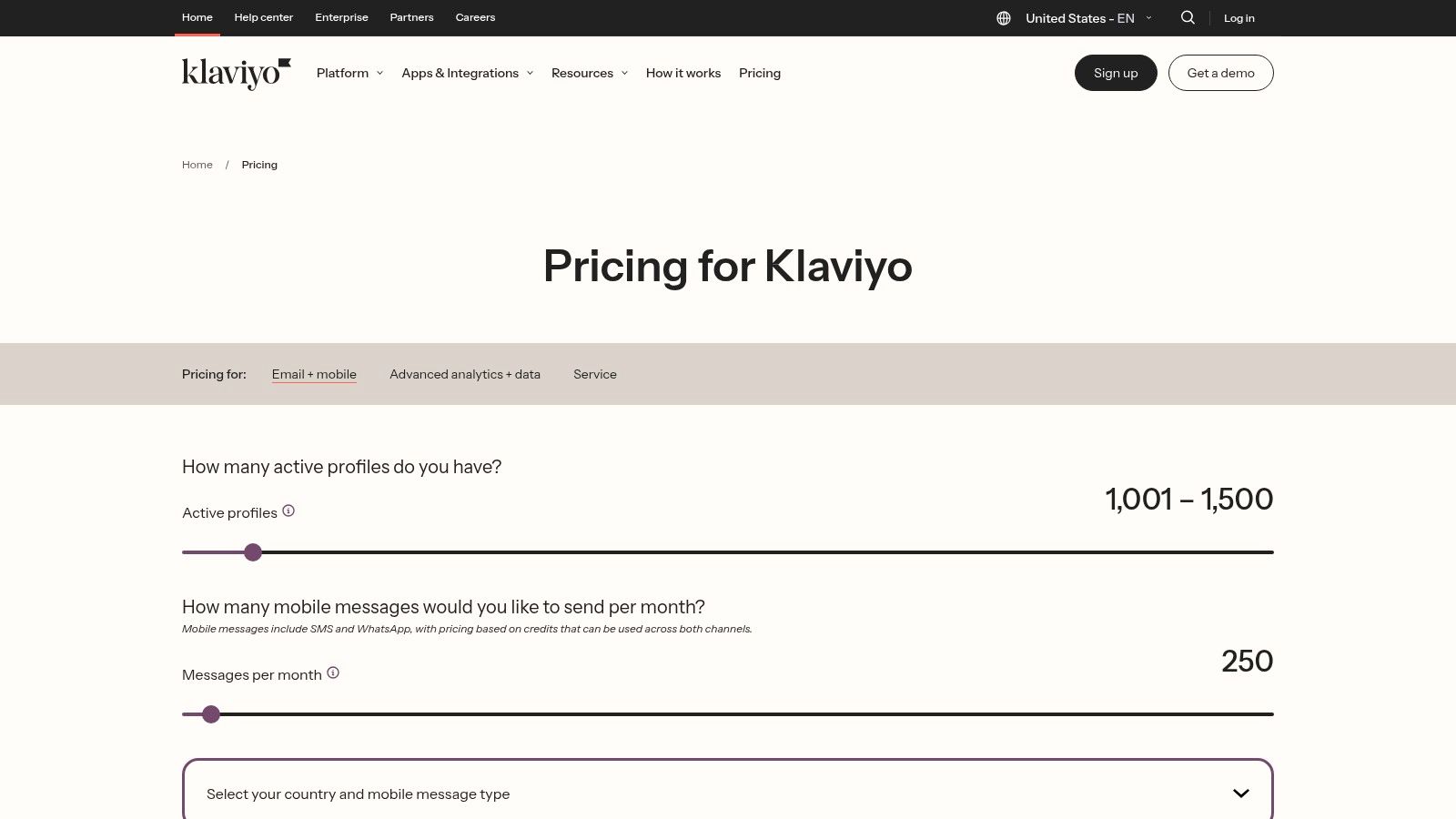
While its core focus is B2C, its powerful segmentation engine and robust feature set can be adapted for certain B2B SaaS use cases, particularly for high-volume, product-led companies with transactional business models. The platform's ability to combine email and SMS channels into a single, unified customer journey provides a significant advantage for engaging users across multiple touchpoints. Its library of over 350 integrations ensures it can connect with most existing tech stacks.
Key Features and Considerations
Klaviyo excels at providing commerce-native functionality that delivers a fast time-to-value, especially for teams without extensive development resources. However, scaling costs and support limitations are important factors to consider as your business grows.
Pricing: A transparent slider-based model is used for both email and SMS, based on active profiles and message credits. A free tier is available for up to 250 contacts, making it accessible for testing. Costs can escalate quickly as your contact list and messaging volume increase.
Onboarding: The platform is known for its user-friendly onboarding, allowing teams to get started quickly. However, the level of customer support is directly tied to your monthly spending tier, with dedicated support reserved for higher-paying customers.
Best For: E-commerce and direct-to-consumer brands that need powerful, out-of-the-box segmentation and automation tightly integrated with their sales platform. It is also a strong choice for companies prioritizing a combined email and SMS marketing strategy.
Website: https://klaviyo.com/pricing
8. Iterable
Iterable positions itself as a powerful cross-channel customer engagement platform, designed for businesses that need to deliver unified experiences across email, SMS, push, and in-app messaging. Its key differentiator is the ability to ingest and act on real-time user data, enabling dynamic and highly individualized communication at scale. This makes it one of the top marketing automation platforms for B2C or product-led B2B companies with large user bases.
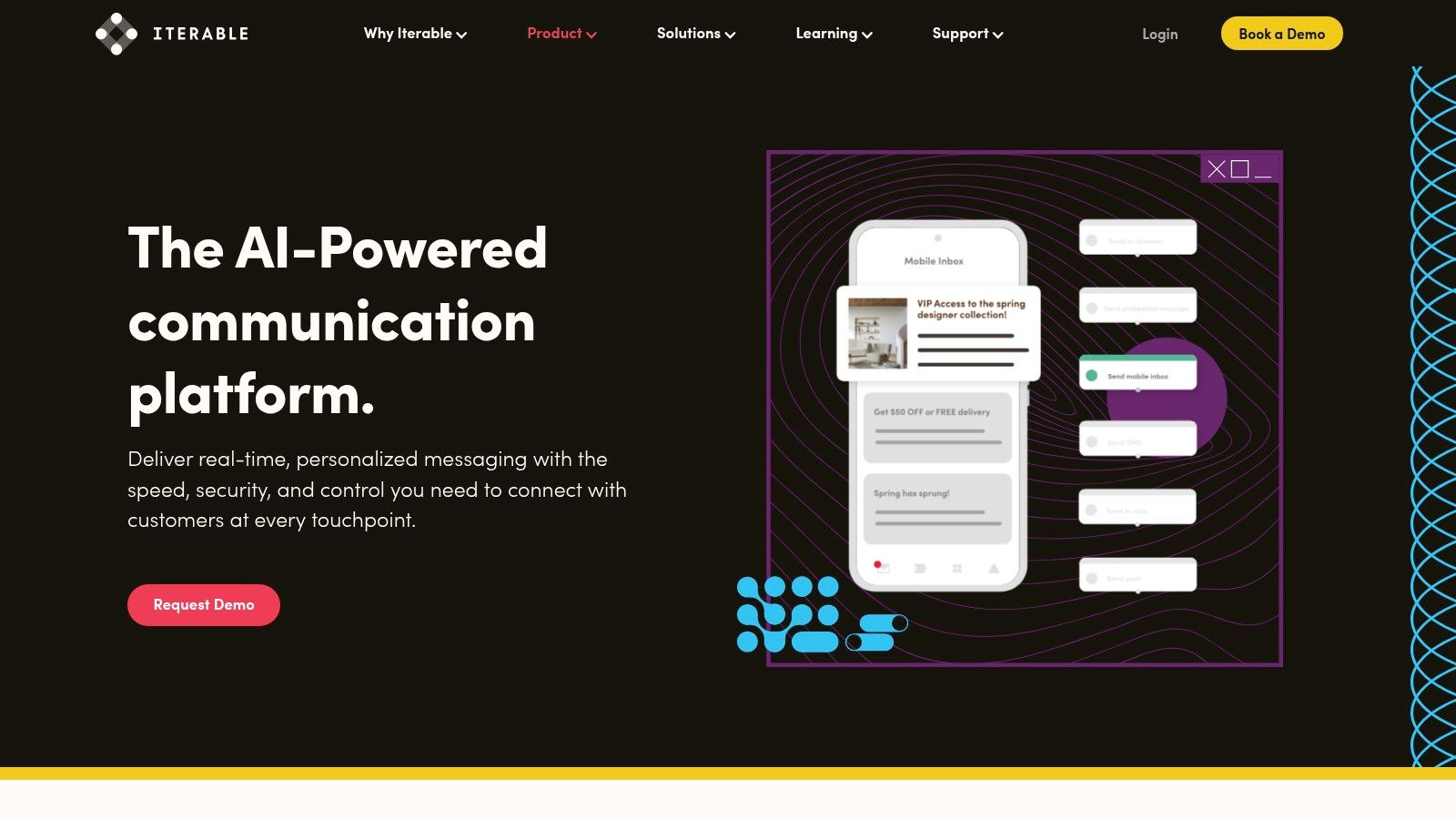
The platform is engineered for enterprise-level demands, focusing on scalability and open data integrations. Its AI-assisted personalization and journey orchestration tools allow marketers to create complex, responsive campaigns that adapt to individual user behaviors in the moment. For instance, a SaaS business can trigger an in-app message based on feature usage and immediately follow up with a personalized email, all within a single workflow.
Key Features and Considerations
Iterable is built for sophisticated marketing teams that require deep data integration and real-time responsiveness, but this power comes with an enterprise-level purchasing process and commitment.
Pricing: No public pricing is available. Contracts are customized for enterprise clients, often involving Master Service Agreements (MSAs) and significant annual commitments with prepaid, non-cancellable terms.
Onboarding: The purchasing process is sales-assisted, and implementation typically requires dedicated resources to integrate data sources and configure the platform for optimal use.
Best For: Enterprise-scale companies, especially in mobile-first B2C industries or large B2B SaaS, that need a robust, scalable solution for 1:1 personalization across multiple communication channels and have the technical resources to support its open data model.
Website: https://iterable.com/product
9. Braze
Braze is a customer engagement platform that excels in mobile-first communication, making it one of the top marketing automation platforms for product-led B2B SaaS and consumer-facing apps. Its primary strength is its powerful mobile and app channel capabilities, including push notifications and in-app messaging, seamlessly integrated with traditional channels like email and web. This allows teams to create truly cross-channel journeys that engage users based on their real-time behavior.
The platform is designed for teams that prioritize deep user engagement and retention driven by product usage data. Its journey orchestration tool, Canvas, enables marketers to build sophisticated, multi-step campaigns that react to user actions across any channel. For SaaS businesses with a significant mobile presence, this means you can orchestrate onboarding flows that combine in-app messages with follow-up emails, or re-engage dormant users with targeted push notifications.
Key Features and Considerations
Braze offers a powerful, enterprise-grade solution, but its evaluation and adoption process reflects its market position. The availability of a trial makes it stand out against competitors at this level.
Pricing: Pricing is quote-based and requires interaction with their sales team. It's generally positioned at the higher end of the market, suitable for well-funded startups and established companies.
Onboarding: The platform offers a hands-on, 14-day free trial that allows teams to explore its capabilities without a credit card. Full implementation and onboarding, however, are typically sales-led processes. They also have a startup program offering free access for eligible companies.
Best For: Mobile-first or product-led SaaS companies that need robust, cross-channel engagement tools. If your user journey heavily involves a mobile app, Braze provides a specialized and powerful toolkit that generalist platforms often lack.
Website: https://braze.com
10. Customer.io
Customer.io is a data-driven messaging platform designed for technical teams that need to send automated messages across multiple channels. Its core strength lies in its flexible data model and powerful API, which allow for deeply personalized campaigns based on real-time user behavior. This makes it a strong contender among top marketing automation platforms for product-led businesses and those in regulated industries like health tech.
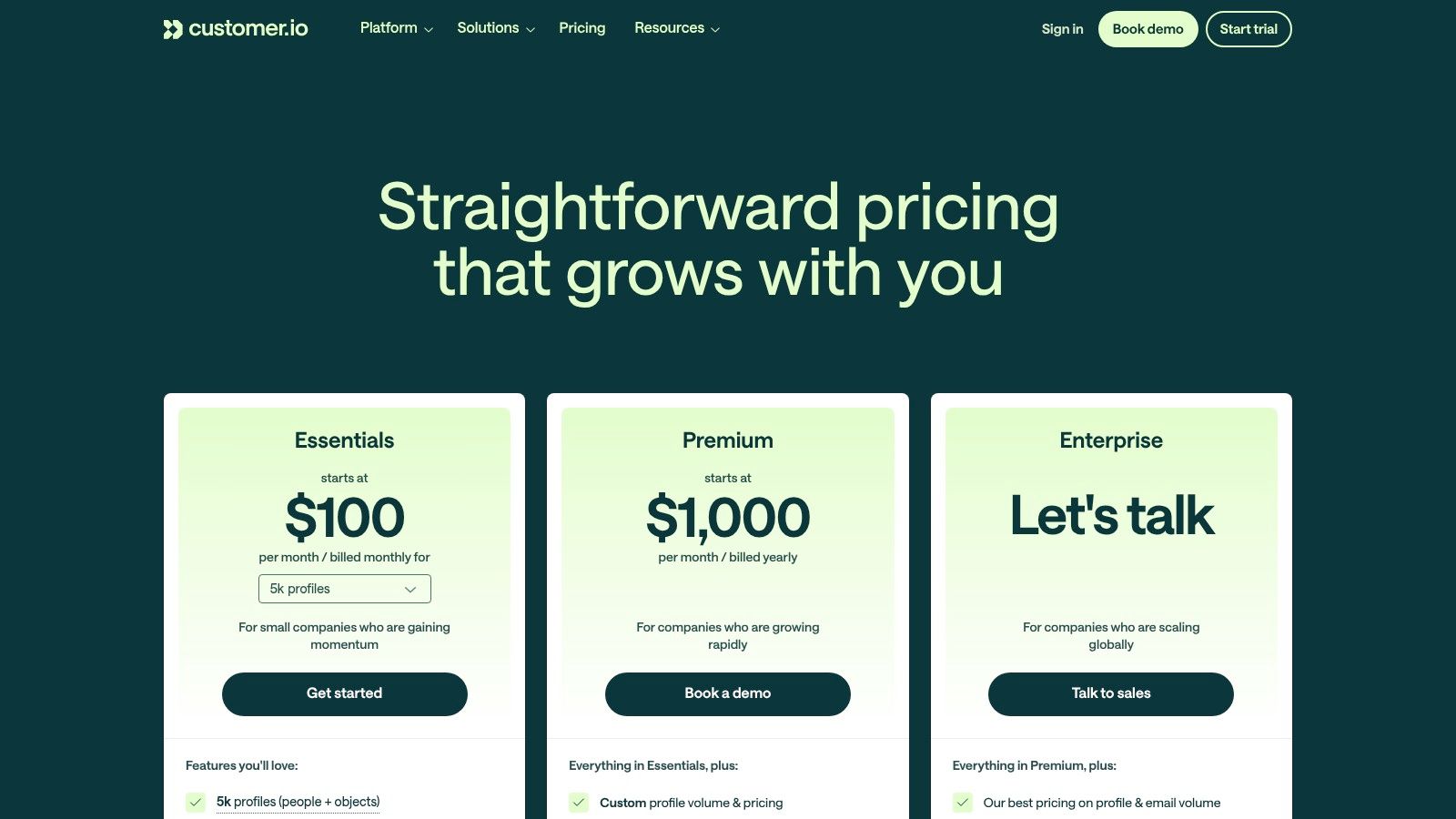
The platform is best suited for B2B SaaS and mobile-first companies that require granular control over their data and messaging logic. Its "Journeys" feature enables the creation of complex, multi-channel workflows incorporating email, SMS, push notifications, and webhooks. For developers, this means you can trigger transactional messages or update third-party systems directly from an automation sequence, offering a high degree of integration and flexibility.
Key Features and Considerations
Customer.io excels in its developer-friendly approach and generous sending limits on entry-level plans, but its pricing model can be a point of friction for some teams.
Pricing: The model is based on the number of user profiles, with high-volume email sends included. However, pricing is based on a "high-watermark," meaning you are billed for the peak number of profiles in your account during a billing period, which can lead to unpredictable costs. Premium plans require annual billing.
Onboarding: The platform is more technical than many competitors. While powerful, teams without dedicated developer resources may face a steeper learning curve when setting up complex data models and integrations.
Best For: Product-led companies with engineering resources that need to send behavior-triggered messages across email, push, and SMS. Its HIPAA-compliant options also make it a go-to choice for businesses in the healthcare space needing a secure and flexible messaging solution.
Website: https://customer.io/pricing
11. G2
While not a platform itself, G2 is an indispensable resource for researching and validating the top marketing automation platforms. It functions as an independent software marketplace driven by verified user reviews, providing unbiased insights that cut through vendor marketing claims. Its core value lies in aggregating real-world feedback on everything from ease of use and implementation to the quality of customer support, allowing teams to shortlist vendors with confidence.
The platform is best used during the discovery and due diligence phases. B2B SaaS companies can leverage its powerful filtering to narrow down options by company size, specific features like A/B testing or dynamic content, and user satisfaction ratings. The side-by-side comparison grids are particularly useful for creating a data-backed business case for a new tool, directly stacking up features and user-reported pros and cons of your top three to four contenders.
Key Features and Considerations
G2's strength is its large volume of recent, role-specific reviews, which helps ensure the information is current and relevant to your needs. However, it's crucial to use it as a starting point, not the final word.
Pricing: Access to reviews and comparison tools is free for buyers. Vendors pay for enhanced profiles and lead generation, so be mindful of sponsored placements that may influence visibility.
Onboarding: N/A as it is a review marketplace. The user experience is straightforward, requiring only a free account (often linked via LinkedIn for verification) to access in-depth content.
Best For: Teams in the initial research phase who need to build a shortlist of potential vendors based on authentic user feedback. It is an excellent tool for validating marketing claims and discovering niche platforms that may not appear in other "top 10" lists. Always verify pricing and feature specifics directly with the vendors.
12. Capterra
While not a platform itself, Capterra is an indispensable resource for researching and comparing the top marketing automation platforms. It functions as a comprehensive software directory, aggregating verified user reviews, detailed buyer guides, and feature comparisons. Its core value lies in offering a vendor-agnostic starting point for your market scan, allowing you to quickly build a shortlist based on real-world user feedback and specific business needs.
The site is best suited for teams in the initial discovery phase who need to understand the landscape of available tools. For B2B SaaS companies, its filters for industry, company size, and specific features (like lead scoring or A/B testing) are particularly useful. You can quickly generate a list of potential solutions, compare them side-by-side, and read in-depth reviews from peers to understand the practical pros and cons of each system before committing to demos.
Key Features and Considerations
Capterra provides a high-level overview that saves significant time during the initial research phase, helping you identify frontrunners and alternatives you might have otherwise missed. However, its information should be a starting point, not the final word.
Pricing: The platform offers pricing snapshots and filters, but these are often general and may not reflect the latest vendor pricing. Always verify costs directly on the vendor's website, as they can change frequently.
Onboarding: This is a free research tool with no onboarding process. The user experience is straightforward, focusing on search, filtering, and comparison functionalities.
Best For: Teams at the beginning of their buying journey who need to survey the market, create a longlist of potential vendors, and leverage peer reviews to narrow down their choices. It is especially valuable for discovering niche or industry-specific marketing automation tools alongside major players.
Top 12 Marketing Automation Platforms — Quick Feature & Pricing Comparison
| Product | Core features | Deliverability & Security | AI & Personalization | Target audience & Value | Price & Rating |
|---|---|---|---|---|---|
| SMASHSEND 🏆 | Lifecycle CRM + broadcasts, workflows & transactional email ✨ | Dedicated IPs, auto-warmup, SPF/DKIM/DMARC; GDPR/SOC2 in progress ✨ | Doc-like AI Editor (GPT-5/Claude/Gemini), conditional blocks, deep personalization ✨ | 👥 B2B SaaS ($1M–$30M ARR); revenue-first — claims +10–30% ARR 🏆 | Free sign-up; contact for tiers 💰 ★★★★☆ |
| HubSpot Marketing Hub | Full-funnel automation: email, journeys, landing pages, ads | Standard deliverability; enterprise support & onboarding | AI content tools; visual journey builders | 👥 Teams wanting an all‑in‑one CRM-native stack; strong enablement | Published tiers; costs scale with contacts 💰 ★★★★☆ |
| ActiveCampaign | Advanced automations, CRM, SMS/WhatsApp options | Good deliverability; migration services available | Modern AI features + deep segmentation | 👥 SMB → midmarket needing multi-channel automation | Tailored pricing by contacts/channels 💰 ★★★★☆ |
| Mailchimp | Email, prebuilt journeys, templates & basic CRM | Standard deliverability; free tier limits | AI-assisted content & templates | 👥 Small SMBs and beginners getting started | Free tier; upgrades escalate with contacts 💰 ★★★☆☆ |
| Adobe Marketo Engage | Enterprise ABM, attribution, API packages | Enterprise-grade security; heavy implementations | Personalization & attribution at scale | 👥 Large B2B enterprises with complex ABM needs | Quote-based enterprise pricing 💰 ★★★★☆ |
| Salesforce Pardot (Account Engagement) | Lead scoring, nurturing, campaign analytics; Salesforce-native | Strong CRM alignment; enterprise controls | Campaign analytics, sandboxes & governance | 👥 Salesforce-centric B2B orgs needing tight CRM sync | Published starters; costs scale with contacts 💰 ★★★★☆ |
| Klaviyo | Email + SMS, product recommendations, commerce integrations | Commerce-focused deliverability | Real-time segmentation & product recs | 👥 E‑commerce brands seeking commerce-native automations | Profile-based pricing sliders; free tier 💰 ★★★★☆ |
| Iterable | Cross-channel engagement (email/SMS/push/in-app), real-time data | Enterprise security; open integrations | AI-assisted personalization & orchestration | 👥 Large enterprises needing scale & 1:1 personalization | Enterprise contracts; no public pricing 💰 ★★★★☆ |
| Braze | Mobile/app-first engagement, journey orchestration | Strong mobile deliverability; enterprise controls | AI features; guided trials & startup program | 👥 Product-led / mobile-first teams | Quote-based pricing; 14‑day trial 💰 ★★★★☆ |
| Customer.io | Journeys across email/SMS/push/in-app; flexible data models | HIPAA option; developer-friendly APIs | Profile-based segmentation; flexible events | 👥 Technical teams & regulated use cases | Profile-based pricing; generous entry sends 💰 ★★★★☆ |
| G2 | User reviews, rankings, side‑by‑side comparisons | N/A (marketplace) | N/A | 👥 Buyers shortlisting & reading verified feedback | Free research & filters 💰 ★★★★☆ |
| Capterra | Verified reviews, buyer guides, pricing snapshots | N/A | N/A | 👥 Buyers doing an initial market scan | Free vendor-agnostic research 💰 ★★★★☆ |
Making Your Final Choice: Which Platform Aligns With Your Revenue Goals?
Navigating the landscape of top marketing automation platforms can feel overwhelming, but after this detailed breakdown, you should have a much clearer picture of the market. We've explored everything from the all-in-one ecosystem giants like HubSpot and Salesforce to the SMB-friendly flexibility of ActiveCampaign and the B2C prowess of Klaviyo. Each tool is built with a specific philosophy and user in mind.
Your final decision shouldn't be about finding the platform with the most features. Instead, it's about identifying the one whose core strengths directly map to your most critical business objectives. The key takeaway is to move beyond feature checklists and focus on strategic alignment.
Recapping the Core Contenders
Let's briefly summarize the strategic fit for the main categories we've discussed:
Ecosystem-Centric Platforms (HubSpot, Salesforce): These are the obvious choice if your entire business already operates within their respective ecosystems. The seamless data integration and unified customer view are powerful, but they come at a premium and can lead to vendor lock-in. Their automation capabilities are broad but may lack the specialized depth required for sophisticated SaaS lifecycle marketing.
Mid-Market Powerhouses (ActiveCampaign, Mailchimp): These platforms offer a fantastic balance of functionality and affordability. ActiveCampaign, in particular, excels with its powerful automation builder. They are excellent choices for businesses scaling up but may eventually hit limitations around advanced segmentation, API flexibility, and deliverability at scale.
Enterprise & Developer-First (Marketo, Braze, Iterable): These tools are built for complexity, massive data volumes, and cross-channel orchestration. They offer unparalleled power but demand significant technical resources, a dedicated team for implementation, and a substantial budget. They are often overkill for B2B SaaS companies under $30M ARR.
Revenue-Focused for SaaS (SMASHSEND, Customer.io): This category is purpose-built for the unique challenges of SaaS. They prioritize product-led signals, transactional email reliability, and automation tied directly to revenue outcomes like trial conversions, upgrades, and churn reduction. A platform like SMASHSEND is specifically engineered to turn your email channel into a revenue engine, not just a communication tool.
A Practical Framework for Your Final Decision
To make a confident choice, move from analysis to action. Create a shortlist of your top two or three contenders and use this framework to guide your final evaluation:
Define Your "Must-Have" Use Cases: Don't just list features. Document your three most critical automation flows. Is it a complex trial-to-paid sequence? A billing dunning series to recover failed payments? An upsell campaign triggered by product usage? Frame your evaluation around these real-world scenarios.
Book Personalized Demos: During demos, take control. Don't just watch a generic presentation. Ask the sales engineer to show you exactly how to build one of your must-have use cases in their platform. This will quickly reveal the platform's true usability and power.
Scrutinize Migration & Onboarding: Ask pointed questions about the migration process. How will they help you import contacts, templates, and existing automation rules? A poor migration can cost you months of momentum. A platform with dedicated migration support is a huge asset.
Evaluate the True Cost of Ownership: Look beyond the sticker price. Consider implementation costs, the need for specialized hires, and potential add-on fees. A cheaper platform that requires significant developer time might be more expensive in the long run. To justify this investment internally, you need a clear grasp of your financial metrics. When evaluating which platform best aligns with your revenue goals, it's crucial to understand how to effectively calculate marketing ROI. This will help you build a compelling business case for the platform that drives the most value.
Choosing from the top marketing automation platforms is a strategic investment in your company's growth. The right tool won't just send emails; it will become a core part of your revenue infrastructure, working 24/7 to convert, retain, and expand your customer base. Take the time to choose wisely, and you'll build a powerful, automated engine for sustainable growth.
Ready to see how a revenue-focused automation platform can transform your SaaS business? SMASHSEND is designed specifically to help you increase ARR with powerful, easy-to-use lifecycle marketing tools. Book a demo of SMASHSEND today and discover a smarter way to drive growth.
Frequently Asked Questions
Still have questions about choosing the right marketing automation platform? Here are answers to the most common concerns from B2B SaaS teams:
Frequently Asked Questions
Have a question not in here? Contact us
- What is the best marketing automation platform for B2B SaaS?
SMASHSEND is specifically designed for B2B SaaS companies, offering lifecycle CRM, automation workflows, and transactional email with a focus on revenue growth. For larger enterprises already using Salesforce, Pardot may be ideal, while HubSpot works well for all-in-one needs.
- How much should I budget for marketing automation?
Pricing varies significantly. Entry-level platforms like Mailchimp start around $10-50/month, mid-market solutions like ActiveCampaign range from $49-$259/month, while enterprise platforms like Marketo and Pardot can cost thousands monthly. Consider implementation and training costs too.
- Can small SaaS teams benefit from marketing automation?
Absolutely. Marketing automation is especially valuable for small teams as it multiplies their effectiveness without requiring additional headcount. Platforms like SMASHSEND are designed specifically for lean SaaS teams to drive revenue growth efficiently.
- Should I migrate from Mailchimp to a more advanced platform?
If you're experiencing limitations with segmentation, automation depth, or need better API integrations, it's time to upgrade. Look for platforms that offer migration assistance and can handle your specific B2B SaaS use cases like user activation and churn prevention.