
10 Product Led Growth Examples That Built Billion-Dollar Companies in 2026
In the competitive SaaS market, relying solely on traditional sales and marketing funnels is a recipe for stagnation. The most resilient and fastest-growing companies have shifted their focus from selling to customers to helping customers succeed with their product from the very first click. This is the essence of product-led growth (PLG), a go-to-market strategy where the product itself serves as the primary driver of customer acquisition, conversion, and expansion. It's about delivering value before asking for a credit card, letting users experience the "aha!" moment firsthand, and turning that experience into a powerful, self-sustaining growth engine.
This article moves beyond theory to provide a tactical deep-dive into real-world product led growth examples. We won't just list companies that have succeeded; we will dissect the specific mechanics behind their growth. For each example, from Slack's viral freemium model to Calendly's integration-driven network effects, you will find a breakdown of the strategy, the key metrics, and most importantly, actionable takeaways you can implement. We'll explore how to replicate these plays using targeted email, lifecycle marketing automation, and smart user onboarding to guide users toward activation and upgrades.
If you are looking for a foundational overview before diving into these examples, consider this comprehensive guide to product-led growth strategy for a deeper look at the core principles. But if you're ready to see how the best in the business put those principles into practice, let's explore the specific tactics that transformed these companies into market leaders.
1. Slack's Freemium-to-Enterprise PLG Model
Slack's approach is a masterclass in product-led growth examples, demonstrating how a free, high-value product can become an enterprise sales engine. The core tactic is a freemium model that delivers immediate value, creating a bottom-up adoption loop. New users can sign up, create a workspace, and invite colleagues in minutes, experiencing the core benefit of real-time collaboration without ever speaking to a salesperson.
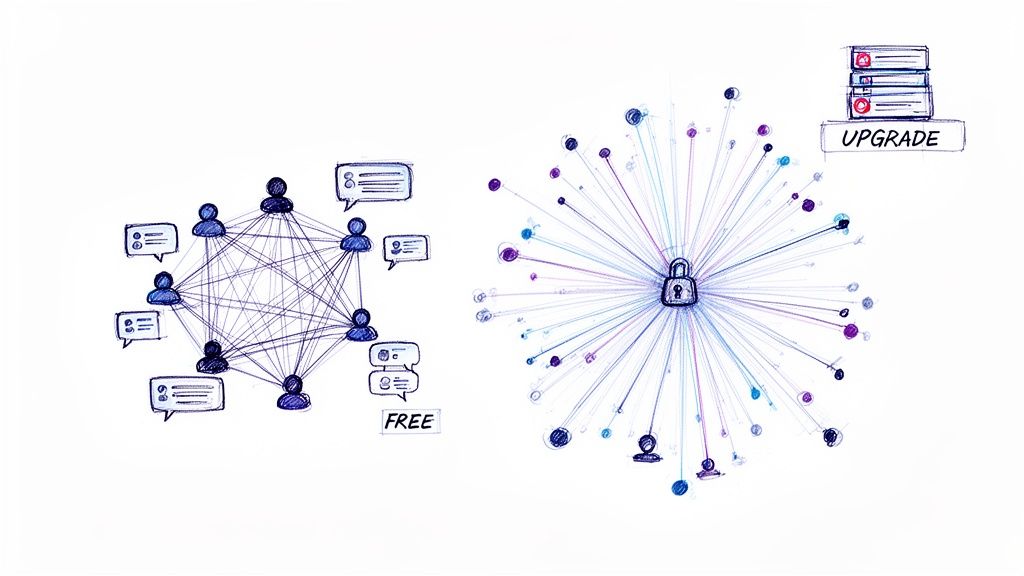
This model thrives on network effects; the more team members who join, the more indispensable Slack becomes. The magic happens at the point of friction, where Slack strategically places limitations that create natural upgrade triggers. For growing teams, the 10,000-message history limit is the most famous example. Once a team relies on Slack as its knowledge base, losing access to older messages becomes a significant business pain, making an upgrade to a paid plan an easy decision.
Key Takeaways & Implementation
Design for Instant Value: Your free tier should solve a real problem and demonstrate core value within the first user session. Activation is the goal.
Identify Natural Upgrade Paths: Analyze user behavior to find the "aha!" moments that correlate with long-term retention. Place your monetization gates just beyond these points, such as limiting advanced features, storage, or history.
Automate Onboarding Nudges: Use lifecycle automation to guide new users toward activation milestones. For example, send an email when a user invites their first teammate, encouraging them to try a specific integration. This proactive engagement is crucial for turning free users into power users, and you can explore more strategies for this in our guide to email marketing for SaaS.
Build for Team Expansion: Incentivize users to invite colleagues. The product itself should become the primary driver of viral, organic growth within an organization.
2. Notion's Content-Led PLG with Creator Ecosystem
Notion's strategy is a premier example of leveraging a community to drive product-led growth. Instead of relying solely on its internal team, Notion built a flexible product and empowered its users to become its most effective marketers. The core of this model is a powerful free-forever personal plan that allows individuals to discover the product's immense versatility, from project management to personal wikis. This creates a foundation of dedicated power users.
This user base then becomes a content engine. Enthusiastic users create and share templates, tutorials, and entire workflows on platforms like YouTube, TikTok, and Twitter, generating massive organic awareness. Notion actively nurtures this creator ecosystem, turning the product's flexibility into a key acquisition channel. A potential user doesn't just see a generic "notes app"; they see a solution for their specific need, built and demonstrated by a peer. This user-generated content acts as an infinite library of use cases, attracting a diverse audience and driving bottom-up adoption.
Key Takeaways & Implementation
Build a Flexible "Playground": Design your product to be a versatile toolkit rather than a rigid, single-purpose solution. This encourages users to discover novel use cases that your team may not have even considered.
Empower User-Generated Content: Create features that make it easy for users to create and share their work. Notion's template gallery is a perfect example, allowing users to monetize their expertise or simply share their best workflows, which in turn showcases the product's power.
Nurture Your Creator Community: Actively support and promote your power users. Feature their templates in newsletters, offer them early access to new features, or create affiliate programs. This fosters loyalty and incentivizes the creation of high-quality content that drives new sign-ups.
Focus on Collaborative Triggers: While individual use drives initial adoption, ensure the product has clear pathways to team collaboration. Features like shared databases and team wikis encourage users to invite colleagues, turning individual evangelists into internal champions who drive team-wide conversion.
3. Calendly's Integration-Driven Network Effects
Calendly's strategy is a prime example of product-led growth fueled by removing friction and creating a viral loop through external sharing. The core product solves a universal, high-frequency pain point: scheduling meetings. A user can sign up and share their first scheduling link within minutes, experiencing immediate value without needing a sales demo or complex setup.
This model's genius lies in its inherent network effect, which operates outside the user's own company. When a user sends a Calendly link to a prospect, client, or candidate, the recipient experiences the product's value firsthand by easily booking a time. This positive, friction-free interaction acts as the primary acquisition channel, turning every meeting invitation into a product demo. The recipient, having seen how simple it is, is then prompted to sign up for their own account, perpetuating the cycle.
Key Takeaways & Implementation
Solve a Universal, High-Frequency Problem: Identify a simple, recurring pain point that affects a broad audience. Calendly addressed the endless back-and-forth emails required for scheduling.
Design for External Virality: The product's core function should naturally involve sharing it with non-users. This turns your existing user base into your most effective acquisition engine.
Prioritize Integration as a Core Feature: Don't treat integrations as an add-on. Calendly's deep connections with calendars (Google, Outlook), video conferencing (Zoom, Teams), and CRMs make it an indispensable part of the user's existing tech stack.
Monetize Team-Based Value: Keep the core individual utility free to maximize the viral loop. Introduce paid tiers that solve coordination problems for teams, such as round-robin scheduling, centralized billing, and advanced reporting.
4. Figma's Design Collaboration as PLG Engine
Figma's strategy is a benchmark for modern product-led growth examples, leveraging browser-based collaboration to dismantle the barriers of traditional design software. By making design accessible in a web browser, Figma eliminated download and installation friction, allowing anyone to start creating or collaborating instantly. This created a powerful bottom-up adoption model where a single designer can introduce the tool to an entire organization simply by sharing a link.
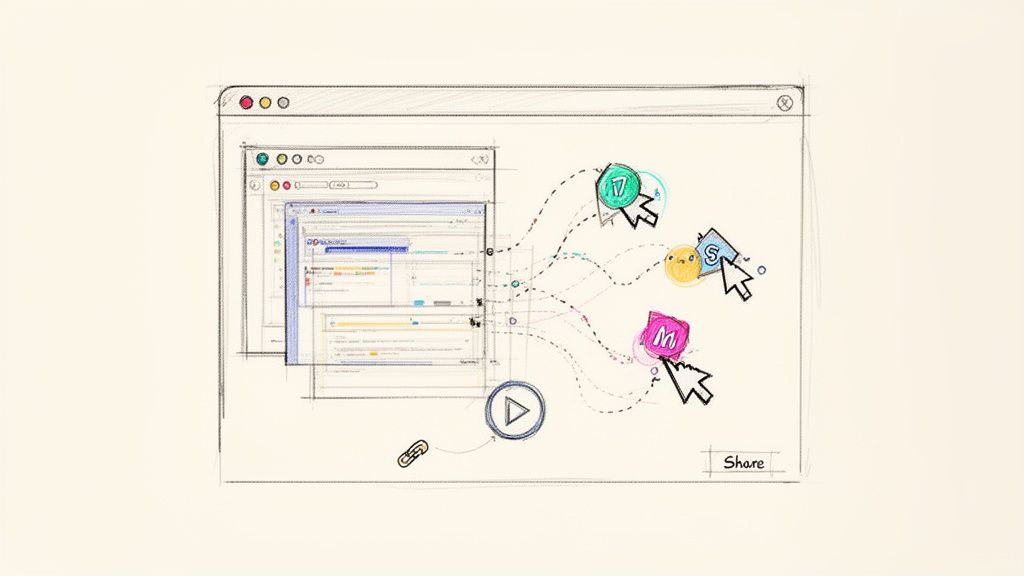
The product's true genius lies in its value creation for non-designers. When a designer shares a prototype with a product manager for review or a developer for handoff, those stakeholders experience Figma's value firsthand without being the primary creator. This cross-functional utility turns a design tool into a central collaboration hub, driving a natural land-and-expand motion. The freemium model's limitations, such as the number of project files, are strategically designed to trigger upgrades only after a team becomes deeply embedded and reliant on the platform for its workflow.
Key Takeaways & Implementation
Build Collaboration as a Core Feature: Don't treat collaboration as an add-on. Design your product's core value proposition around how users work together, making it inherently viral.
Create Value for Multiple Stakeholders: Your product should solve problems not just for the primary user but also for adjacent roles. A developer experiencing a seamless handoff is a powerful advocate for adoption.
Enable Effortless Sharing with Non-Users: Make sharing content with people outside the platform as simple as sending a link. This is your primary user acquisition channel, turning your product into its own marketing engine.
Design Freemium Limits Around Team Growth: Structure your free tier to be generous for individuals but create natural friction points as teams grow. Limits on shared projects, team libraries, or advanced permissions prompt a commercial conversation.
5. Dropbox's Referral Loop and File Syncing
Dropbox is a foundational case study in product-led growth examples, showcasing how a simple referral loop can become a company's primary acquisition engine. Their core strategy was built on a dual-sided incentive: offer free storage to both the person referring and the person who signs up. This masterfully turned every user into a potential advocate, creating a viral growth loop that was far more cost-effective than traditional paid advertising.
The genius of this model was its direct link to the product's core value. More storage directly enhanced the user experience, making the incentive feel less like a marketing gimmick and more like a product feature. This was paired with a freemium model where storage limits served as the natural upgrade trigger. As users synced more files and invited collaborators to shared folders, they inevitably hit the free tier ceiling, creating a frictionless path to a paid subscription for a product they already depended on.
Key Takeaways & Implementation
Design a Win-Win Referral System: Your incentive should benefit both the referrer and the new user. This mutual benefit removes the friction of a one-sided sales pitch and encourages genuine sharing.
Tie Incentives to Core Product Value: The reward for referring should enhance the user's experience. Whether it's more usage credits, access to a premium feature, or extra storage like Dropbox, the reward should make the product itself better.
Build-In Natural Network Effects: Create features that are inherently more valuable when used with others. Dropbox's shared folders were a perfect example, as one user's adoption naturally pulled in their collaborators, seeding new potential customers within their network.
Monitor Your Viral Coefficient: The goal is to have each new user bring in at least one more user (a coefficient > 1). Track the performance of your referral program closely and optimize the incentives and messaging to ensure it remains a sustainable growth channel.
6. HubSpot's Free CRM as the Cornerstone of Expansion PLG
HubSpot's strategy is one of the most powerful product-led growth examples, showing how a genuinely free product can act as the foundation for a billion-dollar ecosystem. The core tactic is a freemium CRM that removes all traditional barriers to entry; it's free forever, for unlimited users, with no credit card required. This approach allows small businesses and sales teams to adopt a powerful tool for contact and deal management, solving an immediate and critical business need without any financial commitment.
This "land-and-expand" motion creates a massive user base that becomes deeply embedded in the HubSpot platform. The product is designed to grow with the customer. As a startup's sales team matures, they naturally require more advanced features like sophisticated reporting, automation workflows, and deeper integrations. The upgrade path feels less like a sales pitch and more like a logical next step in their growth journey, turning the free CRM into a highly effective customer acquisition engine for paid products like Marketing Hub, Sales Hub, and Service Hub.
Key Takeaways & Implementation
Offer Unrestricted Core Value: Make your free product genuinely useful and solve a significant pain point without major limitations on core features, like HubSpot's unlimited contacts. This builds trust and deep user adoption.
Design for Team-Wide Adoption: By removing user-based pricing from the free tier, you encourage entire teams or companies to standardize on your platform. This creates high switching costs and makes future expansion sales much easier.
Build a Modular Ecosystem: Structure your product so users can add new capabilities or "hubs" as their needs evolve. This creates multiple, natural upgrade paths beyond just a single premium tier.
Nurture Free Users Toward Expansion: Use targeted lifecycle messaging to educate free users on the value of paid features as their usage patterns mature. This proactive approach is key, and you can discover more about boosting the value of these relationships in our guide to increasing customer lifetime value.
7. Stripe's Developer-First API as Viral Growth Engine
Stripe's developer-centric approach is one of the most powerful product-led growth examples, showcasing how an API can be the product and the primary marketing channel. Instead of targeting executives, Stripe focused obsessively on the end user: the developer. They removed the immense friction associated with legacy payment processing, transforming a multi-week ordeal into a task developers could complete in minutes with elegant, well-documented code.
This superior developer experience created a powerful bottom-up adoption loop. A developer at a startup could integrate Stripe, see immediate value, and become an internal champion. As that startup grew, Stripe grew with it. When the developer moved to a new company, they brought their preference for Stripe with them, seeding the product in a new organization. This reliance on developer advocacy and word-of-mouth allowed Stripe to embed itself into the technical fabric of thousands of companies, creating high switching costs and organic expansion.
Key Takeaways & Implementation
Obsess Over Developer Experience: Your product's ease of use for its technical user is paramount. Invest heavily in clear, comprehensive documentation, code examples, and SDKs. The goal is to make integration a delightful, not a dreaded, experience.
Target the First "Aha!" Moment: Design your API for a quick win. Stripe famously enabled developers to accept a payment in minutes. Identify a similar core action for your product and optimize the user journey to achieve it in under 30 minutes.
Build for Embedded Value: Create a product that becomes a critical part of your customer's infrastructure. When your API is deeply integrated into their core services, it becomes difficult and costly to replace, locking in long-term value and expansion revenue.
Foster a Community: Use transparency in pricing, excellent support, and community forums to build trust. Unlike opaque incumbents, Stripe built a reputation for being a partner, turning developers into loyal advocates who drive your viral growth.
8. Zapier's No-Code Automation as Ecosystem PLG
Zapier exemplifies one of the most powerful product led growth examples by turning its integration platform into a self-propagating ecosystem. The company's PLG model is built on a freemium offering that allows non-technical users to connect their favorite apps and automate workflows, experiencing the core "aha!" moment in minutes. This immediate, tangible value removes the need for a traditional sales process for initial adoption.
The strategy thrives on both accessibility and network effects. By supporting thousands of app integrations, Zapier becomes the central nervous system for a company's software stack. Growth occurs organically as one employee builds a useful "Zap" (e.g., sending a Slack notification for a new CRM lead) and shares it with their team. The freemium limits are strategically based on usage intensity (number of tasks per month) rather than features, encouraging users to build more and more automations until upgrading becomes a necessity for their operations.
Key Takeaways & Implementation
Focus Freemium on Usage Intensity: Instead of gating core features, limit the volume of usage. This allows users to fully explore the product's value and build dependency, creating a natural and compelling reason to upgrade as their usage scales.
Invest in Templates and Pre-Built Workflows: Reduce time-to-value by offering a rich library of ready-to-use automation templates. This lowers the barrier to entry and helps users discover new use cases they hadn't considered, accelerating their journey to becoming power users.
Build Viral Loops Through Sharing: The product should make it easy for users to share their creations. For Zapier, sharing a "Zap" template is a powerful internal growth loop that drives team-wide adoption without any sales intervention.
Prioritize Ecosystem Expansion: Your integration library is your competitive moat. Aggressively expand and maintain integrations to ensure your product remains indispensable. The more tools you connect, the stickier your platform becomes. For a deeper dive, explore how to apply these concepts in your marketing with our guide to workflow marketing automation.
9. Canva's Design Democratization Through Freemium
Canva's strategy is a powerful product led growth example that shows how to build a massive user base by making a complex skill accessible to everyone. The company democratized design with a simple, intuitive freemium tool that empowers non-designers to create professional-looking graphics in minutes. Users experience immediate value by selecting a template and quickly customizing it, removing the friction associated with traditional design software.
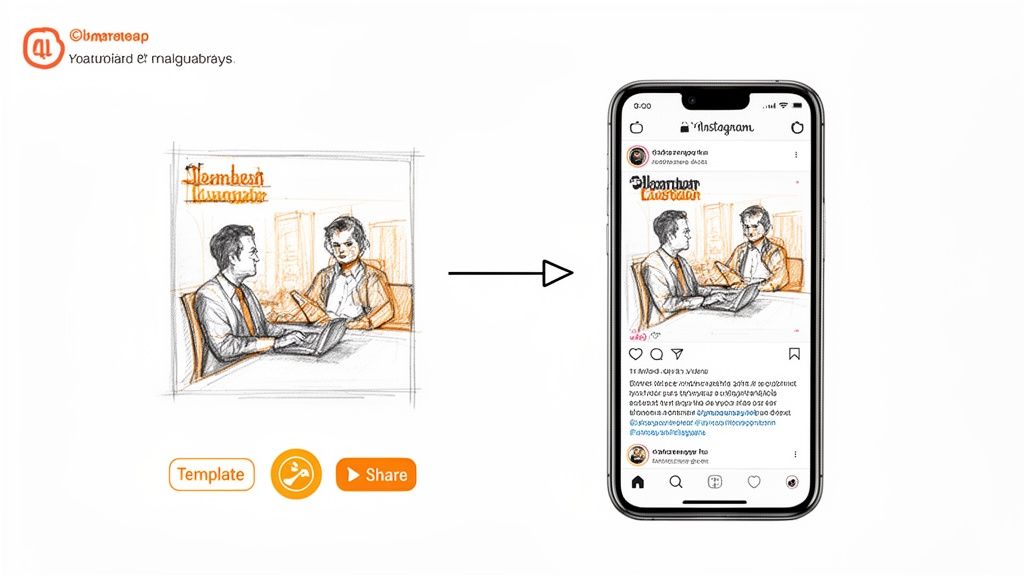
This model's success hinges on a powerful viral loop fueled by the product's output. When a user creates a graphic for social media or a presentation, the shared content itself becomes an advertisement for Canva. The barrier to entry is virtually non-existent, and the upgrade triggers are logically placed. A free user creating social posts might eventually need the Brand Kit to maintain consistency, or a small business owner might upgrade to access premium stock photos and templates, making the transition to a paid plan a natural step in their workflow.
Key Takeaways & Implementation
Design for the Non-Expert: Build your product with the assumption that users have zero prior knowledge. Focus on an intuitive UI and a quick time-to-value to ensure anyone can succeed.
Make Content the Core Product: Canva's templates aren't just a feature; they are the product. By providing a vast library of use-case-specific starting points (Instagram posts, resumes, flyers), you guide users directly to their desired outcome.
Enable Organic Viral Loops: The product's output should be easily shareable. When users distribute their creations, they are also distributing your brand, creating a self-perpetuating acquisition channel.
Monetize High-Value Capabilities: Reserve features that solve advanced or business-critical problems for paid tiers. Canva monetizes efficiency and brand consistency tools like the Brand Kit, Magic Resize, and premium assets, which have a clear ROI for professional users.
10. Discord's Community Platform as Gaming-to-Enterprise PLG
Discord's journey is a powerful case study in how a niche, community-focused product can become one of the most compelling product led growth examples. The platform started by solving a very specific problem for gamers: the need for free, reliable, low-latency voice chat. By perfecting this core experience, Discord achieved viral adoption through powerful network effects, as inviting friends to a server was essential to the product's value.
This community-centric model created an organic, bottom-up adoption funnel. Initially dominating the gaming world, the platform's utility for real-time communication was recognized by other groups. University classes, developer communities, and even tech companies began creating servers for collaboration and customer support. Discord monetizes through its "Nitro" subscription, which offers enhanced features like better streaming quality and custom emojis. This freemium approach ensures the core product remains free to drive adoption, while power users and large communities willingly pay for upgrades that enhance their experience.
Key Takeaways & Implementation
Solve a Niche Problem Exceptionally Well: Focus on a passionate, underserved community first. By building the best solution for their core need, you can create a loyal user base that becomes your biggest advocate.
Build for Network Effects: Design your product so its value increases exponentially with each new user. Features that encourage invites and shared experiences are crucial for this kind of viral loop.
Monetize Enhancements, Not Core Functionality: Keep the core value proposition free to maximize user acquisition. Monetization should focus on premium features that supercharge the experience for your most engaged users and communities.
Encourage Ecosystem Development: Support third-party integrations and bots. This expands your product's use cases far beyond your initial vision, allowing it to adapt to new markets and user needs organically, as seen with Discord's expansion into non-gaming segments.
10 Product-Led Growth Examples: Side-by-Side Comparison
| Model | 🔄 Implementation Complexity | 💡 Resource Requirements | ⚡ Time-to-Value | 📊 Expected Outcomes | ⭐ Ideal Use Cases & Key Advantages |
|---|---|---|---|---|---|
| Slack's Freemium-to-Enterprise PLG Model | High — real-time messaging, scale, integrations | High infra, integrations + support for teams | Very fast — minutes to core value | Large ARR and organic expansion; strong viral coefficient | Team collaboration; bottom-up adoption; low CAC through network effects |
| Notion's Content-Led PLG with Creator Ecosystem | High — flexible product + marketplace | High investment in creator tools, community, templates | Fast for basics; deeper value over time | Massive organic awareness via creators; broad use-case adoption | All-in-one workspace; creator-driven marketing; templates as distribution |
| Calendly's Integration-Driven Network Effects | Low–Medium — focused product + many integrations | Moderate infra; continuous integration maintenance | Immediate — <2 minutes to first value | Large freemium base; embedded in workflows; high NPS | Scheduling for sales/support; viral link sharing; low onboarding friction |
| Figma's Design Collaboration as PLG Engine | High — real-time browser collaboration tech | Very high R&D and real-time infra; product integrations | Fast to share/collaborate; deeper learning curve for features | Land-and-expand across orgs; strong team adoption and retention | Cross-functional design collaboration; prototyping + handoff advantages |
| Dropbox's Referral Loop and File Syncing | Medium — sync tech + referral mechanics | High storage infra; referral acquisition costs | Fast — instant sync provides immediate value | Viral growth via referrals; high retention from switching costs | Personal & team file sync; shared folders; referral-driven scale |
| HubSpot's Free CRM as the Cornerstone of Expansion PLG | Medium–High — modular platform & integrations | Significant product, support, and sales enablement | Quick for basic CRM use; complexity grows with scale | Large installed base; cross-sell expansion; high LTV if converted | SMBs and sales teams; land-and-expand via modular upgrades |
| Stripe's Developer-First API as Viral Growth Engine | Medium — payments + compliance complexity | High engineering, compliance, docs, and developer relations | Very fast — ~15–30 minutes to initial integration | Developer advocacy; embedded payments; high scale and retention | Developer-focused platforms, e‑commerce; low-friction integration |
| Zapier's No-Code Automation as Ecosystem PLG | Medium — many connectors + orchestration | Ongoing integration maintenance; templates and support | Fast — minutes to first automation | Broad automation adoption; high embedding in workflows | Non-technical automation across apps; templates drive discovery |
| Canva's Design Democratization Through Freemium | Low–Medium — editor + large content library | Large content/licensing, UX, template creation | Immediate — minutes to first design | Viral social sharing; mass-market adoption | Non-designers creating social content, presentations; template-led growth |
| Discord's Community Platform as Gaming-to-Enterprise PLG | Medium–High — real-time voice/video + moderation | High low-latency infra, moderation, bot ecosystem | Immediate for core chat/voice features | High DAU/engagement; strong network effects; cross-segment expansion | Community building (gaming, education, niche communities); real-time communication advantage |
Your Blueprint for Implementing Product-Led Growth
We've journeyed through ten powerful product led growth examples, from Slack's viral team collaboration to Stripe's developer-first API dominance. Each case study reveals a unique path to success, yet they all share a common DNA: they place the product at the very center of the customer journey, making it the primary driver of acquisition, activation, and expansion.
These companies didn't just build great products; they built self-propagating growth engines. They understood that in the modern SaaS landscape, users want to experience value firsthand, not be sold on it. The examples of Notion, Canva, and Figma demonstrate how a generous freemium tier can act as a powerful top-of-funnel, educating the market and building a loyal user base that eventually converts. Meanwhile, Calendly and Zapier show us the immense power of integration ecosystems, creating network effects that make their products indispensable.
Synthesizing the Core PLG Principles
Distilling these diverse strategies, a few core principles emerge as your foundational blueprint. These are not just observations; they are actionable pillars for building your own PLG motion.
Solve a Tangible Pain Point Immediately: The "time to value" (TTV) must be incredibly short. From Dropbox's instant file syncing to Calendly's one-click meeting scheduling, the best PLG products deliver an "aha!" moment within minutes of a user signing up. Your initial user experience must be frictionless and laser-focused on solving one core problem exceptionally well.
Embed Virality and Collaboration: Your product should have built-in mechanisms for sharing. Slack's channels, Figma's collaborative design files, and Dropbox's referral bonuses are not afterthoughts; they are fundamental features that turn single users into multi-user accounts organically. Ask yourself: "How can one user's success naturally require or invite others?"
Design a Natural Upgrade Path: Freemium isn't just about giving things away. It's a strategic pathway to paid conversion. HubSpot's free CRM brilliantly funnels users toward its powerful paid Marketing and Sales Hubs as their needs grow. The transition from free to paid should feel like a logical, value-driven next step, not a restrictive paywall.
From Examples to Execution: Your Next Steps
Reading about these product led growth examples is enlightening, but the real value comes from implementation. The path forward involves shifting your team's mindset from a sales-led to a product-led culture, which requires deep cross-functional alignment between product, marketing, engineering, and sales.
To start, identify the single most valuable action a new user can take in your product. Is it creating a project? Sending an invitation? Running a report? Focus all your onboarding efforts, including your lifecycle email sequences and in-app guides, on driving users to that one critical activation event.
For a deeper dive into the strategic frameworks and operational tactics required for this transition, it is highly valuable to explore comprehensive guides on the topic. To further develop your understanding of PLG implementation, explore this comprehensive guide on Product-Led Growth: The PM's Playbook for Career Acceleration. It provides a structured approach that can help product managers and growth leaders build a robust strategy from the ground up.
Ultimately, the lesson from these titans of industry is clear: a product-led approach is the most durable and scalable way to build a modern software business. It creates a powerful, self-reinforcing loop where a better product leads to more users, which in turn generates the revenue and data needed to improve the product further. Your journey starts now.
Ready to implement the communication and automation strategies we've discussed? SMASHSEND provides the lifecycle CRM and transactional email APIs you need to power your PLG onboarding, activation, and expansion campaigns. Start building your product-led growth engine today with SMASHSEND.
Frequently Asked Questions
Have a question not in here? Contact us
- What is product-led growth (PLG)?
Product-led growth is a go-to-market strategy where the product itself serves as the primary driver of customer acquisition, conversion, and expansion. Instead of relying solely on sales and marketing teams, PLG companies deliver value upfront through freemium models, free trials, or self-service experiences that let users experience the product's value before making a purchase decision.
- How do I identify if my SaaS is ready for product-led growth?
Your SaaS is ready for PLG if you have: a product that can demonstrate clear value quickly (low time-to-value), features that become more valuable with team adoption (network effects), a product complex enough to warrant expansion but simple enough for self-service onboarding, and the ability to track and optimize user activation metrics.
- What are the key metrics for measuring product-led growth success?
Essential PLG metrics include: time to value (how quickly users reach their 'aha!' moment), activation rate (percentage of users who complete key onboarding actions), viral coefficient (how many new users each existing user brings), expansion revenue as a percentage of total revenue, and net revenue retention rate (ideally 110%+).
- Can B2B enterprise companies implement product-led growth strategies?
Yes, many enterprise B2B companies successfully implement PLG strategies. Examples include Figma (design collaboration), Slack (team communication), and HubSpot (free CRM). The key is offering a valuable free or trial experience while building in natural expansion paths as teams grow and need more advanced features or higher usage limits.